

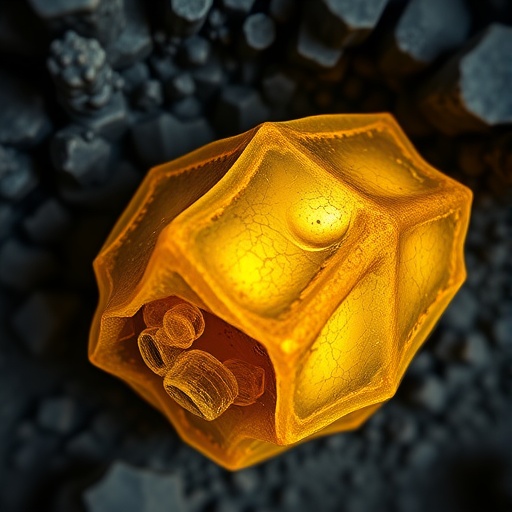
In an extraordinary breakthrough that challenges our understanding of early life on Earth, recent research has revealed that microorganisms from the Palaeoproterozoic era were burrowing into volcanic glass at hydrothermal vent sites, likely in search of essential nutrients such as phosphate. This discovery is reshaping the narrative on how microbial life thrived in extreme environments over 2 billion years ago and sheds light on the complex interactions between early life forms and their geochemical settings.
The study focuses on ichnofossils—trace fossils that record biological activity rather than the physical remains of organisms themselves. These particular ichnofossils were discovered in volcanic glass, a volcanic rock formed from rapid cooling of lava. The unique conditions of rapid cooling and hydrothermal activity preserved minute burrow-like structures, providing a window into microbial behavior during the Palaeoproterozoic, approximately 2.5 to 1.6 billion years ago.
Hydrothermal vents, known for their extreme heat and mineral-rich waters, have long been considered potential cradles for early life. The interaction of volcanic processes and ocean chemistry creates a habitat rich in chemical gradients, providing energy sources for chemolithotrophic microorganisms. The newly found ichnofossils suggest these ancient microorganisms exploited not only the chemical energy but also physical niches within volcanic glass, burrowing intricately to access vital phosphate deposits.
Phosphorus, a critical element in biological molecules such as DNA, RNA, and ATP, is often a limiting nutrient in ecosystems, especially in early Earth environments. The study posits that the microorganisms’ burrowing behavior was driven by the search for phosphate, which had accumulated within the volcanic glass matrix through hydrothermal fluid interactions, making these substrates fertile zones for microbial colonization and activity.
The granularity of the volcanic glass is crucial here. It provides a relatively soft and porous medium that could capture and retain hydrothermal minerals, including phosphate minerals. This microenvironment would have attracted microbial communities seeking nutrients in an otherwise resource-scarce setting. The trace fossils show microscopic tunnels, confirming active exploration or feeding activities within the volcanic glass rather than passive mineral precipitation.
Importantly, these ichnofossils push back the direct evidence for microbial bioturbation in volcanic materials to the Palaeoproterozoic era, offering some of the earliest physical records of microbial life interacting dynamically with its environment. This contrasts with the typical picture of microbial mats on sediment surfaces or in water columns, instead highlighting a more intimate engagement with volcanic substrates.
The broader implications of these findings extend to models of early biogeochemical cycles. Microbial access to phosphate through volcanic glass burrowing might have been a critical driver of early life’s metabolic diversity. Hydrothermal systems, therefore, may not have only been passive chemical reactors supporting life but active arenas wherein microorganisms shaped their habitat and influenced element cycling.
This discovery also enriches the search for life beyond Earth. Volcanic glasses and hydrothermal systems are present on many planetary bodies, including Mars and icy moons like Europa. If ancient terrestrial microbes exploited volcanic glass niches for nutrients, similar niches might be habitable or might preserve biosignatures on other worlds. These artificial ‘footprints’ offer a potential target for future planetary exploration missions seeking evidence of past or present life.
Advanced imaging techniques and geochemical analyses were instrumental in this research. High-resolution scanning electron microscopy revealed the fine-scale burrow networks, while sophisticated isotope and elemental mapping demonstrated the enrichment of phosphate within these features. The convergence of these methods provides robust evidence tying the microbial structures directly to nutrient-acquisition behaviors rather than abiotic processes.
This research highlights the importance of integrating paleobiology with geochemistry and volcanology to unravel Earth’s earliest biosphere complexities. It underscores how early microorganisms did not simply survive passively but actively modified their environments and engaged with geological substrates to access scarce resources, thereby influencing the evolutionary trajectory of life on our planet.
The discoveries made indicate an unexpectedly high level of biological innovation and adaptation during the Palaeoproterozoic. Microbial communities found a way to colonize a harsh and volatile environment by exploiting the chemical gifts of volcanic glass, indicating that life had already established sophisticated survival strategies far earlier than previously appreciated.
Moreover, the ichnofossils show variability in burrow morphology, suggesting a diversity of microbial activities, perhaps reflecting different taxa or behavioral adaptations such as feeding, movement, or habitat construction within the glassy substrate. This diversity points to a rich microbial ecosystem with complex ecological interactions, far removed from the simplistic, unicellular lifeforms often assumed for that time.
This finding also advances our understanding of how biogeochemical cycles involving phosphorus and other nutrients operated billions of years ago. The direct involvement of microbes in dissolving and mobilizing phosphate from volcanic glass likely influenced marine nutrient dynamics, potentially affecting the evolutionary pace of early life and the transition to more complex, eukaryotic organisms.
Conversations about the origin of life typically focus on sedimentary settings or primordial oceans, but these burrows emphasize that volcanic terrains themselves were hotbeds of microbial activity. Hydrothermal vent systems layered with volcanic glass were not just passive backdrops but dynamic ecosystems where life and geology interplayed intimately, offering new perspectives on early Earth habitats.
Ultimately, these findings culminate in a narrative where robust microbial life persisted in extreme environments, ingeniously accessing key nutrients and thereby setting the stage for the diversification and complexity of life over geological time. The volcanic glass ichnofossils serve as an indelible record of this intricate dance between life and rocks during one of Earth’s most formative periods.
By expanding the arena for early microbial activity to include volcanic glass substrates, this research paves the way for reexamining other ancient volcanic terrains globally with fresh eyes, armed with new hypotheses and technological tools. The search for early life’s traces in volcanic materials is poised to become an exciting frontier in paleoenvironmental and astrobiological studies.
As we seek to understand the origins and evolution of life on Earth and beyond, such findings highlight the critical role of geobiological interactions in shaping biospheres. The Palaeoproterozoic microbial foragers who tunneled through volcanic glass have left behind a silent testimony—one that modern science is just beginning to decode, promising a deeper insight into life’s tenacity and adaptability in the universe.


