


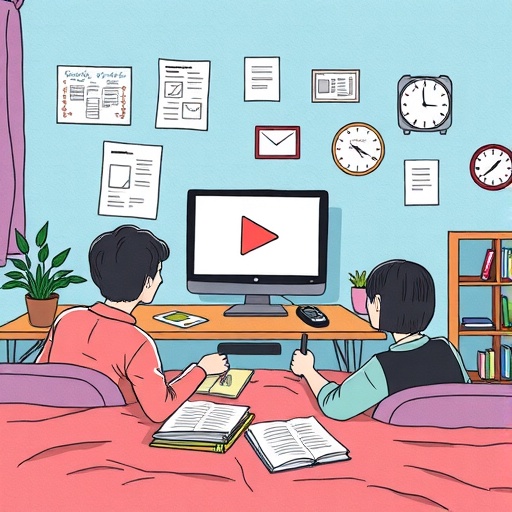
In today’s hyperconnected world, the lure of short-form video platforms such as TikTok, Instagram Reels, and YouTube Shorts has become nearly inescapable, especially among college students. These platforms encourage endless scrolling through engaging, bite-sized content designed to capture and hold attention. Recent research emerging from the University of Kansas’ William Allen White School of Journalism & Mass Communications offers a rigorous analysis of the psychological and physiological repercussions tied to the compulsive consumption of such short-form videos, particularly when used as a tool for procrastination.
The study delves deeply into the behavioral patterns underpinning short-form video use among college students, revealing that those with lower self-control and stronger habitual inclinations toward these platforms are more prone to procrastinatory consumption. Notably, the research highlights how motivations like escapism and the intrinsic human desire to belong catalyze this usage pattern. Students often resort to these video streams as a means of temporary refuge from academic pressures or social anxieties, thereby creating a feedback loop where procrastination further exacerbates stress.
One of the more alarming outcomes identified by the researchers relates to sleep health. Unlike traditional media consumption, which might occur at designated times, short-form videos foster a state of “flow” — a psychological state of deep immersion where the user loses track of time. This phenomenon was vividly illustrated in classroom observations where only a minuscule fraction of students reported going to bed before 10 p.m., implicating the pervasive impact of these apps on circadian rhythms and sleep schedules. Participants reported significant disturbances across multiple sleep dimensions, including subjective sleep quality, sleep onset latency, nocturnal awakenings, and daytime functional capacity.
This research highlights the multidimensional nature of the deleterious effects stemming from short-form video binge sessions. Poor sleep quality is not merely a matter of fatigue but is closely linked to elevated stress levels, creating a synergistic relationship detrimental to overall mental health. The emotional turmoil students endure appears to be tightly coupled with their media use habits, raising concerns about the role these platforms play in amplifying psychological distress within vulnerable populations.
Interestingly, while the study found clear associations between problematic short-form video use, disrupted sleep, and increased stress, there was no statistically significant correlation between procrastinatory video use and academic performance measured by GPA. This finding, however, should not be misconstrued as a complete exoneration of these platforms with respect to educational outcomes. The sample involved predominantly high-achieving students from select universities, which may not fully capture broader academic or demographic variability.
The complex interplay of causality and correlation warrants careful interpretation. Some students indicated using short-form videos explicitly when struggling with sleep, suggesting these platforms are sometimes a coping mechanism rather than the root cause of underlying problems. The researchers caution against simplistic conclusions that pin the blame squarely on social media apps, recommending instead a nuanced approach that considers reciprocal effects and contextual factors influencing media consumption patterns.
At the core of the study’s theoretical framework lies the concept of “flow,” widely studied within media psychology and human-computer interaction disciplines. The effortless design of short-form video interfaces capitalizes on automaticity, making scrolling an almost reflexive behavior. This omnipresent ease of use fundamentally shifts how young adults allocate their attention and time, displacing more diverse or traditionally enriching hobbies. This shift elevates the significance of understanding the behavioral and neurocognitive mechanisms behind these consumption habits.
Given these insights, calls have been made for academic institutions and societal stakeholders to take proactive roles in fostering healthier media habits. Current mental health outreach programs could be enhanced by integrating media literacy components and by tailoring interventions to acknowledge the emerging role of short-form videos in students’ lives. Such initiatives would benefit from direct collaboration with students to co-develop strategies resonant with their lived experiences and digital realities.
The novelty of this research is underscored by its focus on emergent platforms and the extension of prior problematic media use paradigms to short-form videos. This contribution fills a critical knowledge gap and lays a foundation for future inquiries into ever-evolving technologies. The researchers advocate ongoing studies that interrogate how motivations, habitual use, and psychological impacts intertwine across different digital environments, aiming ultimately to inform responsible design and usage policies.
Looking ahead, the landscape of digital media consumption is poised to be further transformed by advancements in agentic artificial intelligence. Such AI systems, envisioned as social companions, academic assistants, and collaborators, will likely become woven into the daily fabric of students’ lives. This emerging frontier presents new challenges and opportunities for understanding human-computer interaction, social connectedness, and well-being in the digital age.
In summary, this comprehensive study elucidates the predictors and effects of procrastinatory short-form video use, offering evidence that while academic performance might not be directly impaired, the associated stress and sleep disturbances constitute significant concerns for student health. Universities, policymakers, and technology developers must consider these findings to foster environments that encourage balanced media engagement without sacrificing mental and physical well-being.
Cite Scienmag News
Courtney Benton. (March 9, 2026). Study Finds Students with Lower Self-Control More Likely to Procrastinate on Short-Form Videos, Affecting Sleep but Not Grades. Scienmag. https://scienmag.com/study-finds-students-with-lower-self-control-more-likely-to-procrastinate-on-short-form-videos-affecting-sleep-but-not-grades/
Courtney Benton. "Study Finds Students with Lower Self-Control More Likely to Procrastinate on Short-Form Videos, Affecting Sleep but Not Grades." Scienmag, 9 March 2026, https://scienmag.com/study-finds-students-with-lower-self-control-more-likely-to-procrastinate-on-short-form-videos-affecting-sleep-but-not-grades/. Accessed 3 September 2026.
Courtney Benton. "Study Finds Students with Lower Self-Control More Likely to Procrastinate on Short-Form Videos, Affecting Sleep but Not Grades." Scienmag. March 9, 2026. https://scienmag.com/study-finds-students-with-lower-self-control-more-likely-to-procrastinate-on-short-form-videos-affecting-sleep-but-not-grades/


