


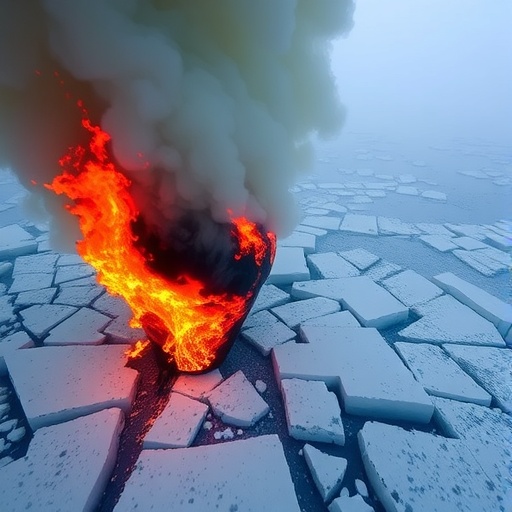
In a groundbreaking new study published in Communications Earth & Environment, researchers Hou, Zhang, Cai, and colleagues have unveiled a striking connection between seasonal fire activity in South America and the variability of Antarctic sea ice during the Southern Hemisphere spring. This discovery sheds light on the intricate links between polar climate systems and terrestrial environmental phenomena thousands of kilometers away, emphasizing the far-reaching impacts of Antarctic sea ice fluctuations on ecosystems and human activity in South America.
The investigators focused on springtime fire outbreaks, a period associated with increased fire activity across the southern cone of South America, particularly in regions encompassing Argentina, Chile, and southern Brazil. By utilizing satellite fire detections alongside sea ice extent measurements over several decades, the study meticulously correlated temporal and spatial patterns of fire activity with Antarctic sea ice variability. The robustness of the association signals a previously underestimated teleconnection mechanism operating between the cryosphere and the subcontinental biosphere.
Antarctic sea ice, an essential component of the Earth’s climate system, exhibits substantial seasonal and interannual variability driven by atmospheric and oceanic processes. The study illustrates that fluctuations in the extent of sea ice during the austral spring months significantly alter regional atmospheric circulation patterns, including shifts in the jet stream and modifications in moisture transport pathways. Such alterations affect temperature, humidity, and wind stability across South America, thereby influencing fire-prone conditions.
One crucial meteorological pathway identified involves the impact of sea ice extent on the Southern Annular Mode (SAM), a major driver of mid-latitude climatic variability in the Southern Hemisphere. Changes in Antarctic sea ice feed back into the SAM’s phase and intensity, which in turn modulates precipitation and temperature regimes over southern South America. Positive SAM phases linked with reduced sea ice tend to bring drier, warmer air masses conducive to fire ignition and spread during spring.
The research team employed advanced statistical techniques alongside machine learning algorithms to disentangle the complex relationships embedded in climatic, fire, and sea ice datasets. This approach enabled the detection of subtle yet reproducible patterns linking diminished sea ice extent to amplified fire activity with a lead time of several months. Such predictability hints at the potential for early-warning systems that leverage Antarctic sea ice observations to forecast fire risk in South America’s vulnerable regions.
Moreover, the study provides compelling evidence that these teleconnections remain robust even in the context of ongoing anthropogenic climate change. As polar regions warm and Antarctic sea ice experiences long-term declines punctuated by episodes of anomalous variability, the modulation of South American fire regimes by sea ice fluctuations could become more pronounced, posing increased risks to biodiversity, public health, and agricultural productivity.
The authors highlight the interdisciplinary nature of their findings, drawing from glaciology, atmospheric sciences, fire ecology, and climate modeling. They stress the importance of integrating polar observations into regional fire management strategies, underscoring that coordinated monitoring of Antarctic sea ice may serve as a crucial tool for South American fire forecasting and mitigation efforts.
In addition to its immediate implications for fire risk assessment, the study sets a new precedent for understanding how remote climate drivers interact with terrestrial disturbances. It calls for increased investment in polar observational infrastructure and improved modeling capabilities that capture the dynamics linking cryospheric variability to biospheric responses.
The paper also discusses potential feedback loops that might emerge from this relationship. For instance, increased fire activity releases additional greenhouse gases and aerosols, potentially influencing atmospheric composition and radiative forcing. These changes could indirectly affect polar climate processes, including sea ice development, illustrating a complex, cyclical interplay warranting further investigation.
Ecological consequences of spring fires in South America are profound, ranging from habitat destruction to altered nutrient cycling. The timing coincides with critical phenological stages of numerous plant and animal species, amplifying the repercussions on ecosystem resilience. By tying these events to Antarctic sea ice variability, the study opens avenues for assessing how climate-induced alterations in polar ice may cascade through ecosystems far beyond the poles.
The researchers also propose that their findings could inform global climate models by incorporating mechanisms of polar-terrestrial coupling, which remain underrepresented in many predictive frameworks. Enhancing model fidelity in this respect is vital for producing more accurate regional climate projections and preparing for future extreme events linked to cryospheric variability.
Importantly, while the study concentrates on spring fires, its implications may extend to other seasons and regions. The atmospheric teleconnection pathways identified could feasibly influence weather patterns beyond South America, suggesting that Antarctic sea ice variability might have even wider relevance for fire activity globally.
The publication comes at a critical time when fire regimes worldwide are shifting in response to climate change, land use transformations, and other anthropogenic pressures. Understanding the multi-scale drivers behind these shifts is imperative for sustainable resource management, disaster response, and climate adaptation planning.
In conclusion, the compelling evidence linking South American fire activity in spring to Antarctic sea ice variability reinforces the complexity and interconnectedness of Earth’s climate system. It highlights the indispensability of cross-regional scientific collaborations and integrated observational networks in tackling emerging environmental challenges posed by rapidly changing polar and terrestrial environments. This landmark study not only redefines aspects of fire ecology but also broadens horizons for future climate science, promising enhanced resilience in the face of escalating global change.
Cite Scienmag News
Violet Maxwell. (March 9, 2026). Spring Fires in South America Tied to Antarctic Ice. Scienmag. https://scienmag.com/spring-fires-in-south-america-tied-to-antarctic-ice/
Violet Maxwell. "Spring Fires in South America Tied to Antarctic Ice." Scienmag, 9 March 2026, https://scienmag.com/spring-fires-in-south-america-tied-to-antarctic-ice/. Accessed 3 September 2026.
Violet Maxwell. "Spring Fires in South America Tied to Antarctic Ice." Scienmag. March 9, 2026. https://scienmag.com/spring-fires-in-south-america-tied-to-antarctic-ice/


