


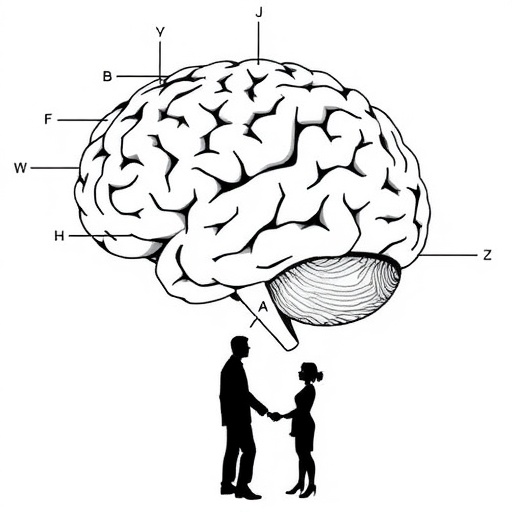
In our daily interactions, whether engaging in casual conversations, competitive games, or high-stakes negotiations, the capacity to rapidly gauge another person’s intellectual agility or predictability is fundamental. This intuitive process, recognized in scientific parlance as “adaptive mentalization,” describes the brain’s ongoing ability to infer others’ intentions and adapt behavior accordingly. Recently, researchers at the University of Zurich have illuminated the intricate neural mechanisms that underpin this dynamic social cognition, offering groundbreaking insights into how our brains continually recalibrate understandings of others in real time.
At the forefront of this research is a team led by Christian Ruff, a distinguished professor specializing in neuroeconomics and decision neuroscience. Their large-scale study involved over 570 participants who engaged in a series of iterative rock-paper-scissors games, facing off against both human competitors and algorithmic opponents designed to mimic varying strategic behaviors. By pioneering a sophisticated computational model, the researchers quantitatively dissected how participants assessed their opponents’ strategies and adapted these estimations after each round, revealing remarkable variability in how quickly and effectively individuals update their social predictions.
This variability in adaptive mentalization showcases a spectrum of social cognitive flexibility. Some participants demonstrated an agile capacity to identify and predict opponent strategies with impressive speed, showcasing advanced analytical processing of social cues. Conversely, others required considerably more time to adjust their mental models accurately, indicating a slower or less flexible cognitive adaptation mechanism. These individual differences underscore the nuanced nature of human social reasoning and point towards innate or learned capacities that modulate strategic interpersonal evaluation.
Leveraging cutting-edge functional magnetic resonance imaging (fMRI), the research team mapped the brain areas engaged during the real-time reassessment of opponents’ intentions. The data revealed a widely distributed neural network that becomes activated when subjects revise their social predictions. Central to this network is the temporoparietal junction, a brain region critically involved in theory of mind—the ability to contemplate others’ thoughts and intentions. Alongside this area, the dorsomedial prefrontal cortex showed heightened activity, a region implicated in evaluating complex social information and inferential reasoning.
Further examination pinpointed activation surges in the anterior insula and adjacent portions of the ventrolateral prefrontal cortex. Intriguingly, these areas appeared especially responsive during moments when participants’ prior expectations were violated, necessitating a recalibration of social assessments. This suggests the anterior insula and ventrolateral prefrontal cortex play pivotal roles in detecting discrepancies between expected and actual social behavior, acting as hubs for processing uncertainty and facilitating adaptive learning in fluid social contexts.
The implications of these neural activity patterns extend beyond descriptive neuroscience. Remarkably, the researchers demonstrated that the observed brain activation signatures could reliably predict the extent to which an individual would update their estimations about an opponent’s behavior. This predictive capability held true even when applied to participants whose neural data had not been previously incorporated into the computational model, hinting at a robust and potentially universal neural “fingerprint” for adaptive mentalization.
Such breakthroughs mark a departure from earlier research paradigms that predominantly employed static and isolated tasks—such as reading hypothetical social stories or making single-shot dispositional judgments—to study social cognition. Instead, by focusing on dynamic, iterative interactions that more faithfully replicate everyday social encounters, this study situates mentalization as a fluid, continuous process rather than a static cognitive state. This real-world relevance enhances the ecological validity of the findings and opens new avenues for investigating social reasoning in context.
Beyond its theoretical contributions, this research harbors significant clinical potential. Difficulties in social adaptation are hallmark features of multiple neuropsychiatric disorders, including autism spectrum disorder and borderline personality disorder, where impairments in theory of mind and social reasoning disrupt interpersonal functioning. By identifying neural markers of adaptive mentalization, clinicians could potentially leverage these biomarkers to more objectively assess social cognitive abilities in affected individuals, facilitating tailored interventions.
Moreover, the prospect of a neural fingerprint could revolutionize therapeutic approaches. Objective measures based on brain activity patterns might enable clinicians to accurately track treatment efficacy over time, guiding personalized adjustments to therapeutic strategies. This could catalyze a shift toward precision psychiatry, where interventions are dynamically refined to optimize social cognitive function in patients with complex psychiatric profiles.
These discoveries also reverberate within the burgeoning field of neuroeconomics, where understanding decision-making processes in social contexts is paramount. Mentalization underpins strategic behavior in economic exchanges, negotiations, and cooperation, shaping outcomes in markets and institutions. The elucidation of neural substrates for adaptive mentalization deepens our grasp of human economic behavior and could inform the design of algorithms and artificial agents capable of more human-like social reasoning.
From a methodological standpoint, the integration of behavioral game theory, computational modeling, and neuroimaging represents a powerful triad enabling unprecedented insight into the mechanics of social cognition. By quantifying how individuals update beliefs about others in iterative settings and correlating these with real-time brain activity, the study exemplifies a multidisciplinary approach that pushes the frontiers of cognitive neuroscience and psychology.
In sum, this landmark research from the University of Zurich not only maps the neural circuitry engaged in the fluid reassessment of social opponents but also establishes a predictive framework for how swiftly and accurately individuals adapt their mental representations in interactive contexts. Its relevance spans fundamental neuroscience, clinical application, and economic behavioral modeling, heralding a new era of understanding the brain’s remarkable capacity for social adaptation.
As we navigate an increasingly complex social landscape, the ability to rapidly and accurately infer others’ intentions remains crucial. This study shines a light on the biological underpinnings of that capacity, emphasizing that mentalization is not a static snapshot but a dynamic, evolving process encoded in distinct neural signatures. Such insights pave the way for innovations in diagnosing and treating social cognitive deficits, while enriching our comprehension of the human social mind.
Cite Scienmag News
Cassandra Pierce. (March 9, 2026). Brain Activity Uncovers How Accurately We Mentally Size Up Others. Scienmag. https://scienmag.com/brain-activity-uncovers-how-accurately-we-mentally-size-up-others/
Cassandra Pierce. "Brain Activity Uncovers How Accurately We Mentally Size Up Others." Scienmag, 9 March 2026, https://scienmag.com/brain-activity-uncovers-how-accurately-we-mentally-size-up-others/. Accessed 3 September 2026.
Cassandra Pierce. "Brain Activity Uncovers How Accurately We Mentally Size Up Others." Scienmag. March 9, 2026. https://scienmag.com/brain-activity-uncovers-how-accurately-we-mentally-size-up-others/


