


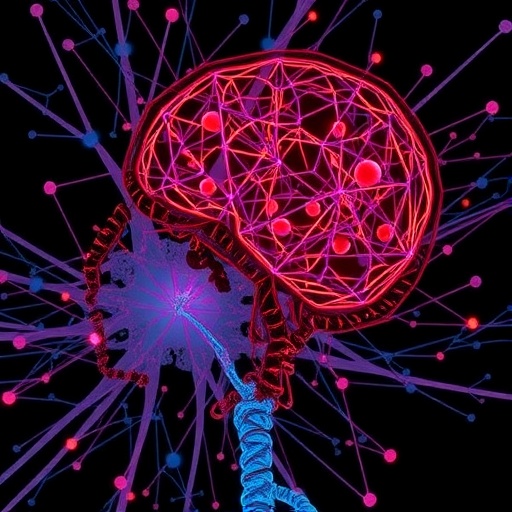
In a groundbreaking study set to redefine our understanding of schizophrenia, researchers have employed cutting-edge in vivo techniques to map protein-protein interactions associated with the disorder’s genetic risk factors. This comprehensive mapping has unveiled a complex and interconnected network, providing unprecedented insight into the molecular underpinnings of schizophrenia and opening new avenues for therapeutic intervention. As this research unfolds, it stands poised to revolutionize the landscape of psychiatric disease research and molecular biology.
Protein-protein interactions (PPIs) constitute the fundamental basis of cellular function, orchestrating everything from enzymatic activity to signal transduction and structural integrity. The challenge in psychiatric disorders like schizophrenia — which have highly polygenic backgrounds and intricate pathophysiological manifestations — has been to translate genetic data into meaningful biological mechanisms. Traditional approaches that analyze proteins in isolation or in vitro often fail to capture the dynamic and context-dependent nature of PPIs in living organisms. This study addresses that challenge by performing in vivo protein interaction mapping, thereby providing a physiologically relevant portrait of interactions.
The research team, led by McClatchy, Lane, and Powell, leveraged state-of-the-art proximity labeling techniques and mass spectrometry to trace interactions within live neuronal tissue. Proximity-dependent biotin identification (BioID) and cross-linking mass spectrometry (XL-MS) allowed for the capture of transient and stable protein complexes with high resolution. These technologies, combined with sophisticated bioinformatics algorithms, enabled the researchers to chart an expansive protein interactome centered on schizophrenia risk gene products.
One of the most striking findings is the dense clustering of risk proteins into functional modules, each corresponding to distinct biological processes implicated in schizophrenia pathogenesis. Modules related to synaptic function, neurotransmitter signaling, chromatin remodeling, and immune response emerged as hubs within the interaction network. Such modularity hints at a multifaceted disease etiology where disruptions in several molecular systems converge, impacting neural circuit stability and cognitive function.
Importantly, the mapping uncovered novel protein partners and previously unrecognized connections between proteins encoded by schizophrenia-associated loci. For example, the interaction between DISC1, a well-known risk gene product, and novel synaptic scaffolding proteins suggests previously unexplored mechanisms through which synaptic architecture may be destabilized in affected individuals. These findings underscore the value of unbiased, systems-level approaches for unveiling hidden relationships that could be overlooked in candidate gene studies.
The network topology also reveals potential points of vulnerability or therapeutic leverage. By quantitatively assessing node centrality and interaction strength, the researchers identified “hub” proteins that serve as critical connectors within the schizophrenia protein interactome. These hubs represent promising targets for intervention, as modulating their function could restore network integrity more effectively than targeting peripheral proteins. Moreover, hub proteins frequently participate in multiple pathways, highlighting their role as integrators of diverse molecular signals.
Beyond risk factor proteins themselves, the study stratified interactions by cell-type specificity within brain regions heavily implicated in schizophrenia, such as the prefrontal cortex and hippocampus. Single-cell proteomics data integration exposed how cellular context shapes protein interaction dynamics, revealing distinct patterns in excitatory neurons, inhibitory interneurons, and glial cells. This dimension of cellular resolution is crucial for understanding how schizophrenia’s heterogeneous symptoms arise from localized molecular alterations.
The study’s methodology also included temporal analysis across developmental stages, offering clues about when in the neurodevelopmental timeline these pathogenic interactions emerge. Early disruptions in protein networks during critical windows of synapse formation and pruning may underlie neurodevelopmental risk trajectories. This temporal insight provides a framework for developing stage-specific therapeutic strategies that could intervene before irreversible neural circuit maladaptations occur.
From a translational perspective, the research sets the stage for biomarker discovery by identifying interaction signatures uniquely altered in schizophrenia. Such molecular fingerprints could enhance diagnostic precision and enable patient stratification based on underlying molecular pathology rather than clinical symptomatology alone. This personalized medicine approach is vital for a disorder as clinically heterogeneous and pharmacologically challenging as schizophrenia.
The integration of protein interaction data with genomic, transcriptomic, and epigenomic datasets further enriches the interpretive power of this work. Through multi-omics integration, the study reforms our understanding of schizophrenia’s biology as a dynamic interplay of genetics, molecular networks, and environmental factors triggering epigenetic modifications. This holistic view is key to unraveling how complex genetic landscapes translate into functional neural abnormalities.
In addition to advancing biological knowledge, this research exemplifies the transformative impact of technological innovation in neuroscience. The application of cutting-edge proteomics and computational tools enables the discipline to transcend reductionist paradigms and embrace complex systems biology. Furthermore, the open sharing of protein interaction datasets from this study promises to accelerate collaborative research efforts aiming to tackle psychiatric diseases worldwide.
Ultimately, the identification of an interconnected disease network that integrates schizophrenia risk factors opens a new chapter in psychiatric research. It challenges the long-held notion of single-gene causality and positions schizophrenia as an emergent property of disrupted protein interaction networks. This paradigm shift compels us to rethink therapeutic development, advocating for multipronged approaches targeting network stability rather than isolated molecular components.
As this research ripples through the scientific and medical communities, it raises profound questions for future exploration. How do environmental insults modify this protein interaction landscape? Can targeted therapies restore network resilience without unintended off-target effects? What are the implications for early diagnosis and prevention? The answers to these questions will shape the next decades of psychiatry and molecular neuroscience.
This pioneering work not only enriches our molecular understanding of schizophrenia but also holds promise for informing treatments tailored to the intricacies of protein network biology. By disentangling the complex web of interactions at the heart of this devastating disorder, the study moves us closer to mitigating its impact on millions of lives globally.
The journey from risk gene identification to a fully mapped interactome exemplifies the power of interdisciplinary collaboration, spanning molecular biology, neuroscience, computational science, and clinical research. As efforts continue to build upon these findings, the vision of precision psychiatry grounded in molecular network biology comes into sharper focus, illuminating a path toward more effective and personalized interventions.
In summary, McClatchy and colleagues have delivered a landmark contribution to schizophrenia research by providing the first comprehensive in vivo protein-protein interaction map of disease-associated factors. This work not only elucidates the molecular complexity of schizophrenia but also sets a precedent for studying other psychiatric disorders through the lens of protein interactomics, heralding a new era of systemic insight into brain diseases.
Cite Scienmag News
Cassandra Pierce. (March 7, 2026). In Vivo Mapping Reveals Schizophrenia Protein Network. Scienmag. https://scienmag.com/in-vivo-mapping-reveals-schizophrenia-protein-network/
Cassandra Pierce. "In Vivo Mapping Reveals Schizophrenia Protein Network." Scienmag, 7 March 2026, https://scienmag.com/in-vivo-mapping-reveals-schizophrenia-protein-network/. Accessed 4 September 2026.
Cassandra Pierce. "In Vivo Mapping Reveals Schizophrenia Protein Network." Scienmag. March 7, 2026. https://scienmag.com/in-vivo-mapping-reveals-schizophrenia-protein-network/


