


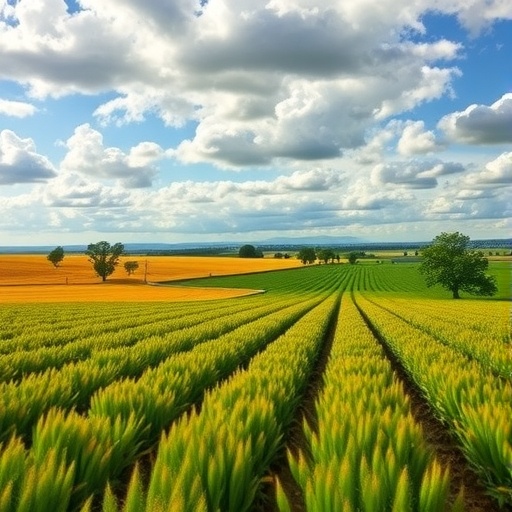
In the contemporary quest to harmonize human progress with environmental stewardship, a new study emerges as a pivotal guide, addressing one of the most pressing dilemmas of our age: balancing land use for conservation, agriculture, and renewable energy. As societies worldwide grapple with the escalating demands of food production, energy needs, and biodiversity preservation, this groundbreaking research from Brock, Roehrdanz, Beringer, and colleagues, published in Nature Communications in 2026, offers a comprehensive and nuanced examination of the spatial and ecological trade-offs inherent in land allocation.
Land, the foundational substrate for all terrestrial life and human activity, is an increasingly contested resource. With the global population projected to surpass 9 billion by 2050, agricultural expansion remains critical for feeding humanity. Simultaneously, the urgent imperative to transition towards renewable energy systems necessitates vast tracts for wind farms, solar arrays, and bioenergy plantations. Meanwhile, natural habitats and ecosystems, the reservoirs of biodiversity and carbon sequestration, face relentless pressures from fragmentation and degradation. The study provides sophisticated modeling and empirical data to delineate pathways that can reconcile these competing objectives without compromising ecological integrity.
Central to the analysis is the development of a multi-criteria spatial optimization framework that integrates ecological, agricultural, and energy system variables. This approach transcends traditional sectoral analyses by incorporating biodiversity conservation priorities, arable land productivity, and renewable energy potential in a unified paradigm. By leveraging high-resolution geospatial data, the authors quantify how land can be apportioned to maximize the synergistic benefits while minimizing conflicts. Such integrative methodologies are vital for informing policy decisions that aspire to sustainability in complex socio-ecological landscapes.
The study underscores the critical role of ecosystem services, emphasizing that land-use decisions extend far beyond immediate economic returns. Conserved natural areas offer indispensable functions including pollination, water regulation, soil stabilization, and carbon storage, which underpin agricultural productivity and climate resilience. Recognizing these indirect benefits, the framework evaluates land not only for its utilitarian value but also for its systemic contributions to environmental stability. The authors model scenarios where conservation is strategically prioritized, illustrating substantial long-term gains in ecosystem service flows that support both agriculture and human well-being.
An innovative aspect of the research lies in its detailed assessment of renewable energy technologies’ land footprints. Unlike fossil fuels, renewable installations have variable spatial efficiencies and environmental impacts. For instance, utility-scale solar installations require significant cleared surfaces but can coexist with certain agricultural practices, such as shade-tolerant crops or grazing. Conversely, wind farms have smaller direct land occupation but can disrupt wildlife movement patterns. Bioenergy crops introduce complex dynamics, often competing directly with food crops or natural vegetation. The analysis meticulously evaluates these dimensions to propose tailored land-use mixes that optimize energy output without degrading food security or biodiversity.
Moreover, the study reveals geographic heterogeneity as a pivotal factor influencing land-use planning. Different regions exhibit stark contrasts in biophysical conditions, crop suitability, conservation priorities, and renewable energy potentials. Tropical forests in the Amazon basin, for example, possess exceptional biodiversity value and carbon storage capacity but also enable subsistence farming for local communities. Arid regions may offer high solar irradiance yet be unsuitable for traditional crops. The authors provide regionally specific recommendations, emphasizing that one-size-fits-all solutions are untenable. Instead, adaptive, context-sensitive land management emerges as essential for sustainable development pathways.
The conflict between food production and conservation is frequently framed as zero-sum, yet the study demonstrates that integrated land-use mosaics can substantially mitigate this paradigm. Agroecological practices, such as agroforestry and diversified cropping systems, enhance habitat connectivity and ecosystem services within agricultural landscapes, thereby supporting biodiversity alongside yield productivity. Similarly, the integration of renewable energy infrastructure into farmlands can diversify income streams for farmers while minimizing ecological disruption. These findings promote mixed-use landscapes where multifunctionality is prioritized, challenging the traditional sectoral silos that dominate land policy discourse.
A notable technical contribution of the research is the incorporation of dynamic climate models to project future land-use suitability and environmental conditions under various emission scenarios. Climate change poses significant uncertainties for agriculture and conservation, altering precipitation regimes, temperatures, and ecological thresholds. By embedding predictive climate data within the spatial optimization framework, the study anticipates shifts in viable land uses and identifies resilient configurations that safeguard ecosystem integrity and food security under climatic stress. This forward-looking perspective equips policymakers with robust tools for long-term strategic planning.
Importantly, the authors address socio-economic dimensions by considering land tenure systems, governance structures, and stakeholder engagements in their analysis. Land-use decisions are inherently political and mediated through complex social interactions. Recognizing these realities, the study discusses mechanisms for participatory planning and equitable benefit-sharing to ensure implementation feasibility. Policies promoting decentralized decision-making and incentivizing sustainable land practices form part of the recommended pathways. This inclusive approach seeks to harmonize ecological and economic objectives with social justice considerations.
Beyond its core findings, the research calls for enhanced monitoring frameworks and data integration platforms to continuously track land-use changes and their cascading effects on biodiversity, agricultural productivity, and energy outcomes. The authors advocate for leveraging advances in remote sensing, big data analytics, and citizen science to create real-time information systems. These tools are critical for adaptive management, enabling rapid responses to emerging challenges and opportunities. The emphasis on evidence-based policy underscores the necessity of rigorous scientific inputs in shaping global land-use trajectories.
The synthesis presented by Brock and colleagues also highlights emerging technological innovations that could further optimize land usage. Precision agriculture, renewable energy storage solutions, and novel bioenergy crops with lower input demands are among the promising advancements referenced. When combined with strategic land allocation, these technologies hold the potential to amplify benefits and reduce trade-offs. The study thus situates itself at the intersection of ecological science, engineering, and policy innovation, charting a multidisciplinary roadmap toward sustainability.
A provocative insight from the study is the identification of “land-use tipping points” beyond which ecosystem degradation becomes irreversible or agricultural systems collapse. These thresholds emphasize the fragility of the terrestrial biosphere and the urgent need for proactive stewardship. The model outputs delineate clear boundaries within which development must occur to avoid catastrophic losses. This conceptual advance provides a critical reference point for global land governance negotiations, reinforcing the necessity of precautionary approaches in the face of uncertainty.
Despite the comprehensive scope, the authors acknowledge limitations related to data resolution variability, uncertainties in future socio-economic trajectories, and the challenges of scaling local insights to global frameworks. They advocate for iterative model refinement and scenario testing as new data emerges. The study also calls for interdisciplinary collaboration to bridge knowledge gaps, integrate indigenous and local expertise, and foster dialog among scientists, policymakers, and communities. Such collective efforts are imperative to realize the balanced land-use vision articulated.
In conclusion, Brock et al.’s landmark study offers a transformative perspective on the intricate balancing act required to sustainably allocate land for conservation, agriculture, and renewable energy production. By integrating ecological science, technological insight, and socio-political considerations within a sophisticated spatial optimization framework, it provides actionable guidance for policymakers and stakeholders. As the global community confronts escalating environmental crises and developmental demands, this research underscores the critical importance of holistic, data-driven, and equitable land-use strategies to secure a resilient future for both people and the planet.
Brock, C., Roehrdanz, P.R., Beringer, T. et al. Balancing land use for conservation, agriculture, and renewable energy.
Nat Commun (2026). https://doi.org/10.1038/s41467-026-69952-6
Cite Scienmag News
Margaret Porter. (March 7, 2026). Balancing Conservation, Farming, and Renewable Energy Land Use. Scienmag. https://scienmag.com/balancing-conservation-farming-and-renewable-energy-land-use/
Margaret Porter. "Balancing Conservation, Farming, and Renewable Energy Land Use." Scienmag, 7 March 2026, https://scienmag.com/balancing-conservation-farming-and-renewable-energy-land-use/. Accessed 3 September 2026.
Margaret Porter. "Balancing Conservation, Farming, and Renewable Energy Land Use." Scienmag. March 7, 2026. https://scienmag.com/balancing-conservation-farming-and-renewable-energy-land-use/


