


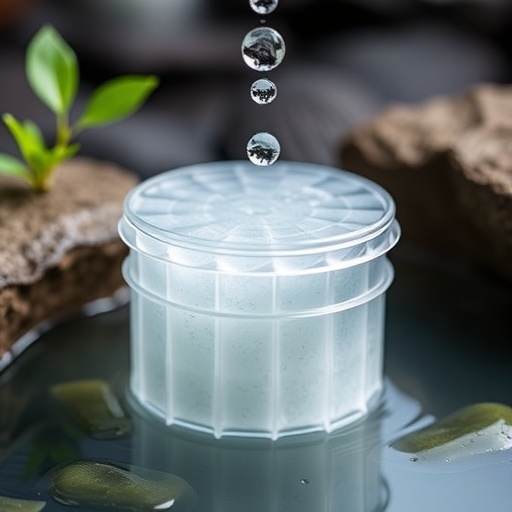
In an era where water scarcity is mounting as one of the most pressing global challenges, innovative technologies aimed at sustainable freshwater production have garnered immense attention. Among these, atmospheric water harvesting (AWH) emerges as a particularly promising approach due to its ability to extract moisture directly from humid air, potentially providing continuous freshwater supply even in arid regions. However, a persistent and critical barrier has been the biological safety of the harvested water. The evaporation and condensation processes involved often facilitate the unintended transport of bacteria and other pathogens, raising concerns about the quality and safety of the collected water for human consumption. Addressing this challenge, a groundbreaking advancement has been unveiled through the development of a novel mussel-inspired, wet-adhesive photothermal aerogel that integrates rapid sorption-desorption capabilities, structural resilience, and potent antibacterial activity.
The innovation stems from the ingenious bioinspired design leveraging the adhesive nature of mussels, whose catechol-rich adhesive proteins enable robust wet adhesion to various surfaces. By incorporating similar molecular motifs into the aerogel, researchers have engineered a material with exceptional water vapor sorption capacity and an inherent ability to resist fouling by microbial contaminants. This mammalian protein-inspired structure not only endows the aerogel with unprecedented hydrophilicity but also promotes strong adherence to atmospheric moisture, facilitating enhanced water uptake even under high relative humidity conditions, specifically at 95% RH. The resulting material exhibits a remarkable water uptake of 6.0 grams per gram of aerogel, with an absorption速 rate of 1.78 grams per gram per hour, marking a significant escalation over previous benchmarks in AWH materials.
Integral to the aerogel’s functionality is its embedded photothermal capability, which harnesses solar irradiation to inactivate more than 90% of bacteria present on the material’s surface. This photothermal effect, catalyzed by light-absorbing components integrated within the aerogel matrix, elevates the local temperature upon sunlight exposure. The elevated heat effectively neutralizes pathogenic bacteria captured during the sorption phase, thereby significantly mitigating the risk of microbial transmission through the harvested water. This dual function of sorption and on-demand disinfection represents a critical innovation, bridging the gap between water collection efficacy and biosafety in AWH technology.
The durability and structural stability of the aerogel compound its utility in practical applications. Unlike many existing materials that suffer degradation or loss of efficacy over repeated wet-dry cycles, this mussel-inspired aerogel maintains its integrity, ensuring consistent performance. Its mechanical robustness allows it to withstand the environmental stresses inherent in outdoor use, such as fluctuating humidity, temperature changes, and mechanical handling. This durability translates to long-term applicability, which is essential for real-world deployment in resource-limited and disaster-prone regions where maintenance and replacement capabilities are constrained.
To test the biological safety of the harvested water, comprehensive in vitro and in vivo assessments were conducted. In vitro cell culture experiments demonstrated that the collected water was non-cytotoxic and supportive of cellular growth, confirming its safety at the cellular level. Moreover, empirical studies involving Sprague Dawley rats showed no indication of tissue damage following water ingestion, underscoring the absence of harmful contaminants and the water’s compatibility with living organisms. These findings collectively validate the aerogel’s promise for delivering potable water that meets stringent safety criteria, a crucial requirement for humanitarian applications.
Expanding beyond proof-of-concept, the researchers engineered a solar-wind-electric hybrid AWH system integrating this advanced aerogel. This device capitalizes on synergistic energy sources to optimize water harvesting efficiency under variable environmental conditions. Solar energy powers photothermal antibacterial activity, while wind energy enhances air flow through the aerogel to maximize moisture capture. Electric components facilitate system control and water collection automation, creating an efficient and scalable solution. This hybrid approach not only broadens operational versatility but also exemplifies a sustainable nexus of renewable energy and environmental engineering.
The implications of this technology span far beyond academic novelty, extending into real-world scenarios such as potable water supply, disaster relief, and healthcare in vulnerable settings. Natural disasters frequently disrupt water infrastructure, leading to urgent needs for rapid deployment of safe water sourcing technologies. This scalable aerogel-based AWH device can fill such gaps by providing pathogen-free water directly from the atmosphere, drastically reducing dependence on contaminated sources. Additionally, in rural or arid regions lacking centralized water treatment facilities, this technology could serve as a decentralized water generation platform, fostering human health and resilience.
Scientifically, the research represents a significant stride in materials science and environmental engineering, merging biomimicry and photothermal technology to solve a formidable problem at the intersection of water security and public health. The use of catechol-based adhesive chemistry inspired by mussels transforms the aerogel beyond a passive sorbent, imbuing it with active biological interaction capabilities. This paradigm shift paves the way for next-generation materials that combine functionality with biosafety, setting new standards for sustainable water harvesting solutions.
Moreover, the integration of photothermal bacterial inactivation addresses a longstanding challenge in atmospheric water harvesting — the contamination of collected water by airborne pathogens. Prior methods often required additional disinfection steps using chemicals or energy-intensive filtration, which limited their feasibility and scalability. By contrast, the simultaneous water sorption and disinfection within a single material activated by abundant solar energy represents a minimalist yet effective approach. This strategy significantly streamlines system complexity and operational costs, crucial for deployment in economically disadvantaged regions.
The aerogel’s water sorption properties are finely tuned to capitalize on atmospheric humidity fluctuations, enabling rapid water collection during times of high moisture availability. The kinetics of sorption and desorption were optimized to ensure quick cycling, facilitating multiple water harvesting cycles per day. This continuous operation enhances the total yield while maintaining the biological safety of the output. The highly porous structure of the aerogel, combined with its hydrophilic coating, accelerates moisture uptake and evaporation, enabling a potent water vapor flux management under atmospheric conditions.
In the context of environmental sustainability, this technology aligns with global efforts aimed at reducing reliance on groundwater extraction and large-scale desalination plants, which often incur significant ecological footprints and energy consumption. By utilizing ambient humidity and renewable energy, the mussel-inspired aerogel-based system offers a low-impact, scalable water production technique. This provides a promising avenue for sustainable water resource management in the face of global climate change and intensifying water scarcity.
Looking forward, the scalability of the aerogel fabrication process highlights the potential for mass production, which is indispensable for wide adoption. The raw materials employed are abundant and environmentally benign, while the manufacturing process is amenable to industrial scaling. This combination ensures that the technology can transition from laboratory prototypes to commercially viable products, accelerating its impact and accessibility worldwide.
Furthermore, this technology also opens pathways for integration with smart sensing and IoT technologies, potentially enabling real-time monitoring of water quality, aerogel performance, and environmental conditions. Such integration would enhance system reliability and user safety, fostering trust and acceptance among end-users, particularly in sensitive applications such as healthcare and disaster response.
In summary, the mussel-inspired wet-adhesive photothermal aerogel represents a transformative leap in the field of atmospheric water harvesting. By intricately balancing high-efficiency water uptake with effective pathogen inactivation, and combining structural robustness with operational versatility, it sets a new benchmark for sustainable and safe freshwater generation. Its successful deployment paves the way for tackling urgent global water challenges while safeguarding public health through innovative material design and sustainable energy utilization.
Cite Scienmag News
Kristina Jarvis. (March 6, 2026). Pathogen-Free Water Harvesting with Mussel-Inspired Aerogel. Scienmag. https://scienmag.com/pathogen-free-water-harvesting-with-mussel-inspired-aerogel/
Kristina Jarvis. "Pathogen-Free Water Harvesting with Mussel-Inspired Aerogel." Scienmag, 6 March 2026, https://scienmag.com/pathogen-free-water-harvesting-with-mussel-inspired-aerogel/. Accessed 4 September 2026.
Kristina Jarvis. "Pathogen-Free Water Harvesting with Mussel-Inspired Aerogel." Scienmag. March 6, 2026. https://scienmag.com/pathogen-free-water-harvesting-with-mussel-inspired-aerogel/


