


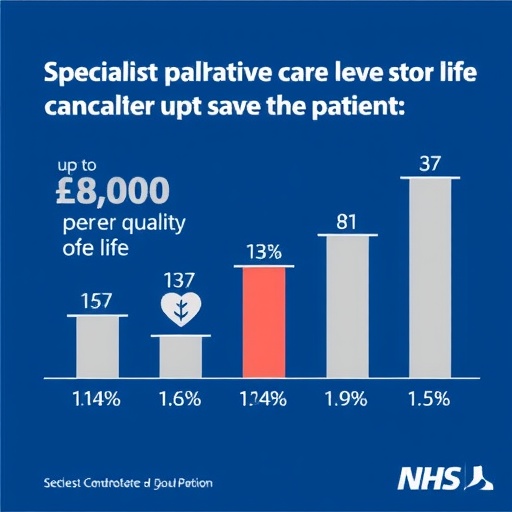
Specialist palliative care emerges as a transformative force in healthcare, demonstrating significant cost savings and substantial improvements in quality of life for patients nearing the end of life. A groundbreaking study conducted by researchers from King’s College London, in collaboration with the National Institute for Health and Research (NIHR) Policy Research Unit in Palliative and end of life care, Hull York Medical School, University of Hull, and University of Leeds, provides compelling evidence that implementing specialist palliative care both in home settings and acute hospitals is not only economically beneficial but profoundly enhances patient well-being.
In high-income countries, a striking paradox exists: approximately 1% of the population dies annually, yet this small demographic accounts for 8-10% of all healthcare expenditures. This disproportionate consumption of resources is largely driven by unplanned hospital admissions, which often result in fragmented and less cohesive care experiences. Despite a prevailing preference among patients with serious, life-limiting illnesses to remain under care at home, many ultimately pass away in hospital settings, where care continuity and comfort may be compromised.
The new study applied rigorous economic modeling techniques to evaluate potential savings achievable by expanding specialist palliative care within the UK’s National Health Service (NHS). It integrated data from a spectrum of previous research alongside official government statistics to quantify cost reductions stemming from decreased unplanned hospital admissions. By doing so, the researchers could extrapolate how specialist palliative care mitigates pressure on hospital resources while simultaneously fostering better patient outcomes.
Quality of life, a central metric in the study, was assessed through a multidimensional framework addressing five critical domains of health: mobility, self-care, usual activities, pain, and psychological aspects such as anxiety and depression. This comprehensive approach ensures that the impact on a patient’s everyday experience of illness is holistically captured, framing palliative care’s benefits beyond simple clinical markers to encompass the broader human condition in terminal phases.
Findings revealed home-based specialist palliative care was associated with an average cost savings of £7,908 per individual who died, while hospital-based specialist palliative care reduced costs by an average of £6,480 per person. These figures underscore an important paradigm shift — investing in specialized, targeted end-of-life care reduces overall system expenditures, challenging previous assumptions about the high cost of comprehensive palliative services.
Specialist palliative care is defined as care provided to individuals with complex, profound needs at the end of life that cannot be adequately managed by core or primary healthcare teams. This specialized care necessitates healthcare professionals possessing in-depth skills and dedicated experience in palliative medicine, who are able to deliver holistic symptom management, psychological support, and care coordination tailored to each patient’s nuanced needs.
In practical terms, the study’s projections for England in 2022 indicated that specialist palliative care facilitated over 20,000 individuals to die outside hospital settings, thereby preventing approximately 1.5 million hospital bed days. This reduction translates into healthcare expenditure savings estimated at £817 million, a figure that illustrates the massive systemic impact possible through wider provision of specialist palliative care.
Despite these clear benefits, the study highlights a significant care gap: only about half of the people who could benefit from specialist palliative care actually receive it. This discrepancy signals urgent policy and system-level challenges, emphasizing a need to understand barriers to access and develop strategies to extend the reach of palliative services throughout communities and healthcare institutions.
Peter May, Senior Lecturer in Health Economics at King’s College London and lead author, underscores the novelty and importance of this economic evaluation, stating, “This is the first study to estimate the economic impact for England.” He emphasizes the cost-effectiveness of specialist palliative care for patients and the NHS alike, adding a call to action: “We must now turn our attention to understanding how and why people who might benefit do not yet receive palliative care.”
The research team also confronted common misconceptions surrounding palliative care. Professor Fliss Murtagh of Hull York Medical School addressed patient hesitancy driven by fears that palliative care might hasten decline or burden the healthcare system. Contrary to these beliefs, the study’s evidence affirms that high-quality, appropriate palliative care substantially improves symptom control and patient experience, while simultaneously alleviating pressures on hospital services.
This compelling evidence aligns with ongoing public health priorities focused on optimizing care pathways for patients with life-limiting illnesses. By shifting the locus of care toward patients’ homes or specialized hospital care units equipped with expert palliative teams, healthcare systems can achieve a sustainable balance of compassionate care provision and resource stewardship.
The study also presents a model for how multidisciplinary healthcare teams—spanning hospices, community nursing, and hospital specialists—can be leveraged towards an integrated approach that addresses complex patient needs in the most beneficial settings. This integration not only promotes dignity and comfort but also generates measurable economic returns by reducing unnecessary acute care episodes.
Published in the peer-reviewed journal Palliative Medicine, this research contributes a crucial dimension to the evolving debate on how best to deliver end-of-life care amidst increasing demand and constrained health budgets. It suggests that investment in specialist palliative care pathways is not a cost but a strategic saving, enhancing the sustainability and humanity of healthcare systems confronted with demographic challenges.
As healthcare policymakers and providers digest these findings, the imperative becomes clear: specialist palliative care should be a central pillar of future health system design, ensuring that more patients can experience quality end-of-life care while enabling the NHS to meet growing needs without unsustainable spending increases.
News Publication Date:
Not specified in the original content
Web References:
Not provided in the original content
References:
May, P. et al. (2023). “Specialist palliative care improves patient experience, reduces bed days and saves money: An economic modelling study of home- and hospital-based care.” Palliative Medicine.
Cite Scienmag News
Courtney Benton. (March 6, 2026). Specialist palliative care can save the NHS up to £8,000 per patient while enhancing quality of life, new research reveals. Scienmag. https://scienmag.com/specialist-palliative-care-can-save-the-nhs-up-to-8000-per-patient-while-enhancing-quality-of-life-new-research-reveals/
Courtney Benton. "Specialist palliative care can save the NHS up to £8,000 per patient while enhancing quality of life, new research reveals." Scienmag, 6 March 2026, https://scienmag.com/specialist-palliative-care-can-save-the-nhs-up-to-8000-per-patient-while-enhancing-quality-of-life-new-research-reveals/. Accessed 4 September 2026.
Courtney Benton. "Specialist palliative care can save the NHS up to £8,000 per patient while enhancing quality of life, new research reveals." Scienmag. March 6, 2026. https://scienmag.com/specialist-palliative-care-can-save-the-nhs-up-to-8000-per-patient-while-enhancing-quality-of-life-new-research-reveals/


