


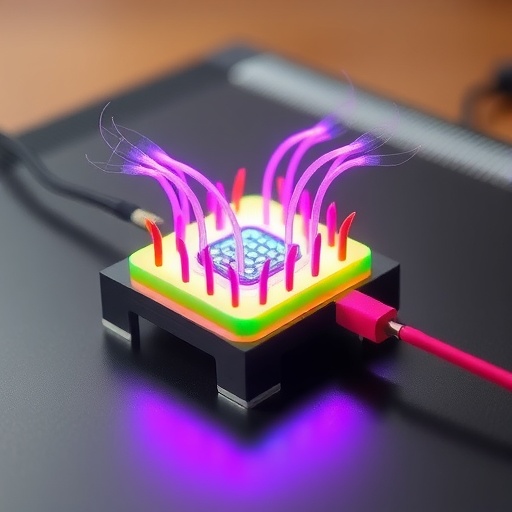
In a groundbreaking advancement that could revolutionize the fields of communication, sensing, and materials science, researchers have unveiled a novel technique for non-contact electroelastic modulation of conventional media. This innovative method leverages two-way electromagnetic induction to manipulate matter without physical contact, setting the stage for transformative applications in both industrial and consumer technologies. The study, spearheaded by Dupont, Christenson, and Tang, and published in the journal Communications Engineering in 2026, offers a detailed exploration of how electromagnetic fields can be harnessed to induce controlled mechanical and electrical responses in traditional materials, bringing new dimensions to the way we interact with and control solid media.
At the heart of this breakthrough is the concept of electroelastic modulation—the dynamic alteration of a material’s elastic and electrical properties through external stimuli. Previously, such modulation required direct physical contact or integrated wiring, limiting practical implementation and scalability. The team’s approach circumvents these constraints by implementing a sophisticated system of two-way electromagnetic induction, enabling remote and contactless control over elastic vibrations and electric polarization within media traditionally considered static or passive. This non-contact feature not only enhances versatility but also opens new avenues for embedding intelligent capabilities into everyday materials and devices.
The physical mechanism relies on carefully engineered electromagnetic fields that propagate from a transmitter coil to an engineered media component. This component contains microstructures or embedded elements that react to the inductive fields by modulating their own electromagnetic states. Through reciprocal induction, these changes influence the transmitter’s field as well, creating a feedback loop that allows precise, real-time modulation of the material properties. In simpler terms, the material and the controlling electromagnetic system communicate bidirectionally without ever needing a physical connector, a feat that marks a significant departure from conventional approaches.
Technically speaking, the researchers constructed a composite material layered with nanoscale conductive and piezoelectric elements. These elements serve as the active agents that convert the external electromagnetic fields into mechanical deformation and changes in electrical polarization—key markers of electroelastic modulation. The interplay between the electromagnetic forces and the piezoelectric response facilitates programmable changes in stiffness, resonance frequency, and dielectric constant, crucial parameters for numerous applications ranging from adaptive optics to smart sensors. Notably, this setup minimizes energy losses, improving efficiency compared to prior contact-based systems.
One of the most exciting aspects of this research lies in its potential for real-world deployment. For instance, in telecommunications, the non-contact modulation technique could enable reconfigurable antennas and filters that dynamically interact with signals, improving bandwidth and reducing interference without bulky mechanical parts or wired adjustments. Similarly, in healthcare, implantable devices or wearable sensors built on the principle of two-way electromagnetic induction could deliver and receive signals non-invasively, facilitating continuous monitoring with unprecedented comfort and reliability.
Moreover, the technique’s universality allows it to work with conventional media like polymers, glasses, and ceramics, which were previously challenging to modulate electronically without invasive integration. By embedding microscopic conductive pathways and piezoelectric domains, these everyday materials can now be transformed into active participants in complex electromagnetic systems. This not only expands the design space for engineers but also aligns with sustainable manufacturing trends by reducing the need for exotic or rare materials.
The researchers also demonstrated the method’s capacity for high spatial resolution control, manipulating localized zones within a bulk material selectively and independently. This spatial selectivity enables creating intricate patterns of elastic and electrical states, useful for applications in acoustic metamaterials, vibration control, and dynamic holography. By tuning electromagnetic parameters such as frequency, amplitude, and phase, the system can sculpt the internal state of the media down to micron scales, offering a versatile platform for tailored material functionalities.
In terms of theoretical contributions, the team advanced the model of coupled electromagnetic and elastic fields beyond classical approximations. They developed a set of nonlinear equations that capture the mutual induction phenomena, including energy transfer, phase synchronization, and dissipative effects. These models provide a robust framework for predicting material responses under various electromagnetic stimuli, assisting in optimizing device designs and scaling up the technology for industrial use.
Crucially, the two-way electromagnetic induction system also introduces a novel feedback control mechanism. Unlike traditional feedforward systems, this technology senses the material’s instantaneous state and adjusts the excitation field accordingly. This feedback loop significantly enhances stability and responsiveness, enabling real-time adaptation to environmental changes or operational demands. Such capabilities pave the way for smart materials capable of self-healing, self-tuning, or autonomous operation.
Experimental validation was conducted using an ensemble of advanced diagnostics, including laser Doppler vibrometry and impedance spectroscopy, to capture the dynamic interactions within the modulated media. The results verified theoretical predictions, showing significant modulation depths and rapid response times with minimal thermal effects. Importantly, the experiments underscored the system’s robustness under variable external conditions, suggesting practicality beyond laboratory settings.
The implications for future technology landscapes are profound. In robotics, non-contact electroelastic modulation could lead to soft robotic components with adaptable stiffness and shape, improving dexterity and safety in human-robot interactions. In optics, materials with tunable refractive indices and elastic properties may form the basis for lenses, filters, or holographic displays with unprecedented flexibility and performance. Additionally, infrastructure monitoring systems could benefit from embedded sensors that detect stress or damage remotely, improving maintenance and safety.
Ethical and environmental considerations also arise from this new modality. By enabling materials to be controlled without physical alteration or wiring, there is potential for reducing electronic waste and enhancing recyclability. The approach supports the integration of electronics in a more harmonious and less intrusive manner, aligning with smart city and Internet of Things (IoT) visions that require seamless, distributed intelligence without complex hardware footprints.
Looking ahead, the research team plans to explore the integration of this modulation method with other emerging technologies such as quantum materials and nanoelectromechanical systems (NEMS). These efforts aim to deepen the control precision down to atomic or molecular scales, potentially unlocking functionalities currently unreachable with classical methods. Multi-physics optimization combining thermal, mechanical, and electromagnetic controls is also on the horizon, promising multifaceted material responsiveness.
In conclusion, the pioneering demonstration of non-contact electroelastic modulation through two-way electromagnetic induction fundamentally reshapes the paradigm of material interaction and control. By fusing advanced electromagnetic theory with practical engineering, this work charts a path toward a future where materials themselves become active, responsive systems interconnected wirelessly with their environments. The potential ripple effects across technology sectors could usher in a new era of smart materials and devices with capabilities that, not long ago, belonged purely in the realm of science fiction.
Dupont, J., Christenson, R. & Tang, J. Non-contact electroelastic modulation of conventional media leveraging two-way electromagnetic induction. Commun Eng (2026). https://doi.org/10.1038/s44172-026-00630-7
Cite Scienmag News
Denise Maddox. (March 5, 2026). Non-Contact Electroelastic Control via Two-Way Induction. Scienmag. https://scienmag.com/non-contact-electroelastic-control-via-two-way-induction/
Denise Maddox. "Non-Contact Electroelastic Control via Two-Way Induction." Scienmag, 5 March 2026, https://scienmag.com/non-contact-electroelastic-control-via-two-way-induction/. Accessed 4 September 2026.
Denise Maddox. "Non-Contact Electroelastic Control via Two-Way Induction." Scienmag. March 5, 2026. https://scienmag.com/non-contact-electroelastic-control-via-two-way-induction/


