


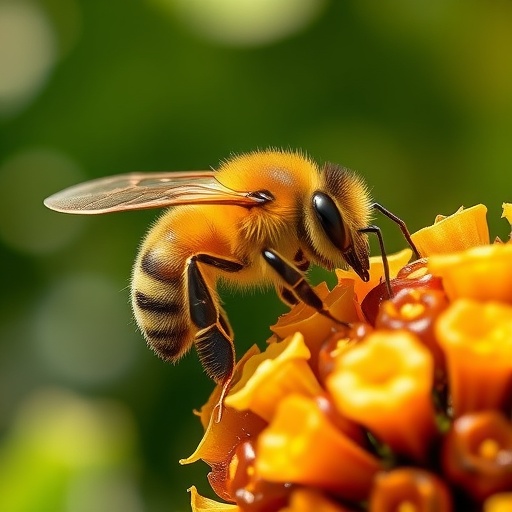
For the first time, groundbreaking research has revealed a direct connection between a crucial social behavior in honey bees and significant physiological benefits that enhance colony survival. This discovery offers a promising new perspective on combating threats to bee populations worldwide by harnessing innate individual immune strengths linked to collective hygienic behavior.
A study published recently in PLOS ONE presents compelling evidence that honey bee colonies exhibiting hygienic behavior possess not only robust social defenses but also heightened individual immune capabilities when faced with the pervasive pathogen Nosema ceranae. This microsporidian parasite infects the digestive tracts of adult bees, compromising their nutrient absorption and overall vitality, thereby undermining colony health. The work focuses on how hygienic colonies seem to resist Nosema infections better than their non-hygienic counterparts despite harboring similar infection loads, a phenomenon that points towards improved physiological resilience rather than simple pathogen avoidance.
Led by Sydney Miller of the University of Vermont’s Department of Agriculture, Landscape, and Environment, the extensive study combined field observations with controlled laboratory analyses to investigate immune responses and survival outcomes among worker bees. Hygienic colonies possess a heritable trait which enables worker bees to detect chemical signals emitted by diseased or dead brood. These workers excise compromised larvae and pupae from the nest, thereby arresting pathogen spread at early developmental stages. However, until now, the impact of this trait on adult bee health and immunity had not been quantified in relation to Nosema infections.
The research team uncovered that bees derived from hygienic colonies exhibited marked upregulation of innate immune genes, notably Vitellogenin (Vg) and Hymenoptaecin (Hym), during Nosema ceranae infection. Vitellogenin, a multifunctional protein, is implicated not only in reproduction but also in antioxidant activity and immune modulation, providing a protective advantage against oxidative stress caused by infection. Hymenoptaecin, an antimicrobial peptide, directly combats microbial pathogens. The enhanced expression of these genes suggests a strengthened immune system capable of mitigating damage and improving infection tolerance.
Distinctively, the study observed that hygienic bees consumed less sugar syrup laced with Nosema spores compared to non-hygienic bees, which may indicate behavioral pathogen avoidance mechanisms at the individual level. This reduced intake of contaminated food sources likely decreases pathogen exposure and subsequent disease severity. This finding points toward a sophisticated integration of social and individual defenses working in concert to limit pathogen impact across the entire colony.
Perhaps most strikingly, the hygienic bees demonstrated significantly longer survival rates under Nosema infection despite similar pathogen loads as their non-hygienic peers. This improved survival underscores a physiological tolerance, implying that hygienic behavior confers benefits beyond merely reducing infection prevalence. The bees’ ability to sustain health and function despite carrying infections is critical for maintaining robust colonies capable of thriving in pathogen-laden environments.
Contrary to some expectations, no Nosema ceranae spores were detected in the brood, confirming that hygienic brood removal does not decrease Nosema levels directly through eliminating infected larvae or pupae. Instead, the beneficial effects arise from enhanced immune and survival traits at the individual adult bee level within hygienic colonies. This insight reshapes the understanding of how social traits can influence physiological defenses in eusocial insects.
The broader implications for apiculture are profound. Hygienic behavior, traditionally valued for preventing brood diseases such as American foulbrood, may offer a multifaceted defense by bolstering adult bee immunocompetence against Nosema and potentially other adult-infecting pathogens. Selective breeding that favors these traits could revolutionize bee health management, enabling the development of colonies inherently equipped with both behavioral and physiological tools to counteract widespread pathogens.
As Nosema ceranae continues to contribute to colony declines, reduced honey production, and increased overwinter mortality across global apiaries, integrating hygienic behavior into breeding programs emerges as a critical, sustainable strategy. This approach alleviates reliance on chemical treatments, which often carry risks of resistance and residual toxicity, and supports ecological balance by fostering natural disease resilience.
Co-author Samantha Alger highlights that the research unveils a clearer mechanism behind the well-documented reduced pest and pathogen burdens in hygienic colonies. It is not only the excision of sick brood but also a robust individual immune response in adult bees that collectively underpin colony health. These findings bridge behavioral ecology and immunology, advancing holistic perspectives on social insect disease defense.
The study represents a collaborative effort between the University of Vermont, the USDA Beltsville Honey Bee Research Lab, and the University of North Carolina Greensboro. Funded by the North American Pollinator Protection Campaign’s Honey Bee Health Grant, the One Hive Foundation, and Optera, LLC, this research embodies a convergence of academic and industry partnerships dedicated to safeguarding pollinator populations vital to ecosystems and agriculture.
By illuminating innate defense pathways activated within hygienic honey bee colonies, this work sets a new paradigm for understanding and leveraging social behaviors for disease mitigation. It invites future research into the molecular underpinnings of these immune enhancements and their potential applicability across other social insects and pollinator species. As global concerns about pollinator declines intensify, such integrative studies offer hope for resilient, healthy bee populations essential to biodiversity and food security.
— End of Article —
Cite Scienmag News
Kristina Jarvis. (March 5, 2026). New Study Uncovers How Hygienic Honey Bees Uniquely Combat Infectious Pathogens in Adult Populations. Scienmag. https://scienmag.com/new-study-uncovers-how-hygienic-honey-bees-uniquely-combat-infectious-pathogens-in-adult-populations/
Kristina Jarvis. "New Study Uncovers How Hygienic Honey Bees Uniquely Combat Infectious Pathogens in Adult Populations." Scienmag, 5 March 2026, https://scienmag.com/new-study-uncovers-how-hygienic-honey-bees-uniquely-combat-infectious-pathogens-in-adult-populations/. Accessed 4 September 2026.
Kristina Jarvis. "New Study Uncovers How Hygienic Honey Bees Uniquely Combat Infectious Pathogens in Adult Populations." Scienmag. March 5, 2026. https://scienmag.com/new-study-uncovers-how-hygienic-honey-bees-uniquely-combat-infectious-pathogens-in-adult-populations/


