


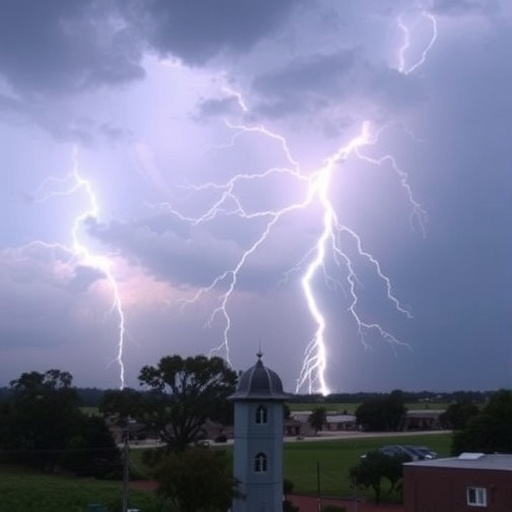
A groundbreaking study led by the UK Centre for Ecology & Hydrology (UKCEH) has revealed crucial insights into the rapid development of thunderstorms on hot days, a phenomenon that has historically baffled meteorologists due to its unpredictability. By meticulously analyzing over two decades of satellite data, this research uncovers how interactions between soil moisture patterns and atmospheric wind shear in the lower atmosphere govern where thunderstorms are most likely to ignite. This advancement promises to revolutionize forecasting accuracy, aiding communities worldwide in preparing for sudden, intense storms that have economically and humanly devastating effects.
Thunderstorms, particularly in tropical regions such as sub-Saharan Africa, often emerge suddenly and violently, sometimes developing within a mere 30 minutes after clouds begin to form. This rapid onset leaves people and infrastructure vulnerable, as warning times are constrained. The challenge has long been that forecasters could only broadly predict the occurrence of thunderstorms without pinpointing locations. The new study provides a tangible breakthrough by demonstrating that thunderstorm initiation is not a random event but intricately linked to environmental soil moisture patterns coupled with wind behavior near the surface.
By studying an extensive dataset comprising 2.2 million storms from 2004 to 2024, collected through an innovative high-resolution satellite imaging technique developed at TU Wien, researchers correlated soil wetness variations at fine scales with the atmospheric dynamics just above the ground. This enabled a novel perspective on how the land’s moisture content influences convective cloud growth. In concert with the wind shear – the variation in wind speed and direction with height – these moisture patterns govern the rapid vertical development of storm clouds, thus controlling the spatial localization of thunderstorm formation.
Wind shear has long been recognized by meteorologists as a driver for storm severity and organization. However, until now, its interactive effect with heterogeneous surface soil moisture was not fully appreciated in the context of thunderstorm initiation. The study reveals that when soil moisture gradients align favorably with the prevailing wind shear, there is a pronounced enhancement in the likelihood and intensity of explosive storm growth. Quantitatively, the study found a remarkable 68% increase in severe thunderstorms under such optimum conditions, highlighting the non-linear amplification effect of this interaction.
The implications of these findings extend deeply into forecasting methodologies. Current weather prediction models often struggle with the microscale triggers of convection, especially when it comes to rapidly emerging storms. By integrating real-time soil moisture monitoring with atmospheric wind profiling, enhanced by the application of artificial intelligence to model complex land-atmosphere interactions, forecasting agencies can achieve earlier and more precise storm warnings. This leap forward is anticipated to provide critical lead times that can save lives, protect livestock, and minimize infrastructure damage, particularly in regions susceptible to flash flooding.
Focus on sub-Saharan Africa in this research is particularly timely given the region’s vulnerability. Urban centers with burgeoning populations face severe risks from flash floods caused by intense, localized thunderstorms compounded by often limited radar coverage and meteorological infrastructure. The high-resolution satellite data breakthrough used in the study overcomes many observational limitations, offering meteorological agencies vital new tools for spatially detailed nowcasting – short-term weather prediction – that extends several hours ahead of storm development.
Professor Christopher Taylor, the study’s lead author, articulates the significance of moving beyond treating land and atmosphere parameters in isolation. His team’s approach synthesizes previously distinct variables into a coherent framework that improves the predictability of storm genesis. This synthesis represents a paradigm shift; it challenges the assumption that thunderstorm initiation is inherently stochastic and instead positions it as a process constrained by deterministic environmental constraints.
The study further underscores the critical role climate change plays in exacerbating these extreme weather phenomena. Increased surface temperatures lead to drier soils in some regions and wetter patches in others, creating uneven patterns of soil moisture that intensify under the influence of changing wind regimes. This evolving interplay enhances convective storm potential. Therefore, forecasting improvements are not only about hazard prediction but also adapting to a rapidly changing climate system that alters the foundational triggers of thunderstorms.
In practical terms, UKCEH’s collaboration with national meteorological agencies, such as Senegal’s ANACIM, has already begun yielding tangible benefits. The new knowledge informs enhancements to early warning systems that address flash flooding, lightning hazards, and strong, damaging winds in West Africa. These advancements, backed by supportive AI algorithms and satellite data streams, promise to extend nowcasting capabilities beyond traditional boundaries, allowing vulnerable populations more time to react to imminent storms.
Meanwhile, the methodological innovation by TU Wien, enabling daily retrievals of soil moisture at unprecedented spatial resolution from satellite observations, provides a critical data backbone. Previously, soil moisture information was either too coarse or infrequent to be useful at the scale required for thunderstorm forecasting. This advancement allows for dynamic updating of soil moisture maps that, when combined with wind shear data, produce an integrated environmental picture essential for anticipating thunderstorm development hotspots.
The broader applicability of the findings cannot be overstated. While the detailed satellite data and observational focus have been grounded in tropical Africa, the underlying atmospheric physics and land-atmosphere dynamics hold globally. This suggests that similar predictive improvements can be transposed to tropical areas in Asia, the Americas, Australia, and even temperate regions such as Europe, where intense summer storms also impact millions. Thus, this research sets the stage for a new generation of weather models that harness soil moisture-wind interactions worldwide.
Given that thunderstorms cause approximately 30,000 deaths and economic losses estimated at $500 billion globally between 2010 and 2019, the urgency of such forecasting enhancements is clear. Early warnings enabled by this novel scientific understanding could mitigate human casualties and reduce the financial costs associated with storm damage. As these methods become operationally embedded in weather services worldwide, emergency response and urban planning stand to benefit greatly from improved climate resilience.
Looking ahead, the integration of AI-driven modeling with continuous satellite monitoring forms the frontier of weather prediction. UKCEH’s ongoing research will further refine these models to translate soil moisture and wind shear interactions into actionable forecasts. The efforts aim not only to improve accuracy but also to support risk planning, emergency response, and climate adaptation strategies, thereby strengthening the ability of societies to anticipate and withstand the rising threat from extreme convective storms in a warming world.
News Publication Date: 4-Mar-2026
Web References:
References:
Taylor et al. 2026. Wind shear enhances soil moisture influence on rapid thunderstorm growth. Nature. DOI: 10.1038/s41586-025-10045-7.
Cite Scienmag News
Russell Cooper. (March 4, 2026). Scientists Uncover Key Mechanism Behind Thunderstorm Formation to Enhance Forecasting. Scienmag. https://scienmag.com/scientists-uncover-key-mechanism-behind-thunderstorm-formation-to-enhance-forecasting/
Russell Cooper. "Scientists Uncover Key Mechanism Behind Thunderstorm Formation to Enhance Forecasting." Scienmag, 4 March 2026, https://scienmag.com/scientists-uncover-key-mechanism-behind-thunderstorm-formation-to-enhance-forecasting/. Accessed 4 September 2026.
Russell Cooper. "Scientists Uncover Key Mechanism Behind Thunderstorm Formation to Enhance Forecasting." Scienmag. March 4, 2026. https://scienmag.com/scientists-uncover-key-mechanism-behind-thunderstorm-formation-to-enhance-forecasting/


