


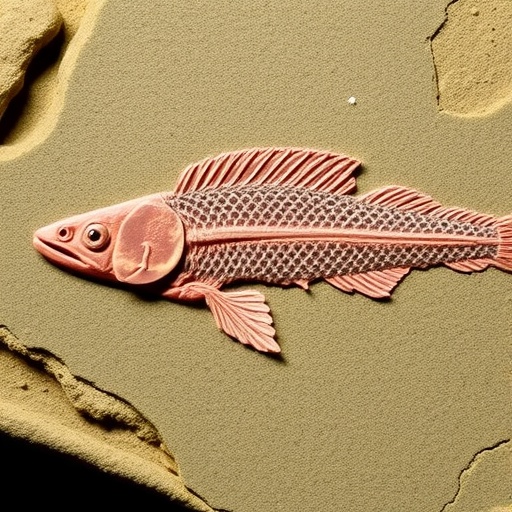
A groundbreaking study led by Professors Min Zhu, Jing Lu, and You’an Zhu from the Institute of Vertebrate Paleontology and Paleoanthropology (IVPP) of the Chinese Academy of Sciences has unveiled crucial insights into the origin and early evolution of bony fishes, the dominant group in the vertebrate lineage. Published as dual cover stories in the prestigious journal Nature, this research provides unprecedented anatomical data from the oldest known fossils of bony fishes, bridging a significant gap in the understanding of vertebrate evolution.
Bony fishes (Osteichthyes) are a diverse group marked by two main extant lineages: ray-finned fishes (Actinopterygii) and lobe-finned fishes (Sarcopterygii), the latter lineage including the ancestors of all tetrapods, which eventually led to terrestrial vertebrates including humans. Despite their evolutionary importance, the origin of bony fishes has been enigmatic due to a paucity of well-preserved fossil evidence predating the Devonian period, a time when many early fish fossils already appear as highly specialized forms.
The team’s discoveries stem from meticulous fieldwork spanning over a decade, involving fossil specimens from the Early and Late Silurian deposits of southern China. This region, encompassing Chongqing and Yunnan provinces, has proven to be a vital repository of early vertebrate fossils that unravel the complex evolutionary history preceding the Devonian radiation of jawed fishes.
The first key specimen, Eosteus chongqingensis, hails from the Early Silurian strata approximately 436 million years old. Measuring a mere 3 centimeters in length, the fossil is remarkably complete, preserving the entire organism from head to tail. This diminutive fish exhibits an intriguing mosaic of features, combining traits recognized in early ray-finned fishes with ancestral characteristics, such as the absence of lepidotrichia (the bony fin rays typical of more derived bony fishes), and the presence of an anal fin spine, a feature previously observed only in cartilaginous fishes and placoderms, which are more primitive jawed vertebrates.
Such a combination of characteristics in Eosteus chongqingensis challenges pre-existing assumptions about the timing of core bony fish traits’ emergence. Notably, morphological features thought to be exclusive to later ray-finned fishes were already present in this early bony fish, suggesting a considerably earlier advent of defining osteichthyan features than was hitherto recognized.
Complementing this discovery is the unearthing and detailed study of Megamastax amblyodus from the Late Silurian Kuanti Formation in Qujing, Yunnan, dating to approximately 423 million years ago. Megamastax stands out as the largest known vertebrate from the Silurian, surpassing one meter in length, which is extraordinary given the generally small size of contemporaneous vertebrates.
Prior to this study, efforts to reconstruct Megamastax’s anatomy were hampered by the fragmentary nature of fossil material and the complexity of internal structures. However, the application of advanced high-resolution computed tomography (HRCT) and three-dimensional digital reconstruction enabled the researchers to visualize the entirety of its cranial anatomy and internal morphology non-destructively. This breakthrough revealed intricate details of the cranial bones, braincase, and musculature, shedding light on its feeding adaptations and internal structures.
The dentition of Megamastax amblyodus is particularly revealing. Unlike modern bony fishes that generally have a single row of teeth, Megamastax’s jaws display a primitive condition with both inner and outer dental arcades. The inner row features tooth cushions resting on broad bases, a configuration that resolves long-standing debates about the taxonomic placement of similarly isolated Silurian tooth remains from the Baltic region. This anatomical evidence confirms that such dental structures are basal osteichthyan features rather than belonging to other groups.
Comprehensive phylogenetic analyses place both Eosteus and Megamastax firmly within the bony fish stem group, representing taxa that predate the divergence of ray-finned and lobe-finned fishes. This placement provides a crucial window into the ancestral condition of osteichthyans and informs reconstructions of their last common ancestor’s morphology. Their existence before the evolutionary split challenges earlier hypotheses suggesting that ancestral bony fishes resembled lobe-finned fishes more than ray-finned types.
These findings carry profound implications for understanding the early evolution of jawed vertebrates. By illuminating the morphological trajectory of key skeletal features, including jaw structure, scales, and fin architecture, the research advances our knowledge of how complex anatomical innovations arose and diversified within early bony fishes. This also refines models of how vertebrates transitioned from aquatic to terrestrial environments, through the lobe-finned lineage.
The study reinforces the significance of southern China as a pivotal paleontological region rich in vertebrate fossils that document critical episodes of early vertebrate evolution. The geological context and exceptional preservation conditions in this area have allowed scientists to capture an evolutionary snapshot that was previously inaccessible, filling a major gap in the fossil record.
Funding for this research was provided by the Key Program of the National Natural Science Foundation of China, the International Research Center of Big Data for Sustainable Development Goals, among other sources, underscoring the collaborative and interdisciplinary nature of this endeavor. The use of cutting-edge imaging technologies and fossil analysis techniques exemplifies the integration of modern scientific tools in unraveling deep-time biological mysteries.
Altogether, the discoveries of Eosteus chongqingensis and Megamastax amblyodus mark a paradigmatic shift in vertebrate paleontology by presenting the earliest clear anatomical evidence for the origin of bony fishes and elucidating critical evolutionary developments that laid the foundation for the diversity of vertebrates seen today. This work not only enhances the intricate tapestry of life’s history but also inspires continued exploration of early fossils to further decode the origins of vertebrate complexity.
News Publication Date: March 4 (year inferred as 2026 from DOI).
Web References:
DOI link to the article
Cite Scienmag News
Gavin Prescott. (March 4, 2026). Fossils of the Oldest Bony Fish Reveal Insights into Early Vertebrate Evolution. Scienmag. https://scienmag.com/fossils-of-the-oldest-bony-fish-reveal-insights-into-early-vertebrate-evolution/
Gavin Prescott. "Fossils of the Oldest Bony Fish Reveal Insights into Early Vertebrate Evolution." Scienmag, 4 March 2026, https://scienmag.com/fossils-of-the-oldest-bony-fish-reveal-insights-into-early-vertebrate-evolution/. Accessed 5 September 2026.
Gavin Prescott. "Fossils of the Oldest Bony Fish Reveal Insights into Early Vertebrate Evolution." Scienmag. March 4, 2026. https://scienmag.com/fossils-of-the-oldest-bony-fish-reveal-insights-into-early-vertebrate-evolution/


