

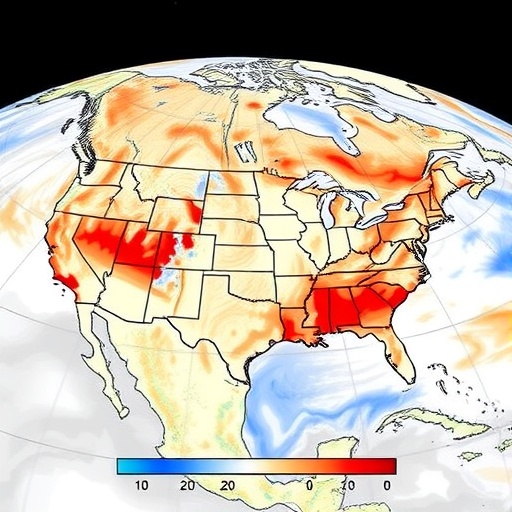
In a groundbreaking study published in Nature Communications, researchers have unveiled new insights into how the decline of anthropogenic aerosols is intensifying the weakening of the Northern Hemisphere’s Hadley circulation throughout the 21st century. This discovery provides an unprecedented understanding of atmospheric dynamics, linking human-induced aerosol emissions to fundamental changes in global climate patterns. The study meticulously dissects the intricate interactions between anthropogenic aerosols and large-scale atmospheric circulation, emphasizing the far-reaching consequences for weather systems, climate variability, and ecological balance.
The Hadley circulation, a vital driver of tropical and subtropical climate, functions as a massive atmospheric conveyor belt that redistributes heat and moisture across the globe. It facilitates the ascent of warm air near the equator and the descent of cooler, drier air at approximately 30 degrees latitude in both hemispheres. Traditionally, this circulation has maintained a relatively stable structure, but recent decades have showcased a noticeable weakening trend, with profound implications for monsoonal systems, arid regions, and mid-latitude weather patterns.
The study centers on a crucial but underappreciated factor: the modulation of Hadley circulation dynamics by anthropogenic aerosols—minute particles released into the atmosphere as byproducts of industrial activities, combustion processes, and land use changes. Aerosols have long been recognized for their role in direct and indirect climate forcing, either by scattering sunlight or altering cloud properties. However, their impact on large-scale atmospheric circulations, especially under evolving emission scenarios, has remained enigmatic.
Employing state-of-the-art climate models that integrate aerosol-cloud-radiation feedback mechanisms, the research team simulated future scenarios under varying levels of aerosol emissions consistent with global climate policy trajectories. Their simulations reveal a striking amplification of Hadley circulation weakening in the Northern Hemisphere as aerosol concentrations decline throughout the 21st century. This trend starkly contrasts with previous assumptions that reductions in aerosols would primarily yield straightforward warming effects without significantly modifying circulation patterns.
Mechanistically, the study elucidates that anthropogenic aerosols induce localized cooling effects, particularly over mid-latitude industrialized regions. This cooling generates temperature gradients that reinforce Hadley circulation strength by driving anomalous upward motions and enhancing the meridional transport of energy. As emissions diminish under intensified air quality regulations, this localized cooling wanes, weakening these reinforcing gradients and thereby accelerating circulation weakening. The diminishing aerosol-induced cooling essentially unshackles the atmospheric circulation, revealing the underlying response to greenhouse gas forcing.
Furthermore, the weakening of the Northern Hemisphere Hadley circulation involves complex feedbacks with sea surface temperature anomalies, especially in the tropical Pacific Ocean. The researchers note that diminishing aerosols disrupt previously established teleconnections between oceanic warming patterns and atmospheric cells, amplifying the decline in circulation intensity. This dual influence of aerosol reduction and ocean-atmosphere coupling intensifies the observed weakening trend beyond what greenhouse gas forcing alone would predict.
The climatic consequences of this amplified Hadley circulation weakening are multifaceted and far-reaching. A weaker Hadley circulation translates to shifts in the position and strength of subtropical dry zones, potentially exacerbating drought conditions across the Mediterranean basin, southwestern United States, and parts of Asia and Africa. Agricultural productivity in these regions could face increased uncertainty, as altered precipitation patterns challenge existing water management practices. Additionally, shifts in atmospheric circulation influence the frequency and intensity of extreme weather events, such as heatwaves and tropical cyclones, with profound implications for human societies and natural ecosystems.
Intriguingly, the findings bear pivotal relevance for understanding mid-century climate projections and developing robust adaptation strategies. By highlighting aerosol reductions as a critical modulator of circulation dynamics, the study urges climate policymakers and scientists to incorporate aerosol emission trajectories into predictive frameworks. This emphasis facilitates more accurate regional climate forecasts and informs the delicate balance between air quality improvements and climate change mitigation.
The research also addresses the broader scientific debate on the interplay between anthropogenic factors and intrinsic climate variability. The team carefully disentangles aerosol influences from natural oceanic oscillations and solar variability by utilizing ensemble model runs and statistical attribution techniques. Their robust methodology strengthens confidence in the causal relationship between human aerosol emissions and the enhanced weakening of the Hadley circulation, marking a significant advance in attribution science.
From a technical standpoint, the study leverages the latest generation of coupled atmosphere-ocean general circulation models (AOGCMs) with finely resolved aerosol microphysics schemes. This modeling sophistication enables nuanced simulation of aerosol radiative effects, cloud formation, and precipitation processes, delivering unprecedented fidelity in representing the physical processes governing Hadley circulation behavior. Additionally, the integration of observational datasets for model validation enhances the empirical grounding of their conclusions.
Beyond atmospheric science, the findings invite interdisciplinary exploration of socio-economic impacts. For instance, altered monsoonal patterns driven by circulation changes could influence water security in densely populated regions heavily reliant on seasonal rains. Ecosystem services dependent on stable climate regimes may also face disruption, underscoring the necessity for integrative climate-resilience planning that transcends disciplinary boundaries.
The study underscores a pressing imperative: as societies transition towards cleaner energy sources and curtail particulate emissions to combat air pollution, parallel efforts must anticipate and manage the unintended climate repercussions of aerosol decline. This nuanced understanding challenges the simplistic view of aerosols as pollutants with exclusively negative implications, revealing their intricate role as both climate forcings and modulators of circulation dynamics.
Encouragingly, the investigation opens new avenues for targeted climate interventions. Geoengineering proposals aiming to mimic aerosol cooling effects or modulate atmospheric circulation could draw on the mechanistic insights presented. However, the authors caution that such interventions require thorough evaluation given the complex chain of interactions and potential unintended side effects highlighted by their findings.
In sum, this seminal work by Kim, Son, Ming, and colleagues redefines the narrative around anthropogenic aerosols and atmospheric circulation in the context of 21st-century climate change. By demonstrating that declining aerosol levels amplify the weakening of the Northern Hemisphere Hadley circulation, the study challenges existing paradigms and injects nuance into climate change projections. It invites climate scientists, policymakers, and the broader community to reconsider the multifaceted implications of aerosol emission trajectories in shaping future climate dynamics.
As the global community wrestles with the dual challenges of decarbonization and sustainable development, these findings serve as a clarion call to integrate aerosol-climate interactions more explicitly into climate action frameworks. Only through such integrative approaches can humanity hope to navigate the complexities of anthropogenic climate influence and safeguard the planet’s atmospheric balance for generations to come.
Subject of Research: The impact of declining anthropogenic aerosol concentrations on the Northern Hemisphere Hadley circulation and associated climate dynamics in the 21st century.
Article Title: Declining anthropogenic aerosols amplify Northern Hemisphere Hadley circulation weakening in the 21st century.
Article References:
Kim, SY., Son, SW., Ming, Y. et al. Declining anthropogenic aerosols amplify Northern Hemisphere Hadley circulation weakening in the 21st century. Nat Commun (2026). https://doi.org/10.1038/s41467-026-69990-0
Image Credits: AI Generated


