


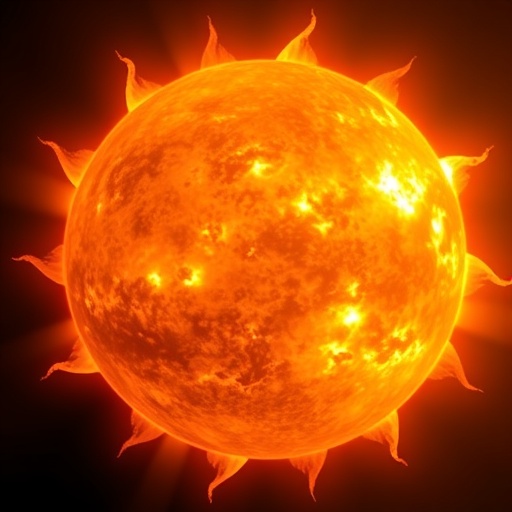
For more than four decades, astronomers have meticulously collected and analyzed data from our closest star, the Sun, leading to a remarkable discovery: the Sun’s internal structure undergoes subtle but definitive changes from one solar cycle minimum to the next. This breakthrough comes from a recent study published in the prestigious Monthly Notices of the Royal Astronomical Society, carried out by researchers from the University of Birmingham and Yale University. Drawing on an extensive dataset, the team has, for the first time, quantified shifts in the solar interior during periods traditionally thought to be quiescent, reshaping our understanding of solar dynamics.
The Sun is well known for its approximately 11-year magnetic activity cycle, swinging between phases of solar maximum—characterized by numerous sunspots and volatile magnetic phenomena—and solar minimum, when surface activity ebbs. While solar minimum was previously considered to signify a uniform, calm solar state, the new research reveals that even these quiet intervals hide significant variations deep within the solar interior. By probing beneath the Sun’s surface, scientists can now detect subtle structural fingerprints left behind by variations in magnetic activity.
Central to this investigation was the Birmingham Solar-Oscillations Network (BiSON), a global ensemble of six ground-based telescopes dedicated to monitoring oscillations in the Sun. These oscillations arise from sound waves trapped inside the solar interior, causing the Sun to gently tremble and pulsate. Helioseismology—the study of these solar vibrations—enables researchers to infer conditions deep within the star, much like seismologists studying Earth’s interior via earthquake waves. Leveraging BiSON’s unique capability to provide uninterrupted, round-the-clock data, the team analyzed four successive solar minima spanning cycles 21 to 25.
Of particular interest was the solar minimum between cycles 23 and 24, occurring around 2008–2009. This interval holds the distinction of being one of the quietest and longest minima on modern record, with dramatically reduced solar activity. Helioseismic analysis showed striking differences in this minimum compared to its three predecessors. Specifically, an amplified “helium glitch”—a distinctive signature in the sound wave data caused by the double ionization of helium—suggested a tangible alteration in the Sun’s internal structure, previously undetected.
This helium glitch is a critical diagnostic marker. As helium loses electrons and becomes doubly ionized within the Sun’s outer layers, it creates a discontinuity affecting the propagation of sound waves. Variations in this discontinuity reveal changes in temperature, pressure, and magnetic field strength. In the prolonged 2008–2009 minimum, a larger glitch indicated the Sun’s outer layers had elevated sound speeds, which correlated to higher gas pressures and temperatures but lower magnetic field strengths. Such revelations hint at a dynamic interior evolving even during apparently placid phases.
Professor Bill Chaplin, a leading helioseismologist at the University of Birmingham, emphasized the significance of these findings: “This is the first definitive measurement showing that the Sun’s internal structure isn’t static across minima but evolves subtly with each cycle.” He further noted that understanding these minute shifts could provide crucial insights into the mechanisms driving solar cycles overall, offering a window into predicting future solar activity.
The implications of this research extend beyond the realm of pure astrophysics into practical concerns on Earth. Solar activity governs space weather, encompassing phenomena like solar flares and coronal mass ejections that unleash energetic particles into the solar system. Such events can disrupt satellite communications, degrade GPS accuracy, cause power grid failures, and introduce hazards for astronauts. More accurate forecasting of solar cycles, grounded in understanding the Sun’s internal changes, could enhance preparedness for these space weather impacts.
Professor Sarbani Basu of Yale University highlighted why peering into the Sun’s “quiet” periods matters: “These minima imprint conditions that influence how magnetic activity rebuilds in subsequent cycles. Understanding this cyclical ‘memory’ will be pivotal for advancing solar and space weather prediction models.” The ability to detect and quantify such internal solar signals during minima marks a critical step in decoding the Sun’s complex magnetic evolution.
This study represents a compelling demonstration of the power and longevity of ground-based solar observation networks like BiSON. By continuously monitoring solar oscillations over decades, researchers have gained an unprecedented perspective on the star’s interior. With upcoming missions like the European Space Agency’s PLATO (PLAnetary Transits and Oscillations of stars), expected to launch in 2026, similar techniques could be extended to other Sun-like stars. This expansion holds promise for comparative stellar seismology—decoding the activity cycles of distant stars and assessing their potential planetary environments.
As the solar science community pushes forward, the integration of helioseismic data with advanced modeling will refine our understanding of the Sun’s magnetic underpinnings. The pivotal role played by long-term datasets underlines the importance of sustained investment in solar observational infrastructure. Continued multidisciplinary efforts will bridge the gap between solar interior dynamics and the space weather phenomena that directly influence life on Earth.
In sum, the discovery that each solar minimum carries a unique internal signature revolutionizes stellar physics by revealing that the Sun’s calm phases are far from uniform. Instead, they host intricate structural variations tied to magnetic field strength, gas pressure, and temperature changes beneath the surface. These variations provide crucial clues to understanding the solar dynamo—the engine driving the Sun’s magnetic cycle—and promise to enhance predictive capabilities for solar and space weather phenomena that have profound technological and societal impacts.
This research not only illuminates the hidden life of our nearest star but also opens a new frontier in astrophysics: the continuous, precise monitoring of solar internal dynamics during periods once thought uneventful. It ushers in a new era where subtle stellar oscillations allow us to probe the secret workings of stars, from our Sun to distant stellar cousins, deepening our grasp of the fundamental processes shaping our cosmic neighborhood.
Cite Scienmag News
Grant Pearson. (March 4, 2026). Four Decades of Data Reveal Unprecedented Insights into the Sun’s Inner Workings. Scienmag. https://scienmag.com/four-decades-of-data-reveal-unprecedented-insights-into-the-suns-inner-workings/
Grant Pearson. "Four Decades of Data Reveal Unprecedented Insights into the Sun’s Inner Workings." Scienmag, 4 March 2026, https://scienmag.com/four-decades-of-data-reveal-unprecedented-insights-into-the-suns-inner-workings/. Accessed 4 September 2026.
Grant Pearson. "Four Decades of Data Reveal Unprecedented Insights into the Sun’s Inner Workings." Scienmag. March 4, 2026. https://scienmag.com/four-decades-of-data-reveal-unprecedented-insights-into-the-suns-inner-workings/


