


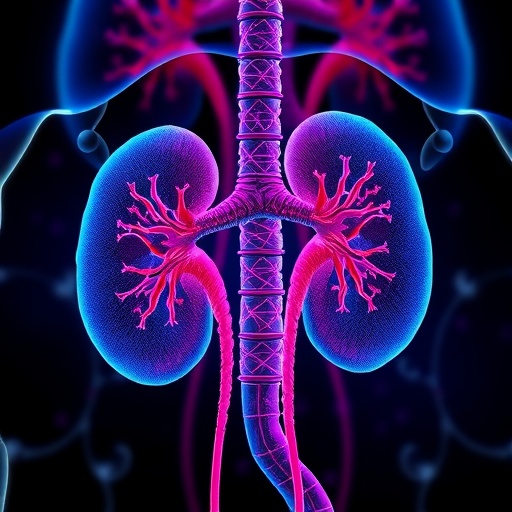
In a groundbreaking study published in Nature Metabolism, researchers have uncovered a pivotal role for early-activated extracellular matrix (ECM) proteins in orchestrating the metabolic and spatial dynamics within the kidney’s fibrotic microenvironment. Kidney fibrosis, a hallmark of chronic kidney disease (CKD), involves complex intercellular dialogue, extensive ECM remodeling, and metabolic rewiring. This intricate interplay exacerbates tissue damage and impedes repair mechanisms. Yet, until now, the influence of early ECM proteins in these pathological processes remained obscure. The team’s revelation that ECM1 acts as an early, critical regulator of kidney remodeling offers promising avenues for targeted therapeutic interventions against fibrosis.
Kidney fibrosis develops progressively, marked first by subtle changes in matrix composition followed by overwhelming ECM deposition and scarring. Traditionally, late-stage ECM alterations, including collagen accumulation, have dominated research focus. However, the early molecular signals triggering this cascade have been less understood. This new work pivots the spotlight onto ECM1—a matrix glycoprotein whose expression surges in the initial stages of kidney disease. Using global knockout mouse models, the researchers found that loss of ECM1 precipitated spontaneous fibrosis and early demise, suggesting its indispensable role in maintaining microenvironmental equilibrium.
Interestingly, ECM1 levels do not decrease but rather increase markedly in biofluids during chronic kidney disease progression. This observation, closely mirroring human pathological conditions, underscores ECM1’s potential as a biomarker for early fibrosis detection. By leveraging adeno-associated virus serotype 9 (AAV9)-mediated gene silencing and fibroblast-specific deletion strategies, the authors demonstrated that targeted ECM1 reduction significantly alleviated renal fibrotic burden. These sophisticated genetic manipulations illuminate ECM1’s dual nature: essential for homeostasis, yet capable of driving pathological remodeling when dysregulated.
At the mechanistic level, ECM1 was shown to exert its effects via the integrin α2β1 receptor, which activates the RhoC GTPase. This signaling axis culminates in the activation of Yes-associated protein (YAP), a master transcriptional co-activator regulating cell proliferation and extracellular matrix production. Deletion of ECM1 disrupted this integrin α2β1–RhoC pathway, suppressing YAP nuclear translocation and attenuating its transcriptional influence. This downregulation relieves repression by the YAP–TEA domain family member 4 (TEAD4) complex on genes critical for mitochondrial biogenesis, notably Pgc1a (peroxisome proliferator-activated receptor gamma coactivator 1-alpha).
The derepression of Pgc1a leads to enhanced mitochondrial oxidative phosphorylation (OXPHOS), which is crucial for energy production and cellular repair. This mitochondrial boost within tubular epithelial cells fosters a reparative environment opposing fibrotic progression. The study elegantly links the ECM’s mechanical cues to metabolic adaptation, underscoring a mechano-metabolic feedback loop sustaining renal tissue integrity. Through advanced spatial transcriptomics and proteomics, the researchers mapped this dynamic interplay, highlighting mitochondrial reprogramming as a cellular defense mechanism in kidney fibrosis.
A striking discovery emerges from the selective nature of this mechano-metabolic crosstalk. While YAP inactivation in fibroblasts curbs their aberrant activation and fibrogenic potential, it does not impair their mitochondrial OXPHOS. This uncoupling indicates nuanced regulatory pathways distinguishing fibroblast activation states from their metabolic demands, a distinction vital for designing precise antifibrotic therapies that preserve essential cellular functions. Such selective targeting holds promise for mitigating fibrosis without compromising tissue homeostasis.
The spatial transcriptomic data provide a powerful lens to visualize how mitochondrial reprogramming and ECM remodeling coordinate within distinct kidney compartments. This spatial heterogeneity reveals that tubule cells adapt metabolically in ways that counter injury and fibrosis, while fibroblasts modulate mechanotransduction pathways controlling their fibrogenic behavior. These insights could revolutionize how researchers and clinicians conceptualize and approach CKD, moving beyond bulk tissue assessments to microenvironment-specific interventions.
Further annotation of the ECM1/YAP/TEAD4 axis deepens understanding of how mechanical signals translate into metabolic responses. YAP’s role as a transcriptional rheostat modulating TEAD4-mediated gene repression offers a refined therapeutic target. Modulating this axis could recalibrate mitochondrial output and fibrotic gene programs, providing a dual strategy to enhance repair while limiting ECM overproduction. This mechanism reflects a broader biological principle whereby extracellular matrix integrity and cellular bioenergetics are intimately interwoven.
The study’s use of AAV9 vectors to achieve fibroblast-specific gene knockdown exemplifies the potential of viral vector-mediated gene therapy in renal diseases. By honing in on ECM1 expression within fibroblasts, the researchers circumvent broader systemic effects, reducing off-target outcomes. Such precise gene-editing strategies can pave the way for next-generation antifibrotic treatments, shifting paradigms from symptomatic management to molecularly guided repair facilitation.
This research represents a paradigm shift in how kidney fibrosis is conceptualized, emphasizing early matrix cues as drivers of disease onset and progression. While ECM1 has been previously noted in matrix biology, its central role as an orchestrator of mechano-metabolic signaling networks in CKD is a novel insight. The coupling of altered mechanical stiffness with mitochondrial adaptations opens exciting research trajectories exploring ECM-targeted therapies combined with metabolic modulators.
Moreover, the findings may have implications beyond nephrology. Fibrosis is a fundamental pathological process in many organs, including the lung, liver, and heart. The ECM1-integrin α2β1-RhoC-YAP axis identified here could represent a conserved mechanism governing tissue remodeling and metabolic reprogramming across fibrotic diseases. Future comparative studies could validate ECM1 as a universal early fibrotic biomarker and therapeutic target, broadening the impact of this discovery.
In addition to its scientific contributions, this study highlights the power of integrated omics approaches in resolving spatial and molecular complexities of chronic disease. The combination of spatial transcriptomics and proteomics allowed unprecedented resolution of cell-type-specific responses and niche-specific adaptations within the fibrotic kidney. This methodology could serve as a blueprint for dissecting similar multifaceted pathologies, fueling innovation in precision medicine.
As the kidney’s microenvironment emerges as a highly dynamic and interactive landscape, therapeutic strategies must also evolve to embrace this complexity. Targeting early ECM proteins like ECM1 offers a window of opportunity to intervene before irreversible scarring and loss of function occur. This early intervention paradigm aligns with emerging clinical needs to halt CKD progression and reduce burden on healthcare systems worldwide.
In summary, the discovery of ECM1 as a master regulator intertwining the kidney’s structural and metabolic remodeling processes marks a milestone in fibrosis research. By delineating the molecular underpinnings of ECM1’s interaction with integrins, RhoC signaling, and YAP-mediated transcriptional control, this study unlocks new therapeutic possibilities. The metabolic reprogramming of mitochondria in tubular cells as an adaptive response further enriches the mechanistic landscape, painting a holistic picture of kidney fibrosis pathogenesis.
These insights not only deepen biological understanding but also clarify potential biomarkers and drug targets that may transform CKD treatment. As fibrosis remains a major cause of morbidity and mortality globally, the translational significance of these findings is immense. By targeting the earliest modulators of ECM remodeling and their downstream metabolic circuits, clinicians may one day halt or even reverse fibrotic damage, offering hope to millions afflicted by chronic kidney disease.
The integration of mechano-metabolic signaling studies into clinical nephrology signals an exciting convergence of fields. This interdisciplinary approach, marrying bioengineering, molecular biology, and metabolism, could usher a new era of therapies tailored to the unique spatial and temporal nuances of kidney disease. As research on ECM1 and related pathways advances, the prospect of personalized, mechanism-based care for CKD patients becomes increasingly tangible and within reach.
Cite Scienmag News
Ophelia Keating. (March 3, 2026). Early Matrix Proteins Drive Kidney Fibrosis Dynamics. Scienmag. https://scienmag.com/early-matrix-proteins-drive-kidney-fibrosis-dynamics/
Ophelia Keating. "Early Matrix Proteins Drive Kidney Fibrosis Dynamics." Scienmag, 3 March 2026, https://scienmag.com/early-matrix-proteins-drive-kidney-fibrosis-dynamics/. Accessed 4 September 2026.
Ophelia Keating. "Early Matrix Proteins Drive Kidney Fibrosis Dynamics." Scienmag. March 3, 2026. https://scienmag.com/early-matrix-proteins-drive-kidney-fibrosis-dynamics/


