


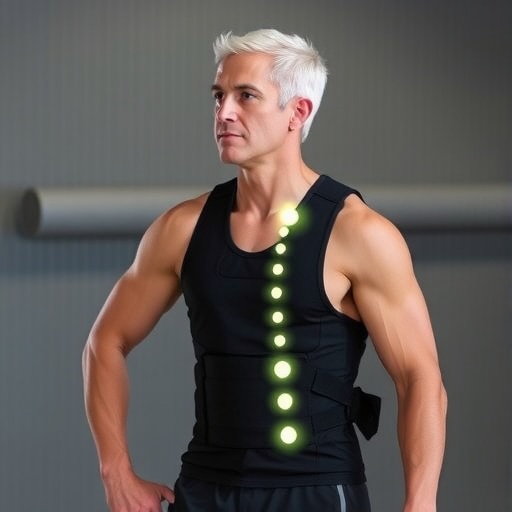
In a groundbreaking study poised to reshape weight loss approaches for older adults, researchers have uncovered compelling evidence that wearing weighted vests during weight reduction efforts can safeguard against the detrimental loss of bone mineral density (BMD)—a common and serious complication of aging and slimming down. The study, recently published in the esteemed peer-reviewed journal Frontiers in Aging, emphasizes the critical role that time spent upright plays in amplifying the benefits of weighted vest use, opening new frontiers in mitigating osteoporosis and muscle degradation amid caloric restriction.
Weight loss, while essential for combating obesity and associated metabolic disorders, often exacts a harsh toll on skeletal health, especially for the elderly. The reduction of mechanical load that accompanies shedding pounds typically triggers declines in BMD and muscle mass, escalating risks for fractures and subsequent disability. Recognizing this paradox, the researchers spearheaded by Jason Fanning, an associate professor of health and exercise science, set out to explore whether substituting lost body weight with a corresponding external load from weighted vests could counteract these physiological setbacks.
This inquiry was nested within the larger framework of Wake Forest University’s INVEST in Bone Health randomized controlled trial. Distinguished by its robust experimental design, participants were stratified into three groups: those undergoing weight loss alone, those combining weight loss with resistance training, and those incorporating weighted vests worn for at least eight hours daily alongside weight loss protocols. Advanced monitoring technologies tracked their physical activity, specifically quantifying time spent upright—either standing or stepping—as a variable potentially modulating BMD outcomes.
The findings illuminated a nuanced interaction between mechanical loading via the vest and physical posture. The group engaging in weight loss supplemented with weighted vest use demonstrated positive alterations in bone mineral density correlated with increased upright time. This contrasts sharply with the weight loss-only cohort, which exhibited declines in BMD despite similar standing or stepping activities, a pattern likely attributable to insufficient mechanical stimuli on the skeletal system. Interestingly, the group combining resistance exercise with weight loss saw no modification in BMD associated with time spent upright, suggesting resistance training itself may saturate the osteogenic stimulus or operate through distinct mechanisms.
Fanning and colleagues hypothesize that greater durations of upright activity amplify the osteogenic benefits conferred by the weighted vest by augmenting the skeletal load-bearing stimulus. Essentially, as participants stand or move while donned in weighted vests, their bones experience mechanical strain commensurate with their pre-weight loss body mass, mitigating the abrupt unloading that precipitates bone resorption. This proposition aligns with well-established mechanotransduction principles, whereby bone adapts structurally to applied mechanical forces through remodeling processes that adjust density and microarchitecture.
The study’s implications resonate profoundly in clinical and gerontological contexts. By demonstrating a feasible, non-pharmacological intervention to preserve bone and muscle tissue during necessary weight reduction, the research affirms the viability of weighted vest therapy as a complementary modality. Notably, the intervention’s simplicity enhances its translational potential; weighted vests are commercially accessible and pose minimal risk, enabling scalable application across diverse aging populations vulnerable to osteoporosis and sarcopenia.
Moreover, the research team is actively designing subsequent investigations to determine if explicitly encouraging increased movement enhances vest efficacy further. This angle acknowledges that the weighted vest alone, while beneficial, cannot substitute for the dynamic biological stimuli derived from motion. As Fanning remarked, the vest is a tool that necessitates accompanying behavioral activation—participants must be upright and mobile to fully harness the bone-preserving advantages.
Underlying these findings are critical insights into the interplay between mechanical loading, physical activity, and aging physiology. The human skeleton thrives under predictable, habitual mechanical stress; when body mass diminishes abruptly through weight loss, the absence of comparable forces signals the body to deprioritize bone remodeling investment, favoring resorption instead. Introducing weighted vests restores this biomechanical continuity, tricking the body into perceiving a consistent load environment despite actual fat and muscle loss.
Additionally, the differential impact seen in the resistance training group suggests that exercise modality nuances bear heavily on bone metabolism. Weight-bearing and resistance exercises are potent stimuli for osteogenesis, likely generating sufficient strain to saturate the bone’s adaptive capacity irrespective of upright time. This positions weighted vest usage as particularly valuable for individuals unable or unwilling to perform strenuous resistance activities, presenting an alternative pathway to preserve skeletal integrity.
This study also touches on broader metabolic considerations. Metabolic slowdown is a notorious barrier in sustainable weight loss, often precipitating weight regain. The mechanical loading from weighted vests may counteract this phenomenon by maintaining the energetic demands on musculature and skeletal structures, thereby supporting metabolic rate stability during caloric restriction. Such a mechanism aligns with the integrative physiology of the musculoskeletal system as an active metabolic organ.
Emerging from this work are important public health messages. Older adults facing the conundrum of losing fat while preserving lean mass can find hope in simple, accessible tools. However, the study underscores that passive interventions relying solely on the vest are insufficient. Active engagement—standing, stepping, moving in daily life—is indispensable to potentiate the benefits. This holistic view situates weighted vest use as a catalyst within a lifestyle paradigm encompassing movement, balance, and mechanical stimulus.
The potential for weighted vest interventions to reduce fracture risk and improve quality of life among aging populations is immense. Given that fractures often precipitate loss of independence and increased mortality in elderly individuals, strategies that fortify bone mass safely during weight loss have societal and economic ramifications extending beyond individual healthspan enhancements.
Future research avenues include delineating optimal loading parameters—vest weights, duration of use, timing in relation to activity—to maximize bone and muscle retention without adverse effects. Additionally, exploring biomechanical feedback mechanisms via advanced imaging and molecular assays could unravel precise pathways through which mechanical load transduction mediates tissue remodeling adaptations.
In tandem, integration with technological innovations such as wearable sensors and digital coaching platforms may enable personalized, real-time adherence monitoring and motivational support, ensuring users achieve requisite upright time and movement intensity. This convergence of biomedical research, engineering, and behavioral science heralds a new frontier in precision geriatric weight management.
In conclusion, this study epitomizes the kind of translational research that converts biomechanical insights into pragmatic, low-risk interventions capable of mitigating age-associated musculoskeletal decline amid weight loss. Weighted vests worn during active periods offer a pragmatic approach to preserving bone mineral density and muscle mass, countering the inadvertent harms of fat reduction in older adults. The evolving evidence underscores a fundamental truth: mechanical load and movement are inseparable pillars of skeletal health and longevity.
News Publication Date: 10-Feb-2026
Web References:
https://www.frontiersin.org/journals/aging/articles/10.3389/fragi.2026.1729001/full
References:
DOI: 10.3389/fragi.2026.1729001
Cite Scienmag News
Ophelia Keating. (March 3, 2026). Boost Bone Strength by Wearing a Weighted Vest: What Science Says. Scienmag. https://scienmag.com/boost-bone-strength-by-wearing-a-weighted-vest-what-science-says/
Ophelia Keating. "Boost Bone Strength by Wearing a Weighted Vest: What Science Says." Scienmag, 3 March 2026, https://scienmag.com/boost-bone-strength-by-wearing-a-weighted-vest-what-science-says/. Accessed 4 September 2026.
Ophelia Keating. "Boost Bone Strength by Wearing a Weighted Vest: What Science Says." Scienmag. March 3, 2026. https://scienmag.com/boost-bone-strength-by-wearing-a-weighted-vest-what-science-says/


