


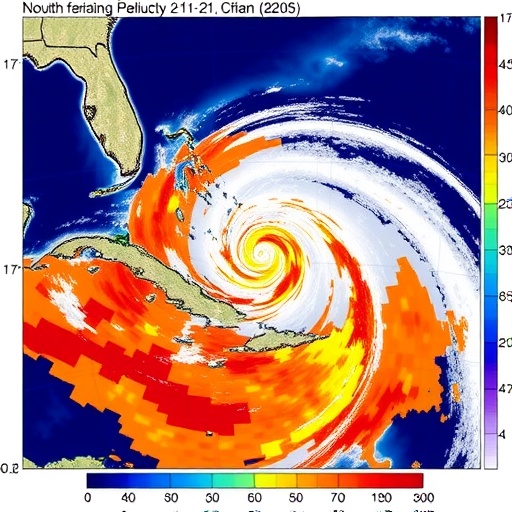
In the ever-evolving field of meteorology, the accurate forecasting of tropical cyclones remains a persistent and critical challenge, particularly when these powerful storms take abrupt and unusual turns in their trajectory. Traditional forecasting models often struggle to predict such nonlinear movements, leading to significant uncertainties and potential under-preparedness for affected regions. In a groundbreaking study recently published in Science China Earth Sciences, a team of researchers has introduced an innovative approach—orthogonal conditional nonlinear optimal perturbations (O-CNOPs)—that promises to revolutionize the predictive capabilities associated with these elusive tropical cyclone paths.
Tropical cyclones are among nature’s most destructive phenomena, characterized not only by their immense power but also by their often unpredictable paths. Rapid changes in direction, commonly known as sharp turns or track deviations, can severely impact the ability of forecasters and emergency management agencies to issue timely and accurate warnings. Conventional ensemble forecasting techniques, while useful, frequently lack the precision required to anticipate these sudden directional shifts, due largely to the complexity of atmospheric variables and nonlinear interactions at play.
The O-CNOPs method specifically aims to address these gaps by focusing on the generation of perturbations—small changes in initial conditions—that are optimally conditioned to explore the most significant uncertainties in tropical cyclone motion. Unlike traditional perturbation methods, which often lack directionally targeted information, O-CNOPs create a set of orthogonal perturbations designed to capture the nonlinear dynamics relevant to abrupt track changes. This ensures that the ensemble members generated through this approach are not only diverse but also highly reflective of the potential range of storm behaviors.
Orthogonality in this context refers to the mathematical independence between different perturbations. By enforcing this condition, the O-CNOP framework ensures that each perturbation contributes unique and non-redundant information about the system’s sensitivity under varying initial conditions. This careful balance allows for a more comprehensive exploration of possible cyclone trajectories. Essentially, the method optimizes the initial state perturbations in a nonlinear manner that respects both the physical realism and the mathematical constraints inherent in atmospheric dynamics.
The researchers implemented the O-CNOPs approach using state-of-the-art numerical weather prediction models and conducted retrospective analyses of historical tropical cyclone events that exhibited pronounced sharp turns. The ensemble forecasts generated with O-CNOPs demonstrated a remarkable ability to predict these complex paths, outperforming traditional ensemble and deterministic methods. This improvement can be attributed to the targeted nature of the perturbations, which explore the relevant unstable directions in the atmospheric state space more effectively than conventional approaches.
Moreover, the study highlighted the scalability and adaptability of the O-CNOPs framework. By structuring the perturbations orthogonally, the method naturally scales to higher-dimensional models with intricate dynamics, making it a viable candidate for integration into existing operational forecasting systems. This adaptability is crucial in light of the increasing resolution and complexity of modern weather models, which demand sophisticated techniques to harness their full predictive potential.
Another significant advantage of the O-CNOPs method lies in its conditional nature—the perturbations are calculated conditionally on specific forecast scenarios or dynamical regimes, such as those prevalent during rapid cyclone directional changes. This conditional approach provides a focused lens that zooms in on the most unstable and uncertain aspects associated with track predictions, thereby effectively reducing forecast errors linked to nonlinear dynamical processes.
The implications of improving forecast reliability for tropical cyclones extend beyond pure academic interest. A more accurate forecast of sharp track deviations enables better disaster preparedness and resource allocation, potentially saving lives and mitigating economic losses. Enhanced forecasting models contribute to timely evacuation orders, improved supply chain management for relief efforts, and optimized responses from multiple stakeholders including governments, humanitarian organizations, and local communities.
While the study’s results are promising, the researchers advocate for continued refinement and testing of the O-CNOPs method across a broader range of tropical cyclone phenomena and geographic regions. Different ocean basins exhibit diverse atmospheric circulation patterns and storm behaviors, which necessitate rigorous validation of the method’s robustness. Additionally, incorporating real-time observational data streams could further enhance the assimilation process and the accuracy of perturbation-based ensemble forecasts.
Beyond tropical cyclones, the conceptual framework of O-CNOPs holds potential applications in other meteorological challenges where nonlinear dynamics confound prediction accuracy. Such fields include severe convective storm tracking, monsoon variability forecasting, and extratropical cyclone movement predictions. The methodological principles developed herein could serve as a blueprint for advancing predictability in various complex earth system models.
The innovative approach opens exciting avenues for the future development of predictive science, spearheading a shift toward more intelligent and fine-tuned ensemble generation techniques. By explicitly accounting for the nonlinear conditional nature of atmospheric perturbations and enforcing orthogonality, the O-CNOPs method pushes the envelope of what is possible in weather forecasting, marking a significant breakthrough in the decades-long quest to master tropical cyclone dynamics.
In summary, the novel orthogonal conditional nonlinear optimal perturbations method introduced by the research team represents a transformative advancement in tropical cyclone forecasting. Its superior performance in predicting sharp storm turns addresses a notorious weakness in current meteorological prediction systems. As climate change continues to influence storm patterns and intensities, such cutting-edge tools will become increasingly vital to safeguarding vulnerable populations and improving the resilience of communities worldwide.
News Publication Date: Not provided
Web References: Not provided
References: Not provided
Cite Scienmag News
Violet Maxwell. (March 2, 2026). Revolutionizing Tropical Cyclone Forecasts: The O-CNOPs Method Boosts Ensemble Reliability for Unusual Storm Tracks. Scienmag. https://scienmag.com/revolutionizing-tropical-cyclone-forecasts-the-o-cnops-method-boosts-ensemble-reliability-for-unusual-storm-tracks/
Violet Maxwell. "Revolutionizing Tropical Cyclone Forecasts: The O-CNOPs Method Boosts Ensemble Reliability for Unusual Storm Tracks." Scienmag, 2 March 2026, https://scienmag.com/revolutionizing-tropical-cyclone-forecasts-the-o-cnops-method-boosts-ensemble-reliability-for-unusual-storm-tracks/. Accessed 3 September 2026.
Violet Maxwell. "Revolutionizing Tropical Cyclone Forecasts: The O-CNOPs Method Boosts Ensemble Reliability for Unusual Storm Tracks." Scienmag. March 2, 2026. https://scienmag.com/revolutionizing-tropical-cyclone-forecasts-the-o-cnops-method-boosts-ensemble-reliability-for-unusual-storm-tracks/


