


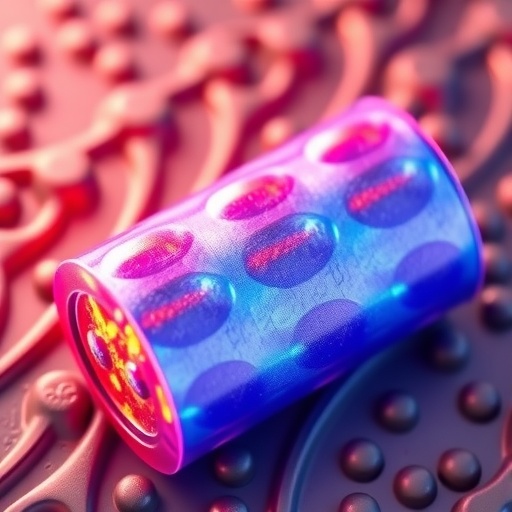
In the relentless pursuit of longer-lasting and more efficient lithium-ion batteries, nickel-rich layered oxide cathodes have emerged as a beacon of hope due to their high energy density and cost-effectiveness. However, these promising materials have been consistently plagued by chemomechanical degradation during battery cycling, particularly at high voltages. For years, the scientific community has attributed this degradation primarily to phase transitions occurring within the cathode material under the influence of cycling-induced mechanical stress. This prevailing understanding has driven the development of intricate mitigation strategies, including compositional doping, surface coatings, and elaborate microstructural designs, all aimed at stabilizing the cathode but resulting in increased synthesis complexity and cost.
A groundbreaking study recently published in Nature Energy by Eum, Ramachandran, Sun, and colleagues challenges this traditional narrative by demonstrating that it is not the high-voltage phase transitions alone which provoke cathode failure. Instead, their work reveals that microscopic heterogeneities in the cathode’s pore structure are the primary culprit driving chemomechanical instability. These nanoscale pores, inherent to the material’s microstructure, exacerbate strain accumulation and crack propagation during battery operation, culminating in rapid capacity fade and mechanical breakdown.
The researchers embarked on a meticulous investigation to unravel the origins of this microstructural non-uniformity. They identified that limited interfacial contact between solid-state precursors during the calcination stage—a crucial synthesis process—was responsible for the formation of irregular and non-uniform pores within the cathode. This insight pivoted the focus from complex chemical modifications to a more straightforward, synthesis-centric solution. By enhancing the melting rate of lithium hydroxide (LiOH), a key reagent in cathode fabrication, they significantly improved the liquid-solid contact between reactants. This enhancement facilitated a more uniform reaction, leading to cathodes with consistent pore structures and dramatically reduced heterogeneities at the nanoscale.
What sets this innovation apart is its elegance and simplicity. Unlike previous approaches that rely on doping or surface coatings, which often add layers of complexity and cost to the production process, this method achieves exceptional stability through optimized synthesis conditions. The uniformly evolved microstructure acts to dissipate mechanical strain more effectively throughout the cathode, mitigating the formation and propagation of microcracks. Remarkably, these undoped and uncoated Ni-rich cathodes maintained their structural integrity and electrochemical performance even when subjected to high-voltage cycling, where phase transitions still occurred.
This pivotal finding runs contrary to the established belief that suppressing high-voltage phase transitions is essential for long-term cathode stability. Instead, the study suggests that addressing microstructural uniformity is a more direct and pragmatic pathway to enhancing battery durability. The implications for battery manufacturing are profound: it is now possible to fabricate high-energy Ni-rich cathodes without reliance on expensive additives or elaborate coatings, significantly simplifying production while improving performance.
The team’s approach involved detailed characterization techniques, including advanced microscopy and electrochemical analysis, to correlate pore uniformity with battery longevity. Their results showed that cathodes synthesized with improved LiOH melting rates exhibited not only enhanced mechanical robustness but also negligible degradation in electrochemical capacity over extended cycling. This finding is a significant stride forward, especially for electric vehicles and grid energy storage systems, which demand batteries with both high capacity and extended lifespan.
Moreover, this research highlights the critical role of liquid-solid interfacial dynamics during the solid-state synthesis of cathode materials—an aspect often overlooked in the quest for improved battery chemistries. By tuning synthesis parameters to promote homogeneous reactions, material scientists can potentially unlock performance gains that rival or surpass those achieved through more complex modifications.
In addition to practical manufacturing benefits, the study provides a compelling mechanistic understanding of chemomechanical failures in Ni-rich cathodes. It underscores the intricate interplay between microstructure and mechanical stress during battery cycling, emphasizing how nanoscale pore distribution dictates the material’s ability to accommodate strain. By mitigating harsh strain gradients through uniform pore structures, the cathode’s resilience is fundamentally enhanced.
This discovery sets a new paradigm in cathode design philosophy. It encourages a shift from an exclusive focus on chemical composition and protective coatings toward a more holistic view that incorporates synthesis dynamics and microstructural homogeneity. Given the challenges associated with increasing nickel content in layered oxides—such as sensitivity to moisture and thermal instability—this synthesis optimization strategy offers a viable route to harness the full potential of Ni-rich materials without compromising safety or reliability.
Furthermore, the findings invite a re-examination of existing degradation models for lithium-ion batteries. The nuanced understanding of how pore structure governs chemomechanical failure may inspire the development of predictive tools that better account for structural uniformity. Such advances could accelerate the formulation of cathode materials tailored for extreme operational conditions, including fast charging and high-voltage protocols.
Critically, this new approach addresses a long-standing trade-off in battery cathodes: the desire for high capacity versus the need for enduring structural integrity. By enabling outstanding cycle life without compositional compromise, it opens avenues for batteries with higher energy density, improved cost-efficiency, and enhanced sustainability. As the demand for electrification grows worldwide, such innovations will be central to meeting performance targets while streamlining manufacturing processes.
In summary, the work by Eum and colleagues represents a paradigm shift that could reshape the development of lithium-ion battery cathodes. Their focus on uniform pore microstructures, achieved through a simple yet powerful modification of the synthesis environment, challenges entrenched assumptions about the necessity of doping and coating for Ni-rich cathodes. This novel insight into the intricate mechanics of cathode degradation not only promises longer-lasting batteries but also simplifies their fabrication, offering a promising path forward for the next generation of electrochemical energy storage technologies.
As battery technology continues to evolve rapidly, this approach exemplifies the critical importance of revisiting and refining foundational processes in material synthesis. Sometimes, the key to complex problems lies not in increasing complexity but in rediscovering simplicity. By illuminating the role of microstructural uniformity, this research opens exciting new horizons for batteries that are robust, efficient, and ready to meet the demands of tomorrow’s energy landscape.
Cite Scienmag News
Denise Maddox. (March 2, 2026). Uniform Pores Prevent Degradation in Ni-Rich Cathodes. Scienmag. https://scienmag.com/uniform-pores-prevent-degradation-in-ni-rich-cathodes/
Denise Maddox. "Uniform Pores Prevent Degradation in Ni-Rich Cathodes." Scienmag, 2 March 2026, https://scienmag.com/uniform-pores-prevent-degradation-in-ni-rich-cathodes/. Accessed 3 September 2026.
Denise Maddox. "Uniform Pores Prevent Degradation in Ni-Rich Cathodes." Scienmag. March 2, 2026. https://scienmag.com/uniform-pores-prevent-degradation-in-ni-rich-cathodes/


