


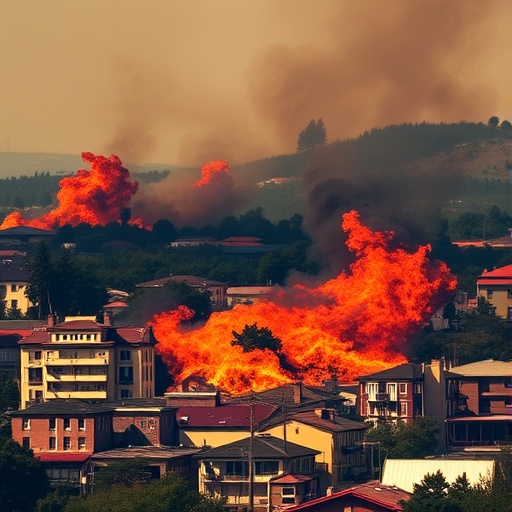
The recent study conducted by McConnell, Mueller, Burow, and their colleagues, published in Communications Earth & Environment in 2026, unveils an eye-opening reality: urban areas across the United States are increasingly grappling with significant wildfire impacts. This groundbreaking research challenges the traditional perception that wildfires predominantly threaten rural and wildland regions, emphasizing that urban landscapes are no longer immune to the devastating effects of these natural disasters. As wildfire seasons grow longer and more intense, understanding the intricate relationship between urban ecosystems and wildfire hazards becomes vital for policymakers, urban planners, and residents alike.
Historically, wildfire risk assessments have primarily focused on wildlands, where dry vegetation and climatic conditions typically create a fire-prone environment. However, the new findings reveal that the proximity of urban centers to wildland interfaces, compounded by factors such as climate change, urban sprawl, and vegetation management practices, has catalyzed the infiltration of wildfire impacts into densely populated areas. The study leverages advanced satellite imagery, meteorological data, and urban demographic analysis to map and quantify the extent of wildfire damage inflicted upon cities, bringing to light the vulnerabilities hidden in plain sight.
One of the core innovations of this research is the use of high-resolution spatial data combined with temporal fire activity patterns to delineate impacted zones within metropolitan regions. Unlike previous assessments that largely treated urban areas as fireproof or minimally affected, this study incorporates urban heterogeneity—including building density, vegetation cover, and infrastructural arrangement—into fire impact modeling. The nuanced approach allows a more precise estimation of exposure, accounting for the complex interplay between human development and fire behavior, which is essential for effective fire risk mitigation in urban settings.
The researchers also delve into the physical and socioeconomic consequences of these wildfire impacts on urban populations. Beyond the obvious threat of property destruction and evacuation costs, wildfire events exacerbate public health issues through heightened air pollution, particularly from fine particulate matter and toxic gases. Vulnerable populations, especially children, the elderly, and those with pre-existing respiratory conditions, face disproportionate health risks. The study emphasizes the critical need for enhanced emergency response protocols and healthcare preparedness tailored to the unique challenges of urban wildfire incidents.
Climate change emerges as a predominant driver intensifying wildfire risks within urban areas. Rising temperatures, prolonged droughts, and shifting weather patterns increase vegetation flammability and reduce natural moisture buffers that historically mitigated fire spread. The research highlights that even cities situated far from traditional fire-prone landscapes are witnessing climatic conditions conducive to wildfire escalation. This underscores the necessity for urban planners to incorporate climate-resilient design strategies and adaptive land-use policies that reduce wildfire susceptibility.
Wildland-urban interface (WUI) zones, where natural landscapes meet suburban or urban development, represent hotspots of wildfire vulnerability. The study identifies that rapid urban expansion into these zones without adequate fire-resilient infrastructure or vegetation management magnifies the potential for destructive fires. Homes built using combustible materials, unregulated landscaping practices, and insufficient buffer zones between structures and wildland vegetation serve as catalysts for rapid fire penetration into urban neighborhoods. Addressing these infrastructure vulnerabilities is paramount for reducing catastrophic fire outcomes.
The interplay between wildfire dynamics and urban infrastructure systems presents multidimensional challenges. Water supply networks, electrical grids, and transportation corridors are all susceptible to wildfire disruption. The study documents instances of fire-induced power outages, damage to critical water infrastructure, and road closures that hamper evacuation and firefighting activities. Such infrastructural vulnerabilities necessitate integrated urban resilience planning, where fire risk is incorporated into utility design, redundancy measures, and emergency logistics.
In addition to physical damage, the economic toll of urban wildfires is staggering. Insurance claims, property devaluation, business closures, and long-term displacement of residents impose heavy economic burdens on cities and states. The study advocates for a reevaluation of insurance policies, zoning laws, and investment in fire mitigation infrastructures such as fire-resistant building materials and community firebreaks. Economic resilience, paired with proactive risk reduction, offers a pathway to mitigate wildfire-induced urban economic shocks.
Technological advances in fire detection and monitoring offer promising tools for safeguarding urban environments. The research highlights the utility of real-time satellite surveillance, drone reconnaissance, and sensor networks that provide early warnings and dynamic fire mapping. Combining these technologies with predictive modeling enables municipalities to implement tailored evacuation plans and deploy firefighting resources more efficiently, potentially saving lives and limiting property damage.
Public awareness and community engagement emerge as critical components of urban wildfire preparedness. The study underscores initiatives that educate residents on fire-safe landscaping, evacuation procedures, and emergency resource accessibility. Building a culture of preparedness, complemented by robust communication networks during wildfire events, empowers urban populations to respond adaptively and reduces panic-induced chaos.
Another dimension explored in the research is the role of urban vegetation management. Urban green spaces, while beneficial for air quality and cooling, can become liabilities if not properly managed during wildfire seasons. The researchers recommend strategic pruning, controlled burns in urban-adjacent areas, and the use of fire-resistant plant species to mitigate fire risk without sacrificing environmental benefits. This balanced approach ensures urban sustainability alongside enhanced fire resilience.
The study also touches upon the psychological impacts of urban wildfires. Frequent exposure to wildfire threats and evacuations has been linked to increased anxiety, trauma, and community fragmentation. Mental health services tailored to fire-affected urban populations, combined with community support systems, are essential to helping residents recover and rebuild after wildfire episodes.
Importantly, McConnell and colleagues stress the necessity of cross-disciplinary collaborations to address urban wildfire challenges comprehensively. Fire scientists, urban planners, public health experts, engineers, and social scientists must work synergistically to develop integrated frameworks that enhance urban fire resilience. Such collaborative efforts are vital to innovating policies and practices that can keep pace with the evolving wildfire hazards facing urban America.
The implications of this research extend beyond the United States. As global urbanization accelerates and climate change heightens wildfire risks, cities worldwide may confront similar challenges. The insights and methodologies developed in this study provide a crucial blueprint for international urban wildfire risk assessment and management. Sharing knowledge and technological innovations across borders will be key to protecting urban populations globally.
In summary, the 2026 study by McConnell and team represents a pivotal contribution to our understanding of wildfire impacts on urban areas. It challenges outdated paradigms, highlights complex vulnerabilities, and offers a roadmap for enhancing urban resilience through technological innovation, policy reform, and community engagement. As wildfire seasons grow increasingly severe, proactive adaptation is indispensable to safeguarding the cities we call home from the relentless threat of fire.
Cite Scienmag News
Violet Maxwell. (March 2, 2026). U.S. Urban Areas Face Major Wildfire Impacts. Scienmag. https://scienmag.com/u-s-urban-areas-face-major-wildfire-impacts/
Violet Maxwell. "U.S. Urban Areas Face Major Wildfire Impacts." Scienmag, 2 March 2026, https://scienmag.com/u-s-urban-areas-face-major-wildfire-impacts/. Accessed 4 September 2026.
Violet Maxwell. "U.S. Urban Areas Face Major Wildfire Impacts." Scienmag. March 2, 2026. https://scienmag.com/u-s-urban-areas-face-major-wildfire-impacts/


