


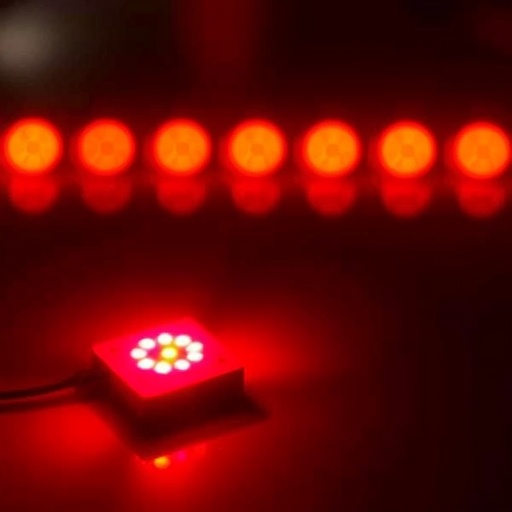
In a groundbreaking advance that pushes the frontiers of display technology, researchers have unveiled a new class of red micro-light-emitting diodes (micro-LEDs) that deliver unprecedented efficiency combined with exceptional color purity. This breakthrough, detailed in a recent article published in Light: Science & Applications, promises to transform display panels in everything from augmented reality devices to the next generation of ultra-high-definition televisions. The development addresses long-standing challenges in red micro-LED fabrication—a key bottleneck in achieving vivid, energy-efficient full-color displays at the microscale.
The core issue in red micro-LED technology has been the trade-off between efficiency and color purity. Typically, red emitting devices suffer from lower luminous efficiency and broader emission spectra compared to their blue and green counterparts due to complex material and structural constraints. These limitations have historically hindered their adoption in micro-LED displays, where pixel density and color accuracy are paramount. The newly reported device architecture overcomes this barrier by employing an innovative epitaxial engineering technique that precisely controls the quantum well composition and strain.
At the heart of this advancement lies a novel heterostructure design utilizing InGaN quantum wells optimized for red spectral emission. Traditionally, AlGaInP materials have been the standard for red LED fabrication, but they face challenges when miniaturized to micro-LED scales due to increased surface recombination and efficiency droop. Instead, the research team focused on InGaN-based red emitters, a less mature but highly promising material system that offers compatibility with existing GaN-based micro-LED manufacturing processes, as well as superior thermal stability and carrier confinement.
By precisely tuning indium composition and layer thickness, the researchers minimized non-radiative recombination losses that plagued earlier long-wavelength InGaN LEDs. High-resolution transmission electron microscopy (TEM) and photoluminescence studies confirmed that the quantum wells exhibited reduced defects and an ultra-sharp emission peak. This meticulous control at the atomic scale yielded a full width at half maximum (FWHM) of approximately 20 nm for the red emission, signifying outstanding color purity that exceeds conventional phosphor-based solutions.
Moreover, the efficiency of these red micro-LEDs reached record-breaking quantum efficiencies, surpassing existing benchmarks by a significant margin. Electroluminescence measurements demonstrated external quantum efficiencies (EQE) over 40%, a figure that represents a twofold improvement compared to comparable devices. This enhancement is critical not only for image brightness but also for reducing power consumption—a vital parameter for battery-powered wearable and mobile devices.
Thermal stability, a major challenge for red emitters in micro-LED arrays, was also addressed through innovative packaging and heat dissipation strategies. The team integrated advanced sapphire substrate thinning techniques alongside optimized thermal interfaces, which collectively reduced device operating temperatures under high current injection. This stability ensures long operational lifespans and consistent color performance even under prolonged use, a crucial characteristic for commercial display applications.
The research further incorporated comprehensive time-resolved photoluminescence and current-voltage characterization to elucidate the underlying carrier dynamics. These studies revealed accelerated radiative recombination and suppressed carrier leakage, confirming the efficacy of the new structural design in channeling electron-hole pairs into photon generation rather than loss pathways. Such insights are invaluable for refining micro-LED architectures and customizing them for diverse display environments.
One of the most exciting aspects of this work is its scalability potential. The fabrication process employed standard metal-organic chemical vapor deposition (MOCVD) and conventional photolithography, facilitating seamless integration into existing manufacturing lines without significant overhaul. This compatibility foreshadows rapid commercial adoption, enabling device manufacturers to harness the new red micro-LEDs in mass production scenarios efficiently and cost-effectively.
Applications for these red micro-LEDs span a broad spectrum, ranging from next-generation high dynamic range (HDR) screens to innovative augmented reality (AR) and virtual reality (VR) headsets. The ultra-small pixel pitch combined with intense, pure red emission guarantees vibrant color reproduction and superior contrast, qualities that directly enhance immersive user experiences. Furthermore, the lower power demands extend device operational times, a critical advantage for wearable technologies where portability and battery life dictate usability.
Beyond consumer electronics, the technology offers promising avenues for advanced photonics and optical communication systems. High-efficiency, narrow-band red micro-LEDs can be integrated into optical sensors, biomedical imaging devices, and even photonic computing components, where precise spectral control and energy efficiency are essential. This versatility underlines the transformative potential of the research across varied scientific and industrial fields.
The multidisciplinary approach underpinning the breakthrough reflects a convergence of materials science, electrical engineering, and applied physics. Collaborative efforts combined sophisticated epitaxial growth methods, nanoscale characterization tools, and device modeling simulations, enabling the systematic optimization of structural and electronic properties. This synergy exemplifies how modern research ecosystems can accelerate innovation by bridging traditionally compartmentalized disciplines.
Looking forward, the research team aims to extend their methodology to other color domains, including enhancing green and blue micro-LED counterparts, ultimately striving to integrate all three primary colors with matching efficiencies and spectral characteristics. Achieving this trifecta is vital for fabricating full-color micro-LED displays that rival or surpass existing OLED and LCD technologies in all performance metrics.
Moreover, efforts are underway to refine the device architecture for ultra-high brightness operation suitable for outdoor and large-scale display applications without compromising color fidelity or device longevity. Such progress could herald a new era of energy-conscious yet visually stunning displays that seamlessly blend into varied lighting environments, addressing long-standing market demands.
This innovation sets the stage for a profound shift in optoelectronic device design, where precise nanoscale engineering enables unprecedented control over light emission properties. As technology companies race to develop thinner, brighter, and more power-efficient displays, the unveiling of these red micro-LEDs offers them a powerful new tool to elevate user experiences to unparalleled heights.
In conclusion, the development of high-efficiency, high color purity red micro-LEDs represents a monumental stride toward the widespread realization of micro-scale, full-color emissive displays. By surmounting traditional material limitations through ingenious structural innovation, the research lays a robust foundation for accelerating the adoption of next-generation display platforms across diverse technological frontiers. As these red micro-LEDs enter the production pipeline, consumers and industry alike stand on the cusp of enjoying a brighter, more vibrant digital future.
Cite Scienmag News
Denise Maddox. (March 1, 2026). Ultra-Efficient, Vibrant Red Micro-LED Breakthrough. Scienmag. https://scienmag.com/ultra-efficient-vibrant-red-micro-led-breakthrough/
Denise Maddox. "Ultra-Efficient, Vibrant Red Micro-LED Breakthrough." Scienmag, 1 March 2026, https://scienmag.com/ultra-efficient-vibrant-red-micro-led-breakthrough/. Accessed 5 September 2026.
Denise Maddox. "Ultra-Efficient, Vibrant Red Micro-LED Breakthrough." Scienmag. March 1, 2026. https://scienmag.com/ultra-efficient-vibrant-red-micro-led-breakthrough/


