


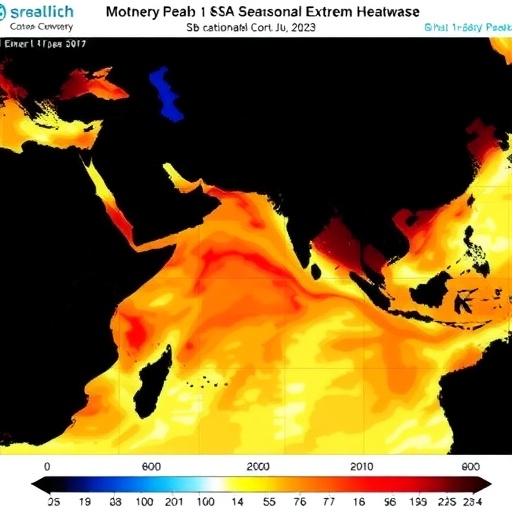
In the face of a rapidly changing climate, understanding the dynamics behind extreme weather events has become a critical scientific endeavor. A groundbreaking study by Lv, Wang, Chen, and colleagues, soon to be published in Communications Earth & Environment, sheds new light on the challenges of predicting prolonged extreme heatwaves. Their research reveals that the intricate coupling between precipitation and soil moisture significantly limits how well we can forecast such heatwaves on a subseasonal timescale—a period spanning weeks to a few months. This insight not only furthers our grasp of climatic complexities but also highlights key obstacles in weather prediction models that must be overcome to better prepare for future climatic extremes.
Extreme heatwaves, characterized by sustained periods of exceptionally high temperatures, pose serious threats to human health, agriculture, and ecosystems. The ability to forecast these episodes weeks in advance can inform mitigation strategies and emergency responses, potentially saving lives and livelihoods. The study’s central focus is the interplay between two critical hydrological variables: precipitation and soil moisture. These variables influence land-atmosphere interactions that modulate temperature extremes. However, their complex feedback loops create nonlinear dynamics that challenge traditional predictive methods, especially when attempting to extend forecasts beyond the initial few days.
Lv and colleagues performed an extensive analysis that integrated observational datasets with advanced climate models to examine how precipitation events and soil moisture conditions interact to shape the development and persistence of heatwaves. Their approach involved dissecting different phases of heatwave evolution, including initiation, intensification, and decay, and understanding how soil moisture anomalies—either excess or deficit—affect surface energy fluxes. By doing so, they identified key periods during which soil moisture exerts a dominant control over local temperature variations, effectively constraining the predictability window.
One of the pivotal findings of this research is the recognition that soil moisture acts as both a memory and a mediator within the climate system. Unlike atmospheric variables that fluctuate rapidly, soil moisture changes more slowly, retaining “memory” of prior precipitation events. This retained soil moisture influences evapotranspiration rates and surface heat exchanges, which in turn affect boundary layer dynamics and temperature regimes. When soil moisture is low due to preceding drought conditions, the reduced evaporative cooling amplifies heatwave intensity and duration, making temperature patterns more persistent but simultaneously decreasing forecast accuracy beyond certain timescales.
The study highlights that dry soil conditions serve as a feedback mechanism that intensifies heatwave persistence by limiting evaporative cooling, which is a natural thermostat for the surface. Conversely, wet soil moisture conditions provide more buffering capacity by enhancing latent heat flux, thereby moderating surface temperatures. These feedbacks are critical for subseasonal forecasting because they create a non-linear dependence of temperature extremes on prior hydrological states. Thus, models that fail to capture these soil-precipitation coupling effects tend to over- or under-predict the severity and longevity of heatwaves.
By deploying state-of-the-art modeling frameworks that explicitly include soil moisture dynamics and coupling processes, the researchers were able to better disentangle the roles of atmospheric and land surface processes. Their findings suggest that improving initial soil moisture conditions in predictive models could lead to substantive improvements in heatwave forecasts at lead times ranging from two to six weeks. This represents a crucial leap forward, as traditional weather forecasts often degrade significantly beyond the 10 to 15-day window due to chaotic atmospheric behavior.
Moreover, the implications of this study extend beyond just heatwave prediction. Understanding the feedbacks between precipitation, soil moisture, and temperature extremes informs broader climate risk assessments, including drought severity, wildfire hazards, and crop yield forecasts. Since soil moisture serves as a physical link between atmospheric conditions and terrestrial ecosystem responses, accurate representation of its state is essential for reliably anticipating the multifaceted impacts of climate variability and change.
In addition to advancing numerical weather prediction capabilities, Lv et al.’s research underscores the need for enhanced observational infrastructure. Soil moisture remains a challenging variable to measure accurately on regional to global scales. Satellite missions such as NASA’s Soil Moisture Active Passive (SMAP) and the European Space Agency’s Soil Moisture and Ocean Salinity (SMOS) provide valuable data, yet spatial and temporal resolution gaps exist. The study suggests that integrating these remote sensing data with ground-based networks can significantly bolster initial conditions for models, improving subsequent forecast skill.
Another noteworthy aspect of the research involves the heterogeneity of soil types, land cover, and vegetation, which modulate how precipitation translates into soil moisture and, subsequently, heatwave characteristics. Areas with sandy soils or sparse vegetation respond differently than those with clay-rich substrates or dense canopies, adding layers of complexity to predictive efforts. The team advocates for region-specific model parameterizations that account for local soil and vegetation traits, enhancing the realism and accuracy of subseasonal forecasts.
The study’s robust methodology also includes sensitivity experiments that simulate varying precipitation inputs and soil moisture states to isolate their individual and combined impacts on heatwave predictability. These controlled simulations reveal threshold behaviors where small changes in soil moisture can tip the system towards prolonged heat extremes. Such nonlinear tipping points are critical to recognize for early warning systems and climate adaptation planning.
Beyond theoretical insights, the findings have profound societal importance. Heatwaves are among the deadliest natural disasters globally, with rising frequency and intensity linked to ongoing climate change. Urban areas, in particular, suffer exacerbated heat stress due to the urban heat island effect combined with declining soil moisture in nearby rural landscapes. Enhanced understanding of precipitation-soil moisture interactions informs not only meteorological forecasting but also urban planning and water resource management strategies designed to mitigate heat impacts.
The authors call for a multidisciplinary approach that brings together climatologists, hydrologists, agronomists, and data scientists to further refine predictive models and to develop actionable heatwave risk maps. Cross-sector collaboration would facilitate the integration of soil moisture data into operational climate services that assist governments and industries in decision-making under increasing climate uncertainty.
Looking ahead, the research opens promising avenues for harnessing machine learning and artificial intelligence to detect early signals of soil moisture anomalies and to predict their cascading effects on heatwaves. Such approaches could complement physical models by identifying emergent patterns in large observational datasets, accelerating the development of more responsive and precise forecast tools.
In conclusion, Lv, Wang, Chen, and their team provide compelling evidence that precipitation and soil moisture coupling constitutes a fundamental constraint on the subseasonal predictability of prolonged extreme heatwaves. Their work not only enhances scientific understanding of land-atmosphere interactions but also lays critical groundwork for improving early warning systems that societies desperately need in an era of unprecedented climatic volatility. As climate change continues to push the boundaries of natural variability, research like this exemplifies the innovative science required to meet the challenge head-on.
Cite Scienmag News
Violet Maxwell. (March 1, 2026). Soil Moisture Limits Subseasonal Extreme Heatwave Forecasts. Scienmag. https://scienmag.com/soil-moisture-limits-subseasonal-extreme-heatwave-forecasts/
Violet Maxwell. "Soil Moisture Limits Subseasonal Extreme Heatwave Forecasts." Scienmag, 1 March 2026, https://scienmag.com/soil-moisture-limits-subseasonal-extreme-heatwave-forecasts/. Accessed 4 September 2026.
Violet Maxwell. "Soil Moisture Limits Subseasonal Extreme Heatwave Forecasts." Scienmag. March 1, 2026. https://scienmag.com/soil-moisture-limits-subseasonal-extreme-heatwave-forecasts/


