


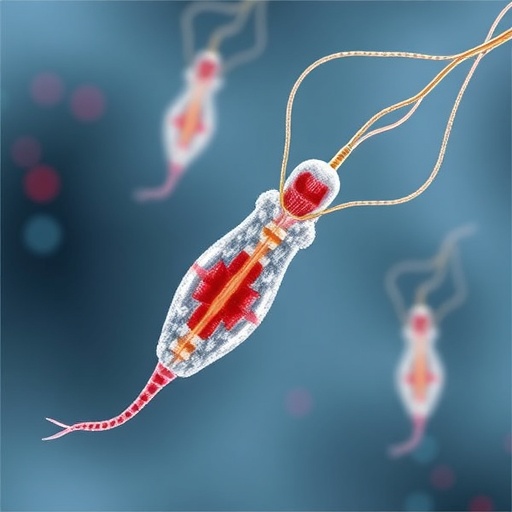
In a groundbreaking study set to reshape our understanding of sperm motility and male fertility, researchers have unveiled the intricate roles of doublet microtubule-associated tektins and their interplay with specific enzymes in regulating sperm flagellar integrity. Published in the prestigious journal Nature Communications in 2026, this research sheds unprecedented light on the molecular architecture that powers sperm motility, a critical determinant of reproductive success.
At the heart of sperm motility lies the flagellum—a whip-like appendage propelled by a highly organized cytoskeletal structure known as the axoneme. The axoneme comprises a canonical “9+2” arrangement of microtubules: nine outer doublet microtubules surrounding a central pair. This ultrastructure is stabilized and regulated by a variety of associated proteins, among which tektins have emerged as essential components. Tektins are filamentous proteins that contribute structural scaffolding, yet their exact functional roles in live flagellar dynamics and motility patterns have remained elusive until now.
Liu, Zhou, Liang, and their team embarked on a meticulous exploration of how these tektins specifically tether to the doublet microtubules and engage enzymatic regulators that modulate flagellar movement. Through the application of cutting-edge cryo-electron microscopy combined with advanced molecular biology techniques, the researchers achieved near-atomic resolution images of the axonemal doublets. These images revealed differential localization patterns of distinct tektin isoforms along the length of the flagellum, suggesting a specialized compartmentalization of structural and regulatory functions.
Moreover, the study demonstrated that tektins are not passive structural elements but active participants in recruiting enzymes that fine-tune dynein motor activity. Dynein motors, responsible for the bending and beating of microtubules, require precise regulation to ensure effective propulsion. The enzymatic partners identified include kinases and phosphatases that modulate the phosphorylation state of dynein arms and associated proteins—a critical switch that dictates the amplitude and frequency of flagellar beats.
One of the study’s hallmark findings is the differentiation of tektins into functional subsets—some isoforms serve predominantly as mechanical stabilizers, maintaining the flagellar rigidity necessary for efficient waveform generation; others act as molecular platforms integrating enzymatic signals to modulate dynamic motility responses. This differential regulation underscores a previously unappreciated complexity in the control mechanisms governing sperm motility.
Disruption of tektin expression patterns, achieved experimentally through gene knockdown and CRISPR-mediated editing, led to marked defects in flagellar morphology and motility kinetics. Spermatozoa deficient in specific tektins exhibited aberrant waveform propagation and reduced swimming velocities, phenotypes that are strongly correlated with male infertility in clinical observations. These results establish the tektin-enzyme axis as a crucial determinant of sperm functional competence.
The implications of this discovery transcend basic biology, offering novel therapeutic avenues for diagnosing and treating male infertility. Targeting the tektin-associated regulatory pathways could enable the development of fertility-enhancing drugs or contraceptives tailored to fine-tune flagellar activity. Moreover, molecular markers derived from tektin isoforms might improve the precision of sperm quality assessments in assisted reproductive technologies.
Beyond fertility, the insights into microtubule-associated tektins have broader ramifications for understanding motile cilia and flagella in diverse cell types, including respiratory and ependymal cells. The conserved nature of axonemal components suggests that the intricate regulatory mechanisms described in sperm flagella might inform treatments of ciliopathies—disorders arising from dysfunctional motile cilia associated with respiratory diseases and hydrocephalus.
Technically, the study exemplifies the power of integrating structural biology with functional assays. The use of high-resolution cryo-EM allowed the team to visualize molecular interactions that had eluded detection by traditional microscopy. Complementary biochemical analyses quantified the enzymatic activity changes in situ, linking structural observations with functional outcomes. In parallel, computational modeling of flagellar beating was employed to simulate how tektin-mediated alterations affect propulsion efficiency, providing a holistic understanding of the biophysical properties influenced by these molecules.
Intriguingly, the research uncovered species-specific variations in tektin composition and enzyme associations, hinting at evolutionary adaptations in sperm motility strategies. Such diversity may help explain why sperm from different organisms exhibit remarkable differences in swimming behavior and fertilization tactics. Future comparative studies are poised to leverage these findings to decipher evolutionary pressures shaping reproductive success across taxa.
The authors also identified previously unknown post-translational modifications on tektins that appear to regulate their interaction with enzymes. These modifications, including phosphorylation and acetylation, introduce a dynamic layer of regulation that could respond to extracellular cues, enabling sperm to modulate motility in response to signals encountered in the female reproductive tract. This adaptability is essential for optimizing fertilization efficiency under varying physiological conditions.
Furthermore, the study’s revelations about the interplay between structural proteins and enzymatic regulators challenge the long-held view of the flagellum as a relatively static organelle. Instead, it emerges as a highly dynamic, regulated machine capable of responding to molecular signals with precision. Such insights deepen our understanding of cellular locomotion mechanisms and may inspire biomimetic designs in micro-robotics and nanotechnology.
In summary, the 2026 study by Liu and colleagues marks a monumental advance in cell biology and reproductive science. By illuminating the detailed molecular choreography of doublet microtubule-associated tektins and their enzymatic partners, the research opens new frontiers in understanding sperm motility. This work not only propels fundamental science forward but also holds transformative potential for human health, fertility treatments, and beyond.
As the scientific community digests these exciting findings, ongoing and future research will undoubtedly expand on the regulatory networks and therapeutic possibilities unveiled herein. The mechanistic nuances unraveled by this study establish a new paradigm in flagellar biology and affirm the intricate connection between structure and function at the molecular level.
This breakthrough underscores the critical importance of interdisciplinary approaches in modern biology, marrying state-of-the-art imaging, molecular manipulation, and computational modeling to solve longstanding biological mysteries. The legacy of this work will resonate throughout reproductive medicine, cell biology, and bioengineering for years to come.
Liu, Q., Zhou, L., Liang, X. et al. Doublet microtubule-associated tektins and enzymes differentially regulate sperm flagellar integrity and motility.
Nat Commun (2026). https://doi.org/10.1038/s41467-026-69714-4
Cite Scienmag News
Ophelia Keating. (March 1, 2026). Tektins and Enzymes Shape Sperm Flagella Function. Scienmag. https://scienmag.com/tektins-and-enzymes-shape-sperm-flagella-function/
Ophelia Keating. "Tektins and Enzymes Shape Sperm Flagella Function." Scienmag, 1 March 2026, https://scienmag.com/tektins-and-enzymes-shape-sperm-flagella-function/. Accessed 4 September 2026.
Ophelia Keating. "Tektins and Enzymes Shape Sperm Flagella Function." Scienmag. March 1, 2026. https://scienmag.com/tektins-and-enzymes-shape-sperm-flagella-function/


