


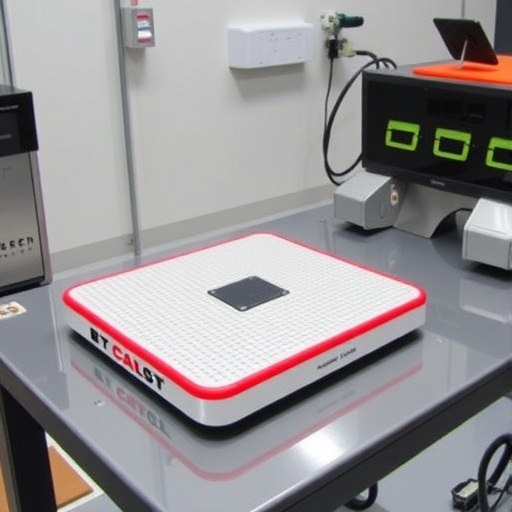
In an era where electric vehicles (EVs) stand as a linchpin for global sustainability, researchers at Tokyo Metropolitan University have made a groundbreaking advance that could accelerate the widespread adoption of EV technology worldwide. Conquering the inherent challenges of dynamic wireless power transfer (DWPT), they developed an innovative rotating tabletop apparatus designed to simulate the real-world conditions of EV wireless charging on a compact laboratory scale. This advancement promises to revolutionize how electric vehicle charging research is conducted, sidestepping the costly, space-intensive setup of traditional test tracks.
Electric vehicles are heralded as the future of eco-friendly transportation, playing an essential role in the fight against climate change. By moving away from internal combustion engines powered by fossil fuels and shifting toward EVs charged with renewable energy, carbon emissions can be significantly reduced. However, the widespread adoption of EVs continues to face two major hurdles: the high upfront cost of batteries and the limited driving range. Increased battery capacity to extend range leads to higher costs and weight, creating an impasse that researchers have tirelessly worked to overcome.
One of the most promising solutions to this dilemma is dynamic wireless power transfer (DWPT), a technology that enables EVs to charge while in motion. If perfected, DWPT could dramatically reduce the battery size needed onboard vehicles by continuously replenishing energy through coils embedded in roadways. The crux of this technology relies on transmitter coils buried under the road surface and receiver coils installed beneath the vehicle, which engage in electromagnetic power transfer without physical connectors.
Despite its elegance, practical exploration of DWPT has been limited by the need for specialized test tracks outfitted with transmitter coils, requiring extensive space and substantial financial investment. Academic institutions and smaller labs rarely have access to such infrastructure, slowing the pace of research in this critical field. Recognizing this bottleneck, the team led by Assistant Professor Ryosuke Ota engineered a rotary testing device that replicates the dynamic conditions of DWPT encountered as an EV passes over a charging coil at speed.
This novel device features a receiving unit mounted on a counterbalanced arm, which rotates smoothly via a precision servo motor. Beneath the path of the arm lies a uniquely shaped, bean-like transmitter coil designed to simulate the electromagnetic environment of roadway-embedded coils. Comprehensive electromagnetic field simulations confirmed that the rotating coil generates fields comparable in intensity and distribution to those created on traditional linear tracks, validating the effectiveness of this miniature but realistic testing platform.
Mechanical stress analysis was another critical dimension addressed by the team. Operating the device at rotation speeds replicating vehicle movement at up to 40 kilometers per hour introduced nontrivial mechanical forces, which could jeopardize precision and durability. Through rigorous evaluation, the researchers confirmed that their apparatus is structurally sound, ensuring repeatable, reliable testing conditions essential for meaningful DWPT experimentation.
A significant breakthrough achieved with the device was the ability to study the impact of misalignments between transmitter and receiver coils, a commonplace occurrence on real roads. The coupling efficiency between coils critically influences the transferred power, and previous test methods struggled to explore this variable dynamically. The rotating arm setup enabled the team to analyze varying alignments under realistic conditions, generating more comprehensive data on performance and reliability.
The prototype demonstrated a steady power transmission of around 3 kilowatts, a meaningful level that closely resembles the practical capabilities required for on-the-move charging. While similar results have been obtained on stationary benches, the introduction of dynamic motion and mechanical stress considerations marks a significant leap forward. The insights gained here pave the way for future research designs that could finally translate DWPT technology from laboratory proof-of-concept to real-world roadway applications.
The implications of this device extend beyond just testing convenience. By making DWPT experimentation accessible to smaller research facilities, it democratizes innovation and accelerates the iterative development cycles needed to refine next-generation wireless charging systems. With increasingly rigorous engineering principles embedded in the prototype, it acts as both a scientific instrument and an engineering blueprint for future scaled-up systems.
Moreover, the pellet-shaped transmitter coil design challenges conventional linear coil configurations, opening avenues for optimizing geometry to maximize power transfer efficiency and minimize electromagnetic interference. As urban roads and highways evolve, such advancements will play a vital role in integrating DWPT infrastructure seamlessly with existing transport networks.
Through the use of simulation-driven design and mechanical validation, this work addresses longstanding challenges at the intersection of electromagnetism and mechanical engineering. The team’s success underscores the importance of multidisciplinarity in advancing EV technology—a critical nexus where physics, electronics, materials science, and structural engineering converge.
As sustainable transportation becomes an urgent global priority, the technology created by this Japanese research team represents a promising beacon. Their work not only simplifies DWPT experimentation but also enhances understanding of this complex phenomenon at the system level. Such progress portends a future where EVs can truly roam indefinitely, charged wirelessly as they travel, thus overcoming the range anxiety that currently hampers mass adoption.
This research has received partial funding support from the TEPCO Memorial Foundation, highlighting the importance of continued investment in innovative clean energy infrastructure solutions.
News Publication Date: December 24, 2025
Web References: http://dx.doi.org/10.1109/OJVT.2025.3647943
Cite Scienmag News
Sloane Callahan. (February 28, 2026). Wireless Car Charging Test Platforms Now Compact Enough to Fit on a Bench. Scienmag. https://scienmag.com/wireless-car-charging-test-platforms-now-compact-enough-to-fit-on-a-bench/
Sloane Callahan. "Wireless Car Charging Test Platforms Now Compact Enough to Fit on a Bench." Scienmag, 28 February 2026, https://scienmag.com/wireless-car-charging-test-platforms-now-compact-enough-to-fit-on-a-bench/. Accessed 4 September 2026.
Sloane Callahan. "Wireless Car Charging Test Platforms Now Compact Enough to Fit on a Bench." Scienmag. February 28, 2026. https://scienmag.com/wireless-car-charging-test-platforms-now-compact-enough-to-fit-on-a-bench/


