


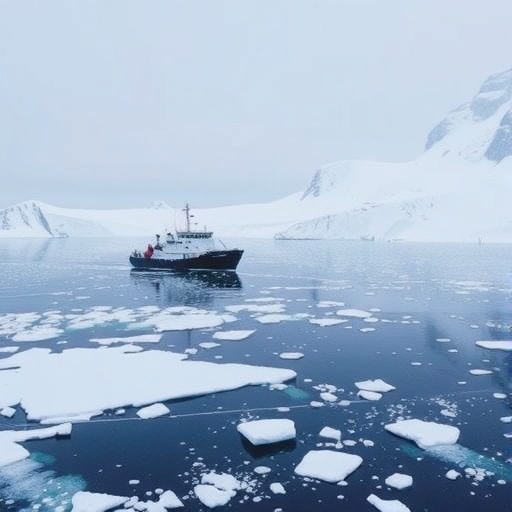
The icy waters of Antarctica’s Amundsen Sea have long captivated scientists striving to unravel the intricate web of interactions that govern global oceanic ecosystems. A recent groundbreaking study has shed crucial light on the sources of iron—a vital micronutrient that fuels marine productivity—in this remote and ecologically significant region. Contrary to longstanding assumptions that mainly attributed iron supply to surface inputs or atmospheric deposition, new findings reveal that circumpolar deepwater and subglacial freshwater from the Antarctic continental shelf dominate the region’s iron supply. This discovery promises to reshape our understanding of biogeochemical cycles and their influence on global climate systems.
Iron functions as an essential nutrient for phytoplankton, the microscopic plants responsible for the foundation of marine food webs and a significant driver of carbon sequestration in the oceans. Despite its importance, iron availability in Southern Ocean waters is notoriously limited due to its tendency to bind with particles and settle out of the water column. The Amundsen Sea, known for its high biological productivity especially during austral summer blooms, presents a natural laboratory for investigating iron supply and cycling mechanisms in a polar marine environment where melting ice shelves and continental inputs intersect.
The research team, led by Chinni et al., utilized a multidisciplinary approach combining oceanographic measurements, trace metal analyses, and modeling to quantify and trace the iron sources contributing to the Amundsen Sea’s iron budget. Their evidence indicates that the circumpolar deepwater, a relatively warm and iron-rich water mass encircling Antarctica, acts as a major conduit delivering dissolved iron to the surface waters. This subsurface inflow supplies iron continuously, fueling phytoplankton growth throughout the seasonal cycles.
Simultaneously, the study underscores the crucial role played by subglacial meltwater emerging from beneath the Antarctic continental ice sheet. This freshwater influx carries highly reactive and bioavailable iron previously locked within glacial substrates, releasing it into the marine environment where it rapidly integrates into biological uptake pathways. The researchers observed elevated iron concentrations in proximity to subglacial outflows, corroborating that the combination of ice sheet dynamics and ocean circulation dictates the regional iron biogeochemistry.
This dual-source system challenges prior paradigms that emphasized aeolian dust deposition or local sediment resuspension as dominant iron suppliers in polar seas. Instead, it situates the Amundsen Sea as a hotspot where deep ocean currents and continental glacial processes converge—each imparting distinct iron signatures and temporal variability. The study’s high-resolution sampling campaigns captured seasonal shifts aligning with ice melt phases, further linking glacial hydrology and oceanic iron cycles.
Understanding these intertwined sources of iron has profound implications for modeling Southern Ocean ecosystems under climate change scenarios. As Antarctic ice shelves undergo rapid retreat and acceleration of glacial melt increases, subglacial iron fluxes could intensify, potentially amplifying phytoplankton blooms. Enhanced biological productivity, in turn, may promote greater carbon dioxide drawdown from the atmosphere, thereby exerting feedbacks on global climate regulation.
Moreover, this research highlights the importance of circumpolar deepwater pathways in sustaining pelagic communities by transporting iron across vast spatial scales beneath the ocean surface. The coupling of deep water masses with shelf processes orchestrates nutrient availability in a delicate balance influenced by shifting currents and ice dynamics. This insight offers new avenues for integrating physical oceanography with marine biogeochemistry in predictive earth system models.
Technically, the study combined sophisticated trace metal sampling techniques with isotopic fingerprinting to distinguish iron sources. The use of subglacial water samples enabled direct characterization of meltwater inputs, while iron concentration gradients documented via CTD (conductivity, temperature, depth) casts illustrated the vertical and horizontal distribution linked to water mass movements. Radiogenic isotope ratios provided a tracer for continental crust-derived iron, validating the subglacial contribution.
The authors also employed numerical simulations to depict how seasonal melting modulates iron release rates and dispersal patterns. By simulating various melt scenarios and mixing regimes, they demonstrated the sensitivity of iron supply to ongoing climatic perturbations. These models paired with empirical measurements create a robust framework for future predictions of nutrient cycling in polar regions experiencing unprecedented environmental shifts.
This comprehensive investigation into the Amundsen Sea’s iron dynamics inevitably raises questions about the broader implications for the Southern Ocean and other glaciated continental margins worldwide. Similar processes may be operating beneath other Antarctic ice shelves and Greenland’s marine-terminating glaciers, suggesting that subglacial meltwater represents a global source of bioavailable iron previously underestimated in oceanographic research.
The elucidation of this iron delivery mechanism comes at a pivotal time, as scientists worldwide seek to decode the complex influences shaping carbon fluxes in oceans that act as major sinks for anthropogenic emissions. The synergy of deep water upwelling and glacial iron export highlighted here reinforces the concept that polar marine ecosystems are highly interconnected with cryospheric and hydrological systems—a nexus sensitive to climate-driven transformations.
In the context of ecosystem sustainability, these insights also offer understanding about the resilience and adaptability of phytoplankton communities under changing nutrient regimes. Shifts in iron availability can cascade through trophic levels, ultimately impacting higher predators dependent on a stable food source. Monitoring and forecasting the evolution of iron supply pathways will be essential for conserving Antarctic marine biodiversity amid rapid environmental change.
Looking forward, the authors advocate for expanded observational programs incorporating autonomous platforms and coordinated international efforts to capture spatial-temporal variability in iron fluxes at finer scales. Advancements in remote sensing, in situ sensing technologies, and geochemical methodologies will enhance resolution and foster new interdisciplinary collaborations bridging oceanography, glaciology, and climate science.
In summary, this pioneering study reveals the dominance of circumpolar deepwater and continental subglacial sources in supplying iron to the Amundsen Sea, revealing a complex but crucial nutrient delivery system sustaining Southern Ocean productivity. It underscores the interplay between ocean currents, ice sheet dynamics, and biogeochemical cycles—a relationship central to understanding and predicting climate-ocean interactions in a rapidly warming world.
Cite Scienmag News
Violet Maxwell. (February 27, 2026). Iron Supply to Amundsen Sea Driven by Deepwater, Ice. Scienmag. https://scienmag.com/iron-supply-to-amundsen-sea-driven-by-deepwater-ice/
Violet Maxwell. "Iron Supply to Amundsen Sea Driven by Deepwater, Ice." Scienmag, 27 February 2026, https://scienmag.com/iron-supply-to-amundsen-sea-driven-by-deepwater-ice/. Accessed 2 September 2026.
Violet Maxwell. "Iron Supply to Amundsen Sea Driven by Deepwater, Ice." Scienmag. February 27, 2026. https://scienmag.com/iron-supply-to-amundsen-sea-driven-by-deepwater-ice/


