


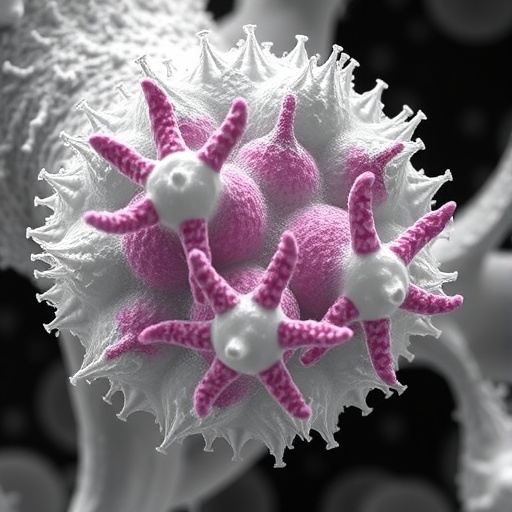
In the relentless battle against antibiotic-resistant bacteria, groundbreaking advancements continue to redefine the landscape of infectious disease treatment. A recently published study in Nature Communications unveils a novel approach leveraging chiral peptidoglycan mimics to disrupt bacterial cell wall biosynthesis, marking a significant breakthrough in pathogen intervention. This innovative strategy targets one of the most fundamental and vulnerable processes in bacterial physiology, offering a promising avenue toward combating formidable bacterial pathogens that have long evaded traditional antibiotics.
Bacterial cell walls, composed predominantly of peptidoglycan, constitute a vital protective barrier conferring structural integrity and resilience. Peptidoglycan biosynthesis involves a complex series of enzymatic steps, orchestrated meticulously to balance cell growth and division. Conventional antibiotics such as beta-lactams and glycopeptides exploit this pathway, inhibiting enzymes critical to peptidoglycan cross-linking and resulting in cell lysis. However, the emergence of resistant strains has necessitated the exploration of alternative molecular interventions capable of overriding bacterial defense mechanisms.
The heart of this research hinges on the design and synthesis of chiral peptidoglycan mimics—molecular entities that emulate the stereochemistry and functional groups of native peptidoglycan subunits with exquisite precision. Unlike many antibacterial agents that nonspecifically disrupt cellular targets, these mimics engage directly with enzymes and intermediates within the cell wall biosynthetic pathway, perturbing normal enzymatic activity through stereospecific interactions. The chiral nature of these mimics is crucial, as biological systems are inherently stereoselective, and effective mimicry requires an accurate representation of three-dimensional molecular architecture.
The authors detail a sophisticated synthetic approach to crafting these mimics, utilizing advanced stereoselective organic synthesis techniques to assemble peptidoglycan analogues faithfully representing native muropeptide fragments. By integrating both peptide and glycan components within single molecules, these constructs achieve functional mimicry of natural substrates encountered by enzymes such as transglycosylases and transpeptidases. Notably, these enzymes are central to polymerizing and cross-linking glycan strands—a dynamic that chiral mimics are designed to disrupt.
Mechanistic studies employing biochemical assays illustrate how these mimics competitively inhibit key enzymes, effectively stalling peptidoglycan polymerization. Binding affinity measurements reveal that the chiral peptidoglycan mimics exhibit remarkable selectivity, surpassing non-chiral analogues in potency. Structural analyses, including X-ray crystallography and molecular docking simulations, provide compelling evidence of mimics binding within catalytic sites, inducing conformational changes that preclude enzymatic turnover.
Importantly, the mimics demonstrate bactericidal effects across a broad spectrum of clinically relevant pathogens, including strains notoriously resistant to frontline antibiotics. In vitro susceptibility testing confirms low minimum inhibitory concentrations (MICs), highlighting their therapeutic potential. Furthermore, bacterial cultures exposed to these mimics show pronounced morphological abnormalities consistent with disrupted cell wall integrity, reaffirming the direct targeting of peptidoglycan biosynthesis.
The study also explores the pharmacokinetic and safety profiles of chiral peptidoglycan mimics in preliminary animal models. Favorable biodistribution and metabolic stability are reported, alongside minimal cytotoxicity toward mammalian cells. This suggests a promising therapeutic index and lays groundwork for future translational research aimed at clinical application.
Beyond their immediate antimicrobial function, these peptidoglycan mimics also stimulate innate immune recognition by unmasking bacterial cell wall components. This dual action potentially enhances pathogen clearance through synergistic antimicrobial and immunomodulatory effects—a feature that could revolutionize how bacterial infections are managed in clinical contexts.
The implications of this work extend into the realm of antibiotic stewardship and resistance management. As multi-drug resistant organisms continue to proliferate, novel agents capable of circumventing existing resistance mechanisms are desperately needed. By directly targeting enzymatic processes with high stereochemical fidelity, chiral peptidoglycan mimics offer an unprecedented mechanism of action that bacteria have yet to counter-evolve effectively.
Moreover, the modular nature of these mimics allows for tailored optimization, where chemical modifications could fine-tune spectrum of activity, pharmacodynamics, or resistance profiles. This adaptability positions them as a versatile platform for next-generation antibacterial agents poised for broad clinical impact.
The research further underscores the importance of integrating chemical biology, structural biochemistry, and microbiology to unravel complex biological systems and engineer effective molecular tools. Harnessing chirality as a design principle exemplifies the nuanced understanding necessary to confront sophisticated biological targets like bacterial cell wall biosynthesis.
Future studies will doubtlessly expand on the scope and refinement of chiral peptidoglycan mimics, exploring combinatorial therapeutic regimens alongside existing antibiotics or investigating targeted delivery mechanisms to enhance site-specific efficacy. Such multidisciplinary efforts could precipitate a paradigm shift in dealing with persistent and emergent infectious diseases globally.
In sum, the pioneering work by Deng, Zou, Zeng, and colleagues heralds a new class of antimicrobial agents centered on chiral molecular mimicry of peptidoglycan structures. Through strategic disruption of bacterial wall biosynthesis, these agents embody a powerful and innovative approach to pathogen intervention, potentially rewiring the battle against bacterial infections for decades to come.
Cite Scienmag News
Kristina Jarvis. (February 27, 2026). Chiral Peptidoglycan Mimics Disrupt Bacterial Wall Formation. Scienmag. https://scienmag.com/chiral-peptidoglycan-mimics-disrupt-bacterial-wall-formation/
Kristina Jarvis. "Chiral Peptidoglycan Mimics Disrupt Bacterial Wall Formation." Scienmag, 27 February 2026, https://scienmag.com/chiral-peptidoglycan-mimics-disrupt-bacterial-wall-formation/. Accessed 6 September 2026.
Kristina Jarvis. "Chiral Peptidoglycan Mimics Disrupt Bacterial Wall Formation." Scienmag. February 27, 2026. https://scienmag.com/chiral-peptidoglycan-mimics-disrupt-bacterial-wall-formation/


