


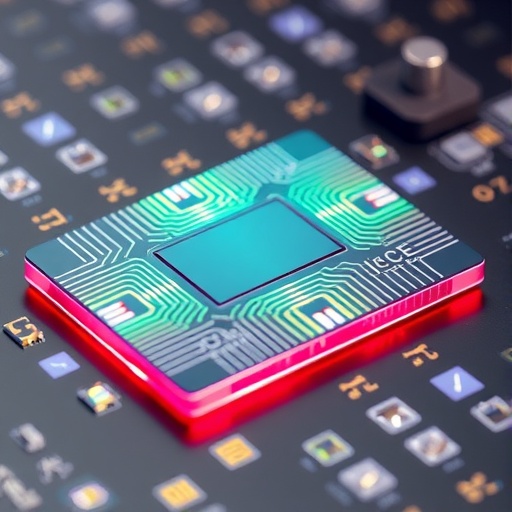
In the relentless pursuit of miniaturization, the frontier of electronic devices has extended to scales where the arrangement of individual atoms dictates functionality. As devices increasingly rely on atomically thin components, even the most subtle imperfections within these materials can have profound effects on their performance. Researchers at Rice University have now uncovered a class of elusive defects within a widely utilized two-dimensional insulating material, hexagonal boron nitride (hBN), revealing how these hidden flaws can trap electrical charges and critically degrade device reliability.
Hexagonal boron nitride, celebrated for its atomically smooth surface, chemical inertness, and excellent insulating properties, has become a foundational element in advanced nanodevices. Its role is pivotal in the construction of heterostructures—complex stacks of diverse two-dimensional materials—used in cutting-edge transistors, photodetectors, and quantum technologies. Yet, Rice University scientists have demonstrated that hBN can harbor minute structural anomalies known as stacking faults. These long, narrow misalignments sporadically embedded within the lattice are reminiscent of creases in a clean stack of papers and can slip past standard detection methods used in material inspections.
The investigators employed a meticulous experimental approach, initially exfoliating thin hBN flakes from bulk crystals via adhesive tape—a standard procedure responsible for transferring monolayer to few-layer sheets onto substrates such as silicon wafers coated with silicon dioxide. Recognizing that this preparation might introduce mechanical bending, the team hypothesized that such handling could inadvertently induce stacking faults. To verify this, they conducted comparative imaging of the same flakes before and after transfer, scrutinizing their structural integrity with various microscopy techniques.
Traditional optical microscopes and atomic force microscopy (AFM) presented the hBN flakes as pristine, flat, and devoid of defects. However, these conventional modalities proved insufficient for detecting subtle lattice imperfections at the atomic scale. The breakthrough came with the application of cathodoluminescence spectroscopy—an advanced technique in which an electron beam excites the material, causing it to emit characteristic light that can be mapped with high spatial resolution. By exploiting this method at Rice’s Shared Equipment Authority, the team visualized bright, ultranarrow fault lines within the hBN flakes, faults that had eluded prior observational efforts.
This cathodoluminescent signature emanates from excitons—quasiparticles formed by electron-hole pairs bound by electrostatic forces—that accumulate near the stacking faults. Notably, the intensity of these emissions intensifies in thicker hBN flakes, suggesting that fault formation is influenced by layer number. The presence of these stacking faults correlates strongly with localized charge trapping, manifesting as microscopic pockets of electric charge that compromise the dielectric uniformity of hBN. Consequently, these faults precipitate an earlier onset of dielectric breakdown, whereby the insulating barrier fails and allows electronic leakage at voltages significantly lower than the pristine material’s threshold.
Such hidden defects have pronounced implications for device reliability and consistency. Two ostensibly identical devices patterned from nominally the same hBN batch could exhibit drastically different electrical behaviors if stacking faults are present in one but absent in the other. The breakthrough study from Rice University thus illuminates a path toward preemptively identifying and circumventing these charge traps, thereby enhancing the performance and uniformity of future ultra-thin electronics.
By synergistically integrating electron microscopy, cathodoluminescence mapping, and nanoscale force measurements, the research team devised an effective methodology capable of detecting these nano-scale faults with unprecedented sensitivity. This approach not only advances the fundamental understanding of hBN’s material properties but also establishes a vital quality control framework applicable across a broad spectrum of layered two-dimensional materials critical to next-generation electronics.
The study’s findings underscore the intricacies of atomically precise material engineering, emphasizing that achieving flawless two-dimensional crystals entails more than just chemical purity—it demands rigorous structural integrity down to the atomic scale. These insights herald a new era for ultra-thin electronics, where every atomic misalignment must be accounted for to realize devices that are both powerful and reliable.
This research was generously funded by notable institutions, including the U.S. Army Research Office and several prestigious Japanese scientific organizations, reflecting the global significance of advancements in nanomaterials technology. The interdisciplinary collaboration showcased here bridges fundamental materials science with applied nanoengineering, positioning hBN and similar insulators as keystones for future electronic architectures.
As the semiconductor industry inches closer to physical limits set by atomic dimensions, innovations like this provide the essential diagnostics to maintain material excellence. The ability to “see” and understand hidden defects preemptively will not only prevent premature device failure but also accelerate the development of technologies that leverage the exotic properties of two-dimensional materials.
With the rapid expansion of quantum devices and other nanoscale applications, researchers anticipate that this method will become a standard tool in materials characterization labs worldwide. Its utility encompasses a vast palette of layered materials, enabling scientists to finely tune device fabrication processes and push the envelope of miniaturization without sacrificing reliability.
The revelations from Rice University provide a compelling reminder: in the race to smaller and more powerful electronics, mastering the atomic landscape is paramount. The discovery and characterization of stacking fault charge traps in hBN mark a pivotal advancement, one that may well shape the fabric of nanoelectronics for years to come.
News Publication Date: February 26, 2026
Web References: https://pubs.acs.org/doi/10.1021/acs.nanolett.5c06347
Keywords
Two dimensional materials, Materials, Material properties, Excitons, Dielectrics, Microscopy, Spectroscopy, Weak force, Electric charge
Cite Scienmag News
Denise Maddox. (February 26, 2026). Innovative Method Detects Hidden Flaws, Enhancing Reliability of Ultrathin Electronics. Scienmag. https://scienmag.com/innovative-method-detects-hidden-flaws-enhancing-reliability-of-ultrathin-electronics/
Denise Maddox. "Innovative Method Detects Hidden Flaws, Enhancing Reliability of Ultrathin Electronics." Scienmag, 26 February 2026, https://scienmag.com/innovative-method-detects-hidden-flaws-enhancing-reliability-of-ultrathin-electronics/. Accessed 6 September 2026.
Denise Maddox. "Innovative Method Detects Hidden Flaws, Enhancing Reliability of Ultrathin Electronics." Scienmag. February 26, 2026. https://scienmag.com/innovative-method-detects-hidden-flaws-enhancing-reliability-of-ultrathin-electronics/


