


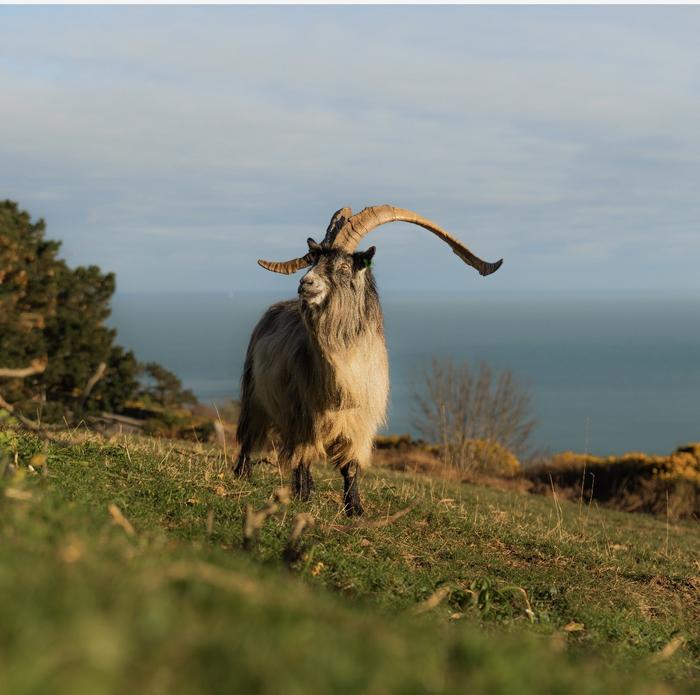
New research unravels an extraordinary genetic lineage connecting Ireland’s present-day Old Irish Goat with its ancestors from over 3,000 years ago. This rare indigenous breed, deeply interwoven with Ireland’s agricultural history, now stands as a living testament to millennia of animal husbandry practices dating back to the Late Bronze Age. The study, a collaborative effort spearheaded by University College Dublin alongside Queen’s University Belfast and international researchers, leverages advanced biomolecular techniques to piece together this surprising continuity that reshapes the narrative of Ireland’s pastoral past.
The investigation centered on goat skeletal remains excavated from two key archaeological sites in Northern Ireland: Haughey’s Fort in County Armagh, dating from roughly 1100 to 900 BCE, and the medieval town of Carrickfergus in County Antrim. These specimens represent the oldest known goat remains excavated within Ireland. Through rigorous radiocarbon dating complemented by genetic and proteomic analyses, researchers confirmed that these Late Bronze Age animals share the closest genetic ties with today’s critically endangered Old Irish Goat population.
One of the groundbreaking methodologies employed was ZooMS (Zooarchaeology by Mass Spectrometry), a protein fingerprinting technique that identifies species based on minute traces of collagen preserved in ancient bones. This approach overcomes the longstanding challenge in archaeological contexts where distinguishing between goat and sheep remains is notoriously difficult, given their morphological similarities. Once species were definitively identified, ancient DNA was meticulously extracted and sequenced, allowing genomic comparisons against a global database encompassing hundreds of modern goat breeds.
The results revealed a remarkable genetic affinity between the ancient samples and the modern Old Irish Goat, indicating a genetic continuity—unbroken for over three millennia—within Ireland. This discovery firmly positions the Old Irish Goat as a living remnant of Ireland’s agricultural past, linking modern populations directly to their ancestral inhabitants who roamed the island during the Late Bronze Age. Additionally, genomic data from medieval goats displayed more genetically diverse profiles, suggesting a more complex and heterogeneous goat population in historical Ireland compared to the present-day bottlenecked population.
The contemporary Old Irish Goat population is critically endangered, exhibiting significant signs of inbreeding due to a severe population contraction in recent decades. This genetic bottleneck contrasts markedly with the extensive genetic diversity observed historically, indicating that current vulnerabilities are a recent, anthropogenic phenomenon rather than an intrinsic feature of Ireland’s goat lineages. This finding underscores an urgent conservation imperative to preserve this irreplaceable genetic heritage before it vanishes.
Beyond the laboratory and genomic data, the Old Irish Goat’s significance extends deeply into Ireland’s cultural and folkloric fabric. Historically known as ‘an Gabhar Fiáin’ or the wild goat, these animals have long existed in small feral herds. They embody attributes such as resilience and wisdom, surviving on marginal land and providing nutrient-rich milk to resourceful rural farmers. Unlike cattle, which dominate Ireland’s mythic traditions, goats tend to feature prominently only in localized customs, place names, and seasonal festivals, most famously in the annual Puck Fair in Killorglin, County Kerry. This ancient festival venerates a captured goat crowned as “King Puck,” symbolizing the profound connection between the animal and Irish communal life.
The research illuminated novel perspectives on Ireland’s agricultural heritage by validating, on a molecular level, what folklore and historical records have intimated for centuries—the Old Irish Goat’s deep roots in the Land of Éire. Lead authors highlight the multi-disciplinary approach combining genetics, proteomics, and archaeology as transformative, granting unprecedented insight into the biological and cultural continuum maintained by this resilient breed.
From a technical vantage, this work exemplifies the power of ancient biomolecules in elucidating not just species identification but evolutionary trajectories and population dynamics across millennia. Through sequencing, the researchers unveiled phylogenetic relationships that recalibrate previous assumptions about livestock management in prehistoric and medieval Ireland. These insights challenge the presumption rooted in sheep-centric archaeological interpretations and advocate for a more nuanced understanding of goat husbandry’s role in ancient economies.
The cross-institutional collaboration further emphasizes the necessity of integrating diverse scientific disciplines—including archaeology, genomics, and proteomics—to approach questions that have long eluded definitive answers. This synergy allowed the research team to navigate the complexities of degraded ancient DNA, overcome contamination impediments, and resolve taxonomic uncertainties in archaeological faunal assemblages.
The findings have potent implications for biodiversity conservation, sustainable agriculture, and heritage preservation. They advocate for targeted protection strategies for the Old Irish Goat, not only as a scientific priority but as a cultural imperative. Conserving this breed safeguards a “living genetic archive” of Ireland’s early farming traditions and enriches the biological tapestry of the island’s fauna.
Moreover, the study paves the way for revisiting other poorly understood elements of Ireland’s prehistoric and medieval archaeogenetic records. The researchers envision future biomolecular analyses unveiling further hidden chapters in Ireland’s animal and agricultural history, potentially revealing a far richer and more complex story than currently grasped.
Tragically, the study also serves as a poignant tribute to Dr. Judith Findlater of Queen’s University Belfast, whose untimely passing before publication underscores the personal dedication behind this landmark research. Her pioneering PhD work on medieval Carrickfergus exemplified the meticulous scholarship fundamental to these breakthroughs.
In essence, this research not only charts an ancient lineage within Ireland’s domestic goats but also reignites appreciation for the often-overlooked species that contributed vitally to Ireland’s environmental and cultural landscapes. As scientific techniques continue to evolve, such revelations highlight the intricate connections linking past and present organisms, peoples, and traditions.
News Publication Date: 25-Feb-2026
Web References:
10.1016/j.jas.2026.106516
Cite Scienmag News
Courtney Benton. (February 26, 2026). From the Late Bronze Age to the Present: The Old Irish Goat Embodies 3,000 Years of Irish Heritage. Scienmag. https://scienmag.com/from-the-late-bronze-age-to-the-present-the-old-irish-goat-embodies-3000-years-of-irish-heritage/
Courtney Benton. "From the Late Bronze Age to the Present: The Old Irish Goat Embodies 3,000 Years of Irish Heritage." Scienmag, 26 February 2026, https://scienmag.com/from-the-late-bronze-age-to-the-present-the-old-irish-goat-embodies-3000-years-of-irish-heritage/. Accessed 4 September 2026.
Courtney Benton. "From the Late Bronze Age to the Present: The Old Irish Goat Embodies 3,000 Years of Irish Heritage." Scienmag. February 26, 2026. https://scienmag.com/from-the-late-bronze-age-to-the-present-the-old-irish-goat-embodies-3000-years-of-irish-heritage/


