


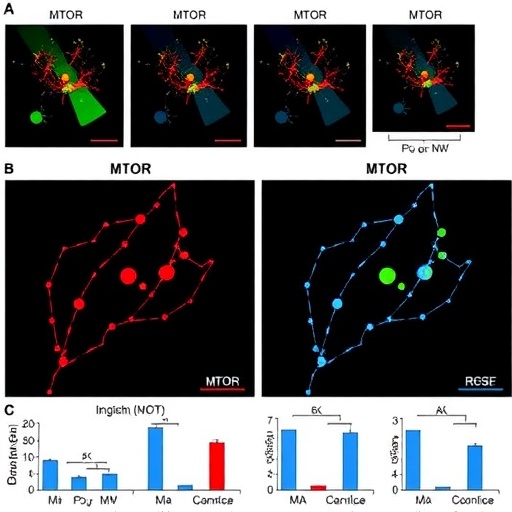
In a groundbreaking advancement in our understanding of sepsis, researchers have unveiled the intricate role of context-specific genetic variation in the MTOR gene in regulating immune cell communication during pneumonia-associated sepsis. This discovery not only expands our grasp of sepsis pathophysiology but also hints at innovative therapeutic strategies capable of modulating immune responses during severe infections. Sepsis, a life-threatening condition rooted in dysregulated host responses to infection, continues to challenge clinicians with high mortality rates and limited targeted treatments. The newly published study in Nature Communications meticulously dissects how subtle differences in MTOR gene regulation can dramatically reshape the interplay between neutrophils and T cells, key players in the immune system’s arsenal against pneumonia.
Central to this investigation is the mammalian target of rapamycin (mTOR) pathway, a master regulator of cellular metabolism, growth, and immunity. MTOR functions as a critical signaling hub within immune cells, translating environmental cues into appropriate functional responses. By focusing on genetic variants that modulate MTOR expression and activity specifically in the context of sepsis, the researchers have elucidated how these variations blunt immune cell crosstalk essential for pathogen clearance and resolution of inflammation. The nuances uncovered underscore the delicate balance required for an effective immune defense, where either hyperactive or insufficient signaling can precipitate immune paralysis or harmful hyperinflammation.
The team employed advanced genomic analyses, including single-cell RNA sequencing and epigenomic profiling, to map the landscape of regulatory variation within immune cells isolated from patients suffering pneumonia-induced sepsis. These cutting-edge methodologies enabled the identification of rare regulatory polymorphisms influencing MTOR transcription and downstream signaling cascades. The analysis revealed that certain regulatory variants diminish MTOR expression in neutrophils, which in turn limits their ability to orchestrate effective communication with T cells. Neutrophils, renowned for their rapid response to infection, thus become less capable of activating T cell responses critical for adaptive immunity, highlighting a fundamental roadblock in the host defense against pneumonia pathogens.
Functional assays further validated that neutrophils carrying these MTOR regulatory variants exhibited depressed cytokine secretion profiles and impaired expression of co-stimulatory molecules key for T cell activation. This immunological dampening effect translated into a measurable deficit in T cell proliferation and cytokine production—hallmarks of a robust adaptive immune response. These findings illuminate how genetic heterogeneity in immune regulation can directly influence clinical outcomes, providing a possible genetic explanation for the variability in sepsis severity and mortality observed across patient populations.
Importantly, the study elucidates how the temporal and cellular context of MTOR regulation shapes immune dynamics. The researchers demonstrated that the impact of regulatory variants is contingent on the inflammatory milieu characteristic of pneumonia-associated lung infection, implying that the effects of such genetic variability might be masked or unmasked depending on disease context. This observation stresses the significance of studying gene-environment interactions rather than isolated genetic effects, particularly in multifactorial diseases like sepsis where immune responses are exquisitely sensitive to fluctuating microenvironments.
Mechanistically, the authors propose that reduced MTOR signaling in neutrophils cripples their metabolic reprogramming and effector functions, which are essential triggers for recruiting and activating T cells. The diminished neutrophil-T cell crosstalk undermines the generation of effective immunological memory and pathogen clearance, setting the stage for persistent infection and systemic inflammation. In this light, MTOR emerges not only as a metabolic regulator but as a pivotal node modulating intercellular communication during immune activation and resolution phases of sepsis.
From a therapeutic perspective, these insights open avenues for precision medicine approaches targeting MTOR signaling pathways. The study suggests that pharmacological modulation of MTOR activity—potentially tailored to the patient’s genetic landscape—could restore proper immune cell crosstalk and mitigate sepsis progression. Given that mTOR inhibitors are already clinically approved for other indications, repurposing or adjusting their use in sepsis could accelerate the translation of these findings into clinical realities. Conversely, strategies to boost MTOR signaling in cases where genetic variants suppress its expression may prove equally valuable in restoring immune competency.
This research also underscores the importance of incorporating genetic screening into sepsis patient stratification frameworks. Identification of MTOR regulatory variants as biomarkers could refine prognosis predictions and personalize therapeutic regimens. As sepsis remains a heterogeneous syndrome influenced by host genetics, pathogen characteristics, and timing of intervention, integrating multi-omic data will be essential for optimizing patient outcomes in the age of precision immunotherapy.
While promising, the study also calls for caution in translating these findings to broad clinical practice. The complexities of MTOR’s roles across different immune cell subsets and tissues necessitate a nuanced understanding of dosing, timing, and patient selection for any MTOR-targeted intervention. Further research into downstream signaling networks and compensatory pathways will be crucial to circumvent potential adverse effects of modulating this central hub excessively.
Beyond the immediate implications for pneumonia-associated sepsis, this work highlights the broader principle that gene regulation, rather than mere gene sequence variation, plays a crucial role in immune modulation. The field of immunogenetics must therefore consider regulatory elements—enhancers, promoters, and epigenetic marks—as integral contributors to disease phenotypes, moving beyond traditional single-nucleotide polymorphism analysis.
Moreover, the findings underscore the interplay between innate and adaptive immunity at a molecular level. Neutrophils, traditionally seen as short-lived and more innate in function, are shown to influence the adaptive arm by modulating T cell activation through mTOR-dependent pathways. This concept challenges existing paradigms and calls for revisiting immune cell classification and communication in the context of infection and inflammation.
Future investigations inspired by this study may look into whether similar context-specific genetic regulation mechanisms operate in other forms of sepsis, or in chronic infectious and inflammatory diseases. Understanding the universality of MTOR’s regulatory role across different pathologies could broaden therapeutic horizons and unravel new dimensions of immune system complexity.
The study’s pioneering use of multi-modal single-cell technologies illustrates the power of integrating genomic, transcriptomic, and epigenomic data to decode the multilayered regulation of immune responses. Continued advances in these technologies promise to uncover even more subtle regulatory variants and their functional consequences, paving the way for a deeper understanding of human immunity at an unprecedented resolution.
In summary, this landmark research illuminates the critical role of context-specific regulatory genetic variation in modulating the mTOR pathway, revealing how such variation disrupts neutrophil-T cell interactions during pneumonia-associated sepsis. By bridging genetic variation with immune cell signaling and clinical disease manifestations, the study propels the field forward towards more personalized and precise approaches to managing sepsis — a condition desperately in need of innovative therapeutic strategies.
Cite Scienmag News
Audrey B. (February 26, 2026). Genetic Variation in MTOR Weakens Immune Cell Crosstalk. Scienmag. https://scienmag.com/genetic-variation-in-mtor-weakens-immune-cell-crosstalk/
Audrey B. "Genetic Variation in MTOR Weakens Immune Cell Crosstalk." Scienmag, 26 February 2026, https://scienmag.com/genetic-variation-in-mtor-weakens-immune-cell-crosstalk/. Accessed 29 August 2026.
Audrey B. "Genetic Variation in MTOR Weakens Immune Cell Crosstalk." Scienmag. February 26, 2026. https://scienmag.com/genetic-variation-in-mtor-weakens-immune-cell-crosstalk/


