


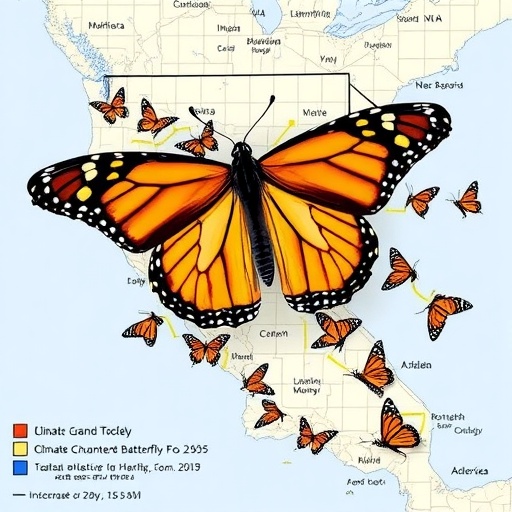
Climate change is emerging as a formidable disruptor to one of nature’s most mesmerizing spectacles: the mass migration of monarch butterflies. A new study published in the open-access journal PLOS Climate on February 25th, conducted by researchers at the National Autonomous University of Mexico, reveals that the suitable habitat for monarch butterflies during their arduous migratory journey is expected to shift significantly southward due to changing climatic conditions. This shift threatens to fragment the butterflies’ migration pathways, potentially transforming their well-known seasonal movements into fragmented, resident populations.
Every year, millions of monarch butterflies (Danaus plexippus) undertake an extraordinary migration, spanning thousands of kilometers. These butterflies travel from breeding grounds scattered across Canada and the United States to special overwintering sites nestled in the mountains of central Mexico. This behavior is both ecologically essential and culturally significant, symbolizing resilience and continuity in the natural world. Yet, the monarch’s journey is increasingly imperiled. Declining population numbers have alarmed conservationists, with threats stemming from habitat degradation, parasitic infestations, and the dwindling availability of crucial food plants.
Central to monarch survival is their specialized relationship with milkweed plants of the genus Asclepias. These plants provide the necessary substrate for egg-laying, larval food, and defensive chemical compounds that protect both caterpillars and adult butterflies from predators. Disruptions to the distribution or availability of milkweed thus directly jeopardize monarch reproduction and survival. Climate change, by altering temperature and precipitation patterns, stands poised to reshape the landscape of milkweed availability across North America, influencing the monarch’s migratory rhythms and success.
To quantitatively assess these impacts, the research team utilized advanced computer modeling techniques to predict the distribution of suitable habitats for monarch eggs, larvae, and tropical milkweed plants within Mexico across future timeframes—namely 2030, 2050, and 2070. The models integrated climatic variables, biological data, and environmental conditions, effectively mapping areas of low, medium, and high suitability for monarch reproduction along migratory routes. Findings indicate a concerning decline in optimal habitat availability, ranging from 8% to as much as 40% by 2070. Notably, this loss corresponds with a marked southward shift in suitable habitat zones.
The spatial reconfiguration revealed by the study carries significant ecological ramifications. As optimal egg-laying sites and food resources become concentrated further south, existing migratory corridors will become increasingly fragmented. Such fragmentation could hinder the capacity of monarchs to complete their traditional north-to-south migratory loops, elevating the energetic costs of migration and potentially encouraging some populations to adopt more sedentary, resident lifestyles. This alteration in migratory behavior would have profound consequences for the monarch’s genetic diversity, ecosystem roles, and overall survival.
Underpinning the southward habitat shift are two primary drivers: climate change itself, which modifies temperature and precipitation regimes, and shifts in the geographic range of milkweed plants in response to these changing conditions. As climate envelopes move, milkweed species may no longer thrive in their historical ranges, forcing monarchs to adapt to new environments or face dwindling reproductive success. The cascading effect highlights the intricate interdependencies within ecosystems and the vulnerability of complex migratory behaviors to climate perturbations.
The study underscores the urgent need for coordinated conservation strategies that transcend national borders. Monarch butterflies navigate multiple jurisdictions on their migratory journey, requiring international collaboration to safeguard their habitats and migration corridors. This is particularly critical given that the projected shifts place the highest quality habitats increasingly farther from the Mexico-U.S. border, complicating access for monarchs originating in northern latitudes. Conservation efforts must therefore consider both current and future habitat distributions shaped by climate change scenarios.
Importantly, the authors emphasize that while the monarch species itself may not face immediate extinction threats under climate change projections, the migratory phenomenon that defines it is at substantial risk. The disruption of migratory pathways can erode the ecological and evolutionary benefits of migration, such as gene flow and population dispersal. Moreover, increasing energy demands for longer or more difficult migrations could increase mortality rates, thereby exacerbating population declines.
To predict these future scenarios, the research employed robust observational study methodologies coupled with statistical climate projections. By analyzing intersecting climatic, biological, and environmental suitability parameters, they created a comprehensive model that captures the nuanced interactions influencing monarch habitat viability. This approach demonstrates the power of integrating ecological data with climate science to foresee and address biodiversity challenges.
The implications of these findings resonate broadly across conservation biology and climate adaptation fields. Migratory species worldwide face similar challenges as climate change alters habitat distributions and phenological cues. The monarch butterfly serves as a sentinel species, highlighting the vulnerability of migratory life cycles to rapid environmental change and emphasizing the intricate ties between climate factors and species survival strategies.
As the planet continues to warm, ongoing monitoring and adaptive management will be critical to support monarch populations. Conservationists must prioritize habitat restoration in projected future suitable areas, enhance connectivity among fragmented landscapes, and promote sustainable practices that mitigate habitat loss. Education and public engagement also remain pivotal to galvanizing support for monarch conservation, leveraging the butterfly’s iconic status to highlight broader ecological issues.
In conclusion, this study delivers compelling evidence that climate change will not simply reduce monarch habitats but will fundamentally alter their migratory dynamics. The southward movement and fragmentation of breeding and feeding grounds present tangible threats that challenge long-held paradigms of monarch migration. Addressing these threats requires an integrated, proactive approach that acknowledges the complex interplay between climate, plant ecology, and animal behavior in a rapidly shifting world.
News Publication Date: February 25, 2026
Web References: http://dx.doi.org/10.1371/journal.pclm.0000802
References:
Sánchez-Cordero V, Castañeda S, Mendoza-Ponce A, Juárez-Jaimes BV, Botello F, Ureta C (2026) Regional risk shifts to monarch butterfly migration due to climate change. PLOS Clim 5(2): e0000802.
Cite Scienmag News
Sloane Callahan. (February 25, 2026). Climate Change Threatens Monarch Butterfly Habitat Connectivity, Jeopardizing Their Mass Migration. Scienmag. https://scienmag.com/climate-change-threatens-monarch-butterfly-habitat-connectivity-jeopardizing-their-mass-migration/
Sloane Callahan. "Climate Change Threatens Monarch Butterfly Habitat Connectivity, Jeopardizing Their Mass Migration." Scienmag, 25 February 2026, https://scienmag.com/climate-change-threatens-monarch-butterfly-habitat-connectivity-jeopardizing-their-mass-migration/. Accessed 31 August 2026.
Sloane Callahan. "Climate Change Threatens Monarch Butterfly Habitat Connectivity, Jeopardizing Their Mass Migration." Scienmag. February 25, 2026. https://scienmag.com/climate-change-threatens-monarch-butterfly-habitat-connectivity-jeopardizing-their-mass-migration/


