


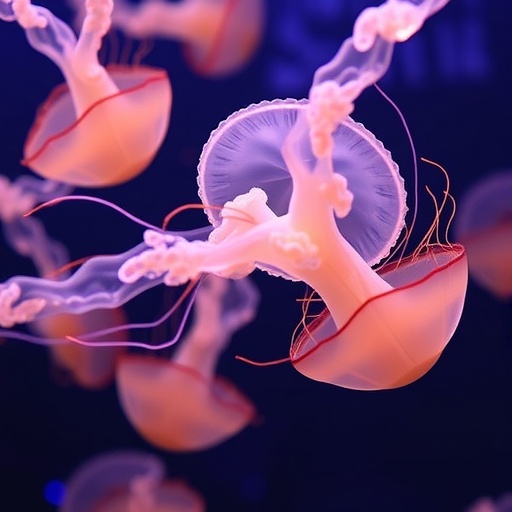
In a remarkable advancement within marine biology, researchers have unveiled a new species of jellyfish, Malagazzia michelin, representing only the second known member of its genus to inhabit Japanese waters. This discovery, led by marine biologist Takato Izumi of Fukuyama University, signifies an important stride in cataloging marine biodiversity and enhancing taxonomic clarification within ornamental jellyfish populations. The interdisciplinary collaboration involved experts from leading institutions such as the Tsuruoka City Kamo Aquarium and the Saikai National Park Kuju-kushima Aquarium, emphasizing the growing role of public aquariums in scientific research.
The initial encounter with Malagazzia michelin occurred in relatively shallow coastal terrains of Nagasaki and Yamaguchi Prefectures. These locale-specific sightings were critical, suggesting that the jellyfish’s natural habitat encompasses temperate marine ecosystems in this region of Japan. Subsequent culturing and controlled propagation within aquarium settings allowed scientists meticulous observation, culminating in the comprehensive documentation of the jellyfish’s life cycle from its polyp stage to fully developed medusa form. The ability to simulate and monitor developmental stages in captivity provided invaluable insights into the organism’s biology and reproductive mechanisms.
Malagazzia michelin is notably small, with an umbrella diameter ranging between 12 and 20 millimeters. Its morphology reflects the Hemispherical umbrella typical of Leptothecata hydrozoans, yet it exhibits unique phenotypic traits. Of particular interest are the enigmatic brown spots distributed over its reproductive structures and central stomach. These spots resemble diminutive oil droplets, distinguishing this species from its congeners. This anatomical novelty was one of several key identifiers that, alongside nuclear DNA sequencing, officially positioned Malagazzia michelin as a novel species within the genus Malagazzia.
DNA barcoding and molecular phylogenetic analyses reinforced the species’ taxonomic uniqueness by illustrating clear genetic divergence from other Malagazzia members and related hydrozoan taxa. These genetic markers provide a robust framework for species delimitation, vital for overcoming the confounding challenges posed by morphological convergence among jellyfish species. Such genetic confirmation underscores the necessity of integrating molecular tools in modern taxonomy, particularly in groups with subtle external differentiations, to ensure accurate biodiversity assessments.
The nomenclature of Malagazzia michelin intriguingly draws inspiration from the prestigious Michelin Guide. The analogy likens the progressive increase in the number of brown spots on maturing jellyfish to the accumulation of Michelin stars by distinguished restaurants, symbolizing excellence. This conceptual naming extends into the species’ Japanese common name, “ama-no-gawa-kurage,” or Milky Way jellyfish, an evocation of the constellation of white gonads juxtaposed with twinkling brown spots, reminiscent of a starry galaxy. This emblematic naming practice bridges public engagement with scientific discovery through an imaginative cultural metaphor.
A significant aspect of the study addresses a pervasive challenge in Japanese marine biology—the potential for misidentification resulting from common naming conventions. Prior to formal scientific description, jellyfish are frequently designated vernacular names reflective of superficial characteristics, such as the “salmon-roe laodicean jellyfish.” Misleading nicknames impede accurate taxonomic tracking and ecological understanding. Malagazzia michelin was historically misclassified under the genus Laodicea in field guides, a taxonomic error resolved through detailed morphological and molecular investigations. The new classification highlights the imperative of rigorous taxonomic protocols to underpin biodiversity cataloging and inform conservation strategies.
This discovery underscores the pivotal function that public aquariums serve beyond exhibition; they act as living repositories for rare and poorly understood marine organisms, offering unparalleled opportunities for live study and species discovery. Aquariums function as crucial hubs where environmental occurrence intersect with controlled scientific experimentation, enabling the elucidation of life histories, ecological roles, and evolutionary relationships of marine invertebrates. Strengthening symbiotic partnerships between aquaria and taxonomic scientists accelerates the pace of marine biodiversity discovery, vital amidst rapid environmental change and habitat degradation.
The unveiling of Malagazzia michelin in 2026 symbolizes the continued potential for discovering previously unknown biodiversity within well-explored habitats, demonstrating that even relatively cosmopolitan regions, such as Japanese coastal waters, still hold cryptic species awaiting recognition. This challenges assumptions about marine species inventory completeness and advocates for sustained, detailed exploration coupled with technological advances like molecular genetics. Thus, it positions marine biodiversity research as a dynamic frontier, where new findings can reframe understanding of marine ecosystems.
Morphologically, Malagazzia michelin’s distinctive brown pigmentation over its reproductive organs may indicate unique physiological functions or ecological adaptations, potentially related to reproductive signaling, photoprotection, or symbiotic relationships with microorganisms. Further biochemical and ecological studies are warranted to elucidate the functional significance of these spots and their developmental progression. Such inquiries could unravel novel biological phenomena and contribute to broader knowledge of cnidarian biology.
The comprehensive life cycle observation facilitated by aquarium cultivation revealed Malagazzia michelin’s progression from sessile polyp stages to free-swimming medusae, a critical lifecycle characteristic for Holoplanktonic hydrozoans. Understanding ontogenetic development not only enriches species-specific biological knowledge but also informs ecological assessments regarding dispersal capabilities, population connectivity, and responses to environmental fluctuations. This holistic lifecycle insight is particularly valuable for species with cryptic polyp phases challenging to detect in natural habitats.
Technological integration remains central to this research, combining morphological taxonomy, molecular phylogenetics, and ecological context to precisely delineate species boundaries within the Hydrozoa class. The multi-faceted approach embodies modern systematic methodologies, moving beyond purely descriptive taxonomy to embrace integrative frameworks. This is indispensable for groups like ornamental jellyfish, where phenotypic plasticity and convergent traits frequently hinder straightforward species identification.
The publication of this discovery in ZooKeys, an open-access journal known for its commitment to accessibility and taxonomic rigor, ensures that scientific data on Malagazzia michelin is widely available to researchers, educators, and conservationists. Open-access dissemination fosters transparency, accelerates scientific exchange, and encourages collaborative efforts to monitor and protect marine biodiversity. It also facilitates public engagement by making cutting-edge scientific findings accessible beyond paywall barriers, raising awareness about marine life’s diversity and conservation needs.
The formal description of Malagazzia michelin not only expands taxonomic knowledge but also signals the urgency of continued marine biodiversity exploration in the face of global environmental challenges. Anthropogenic stressors such as pollution, climate change-induced ocean warming, and habitat alteration threaten many marine invertebrates, particularly those with limited distributions or specialized niches. Identifying and cataloging these species underpin conservation prioritization and the development of protective policies, illustrating taxonomy’s foundational role within marine ecology and environmental stewardship.
Cite Scienmag News
Violet Maxwell. (February 25, 2026). Scientists Discover New Michelin Star Jellyfish Species in Japanese Aquariums. Scienmag. https://scienmag.com/scientists-discover-new-michelin-star-jellyfish-species-in-japanese-aquariums/
Violet Maxwell. "Scientists Discover New Michelin Star Jellyfish Species in Japanese Aquariums." Scienmag, 25 February 2026, https://scienmag.com/scientists-discover-new-michelin-star-jellyfish-species-in-japanese-aquariums/. Accessed 4 September 2026.
Violet Maxwell. "Scientists Discover New Michelin Star Jellyfish Species in Japanese Aquariums." Scienmag. February 25, 2026. https://scienmag.com/scientists-discover-new-michelin-star-jellyfish-species-in-japanese-aquariums/


