


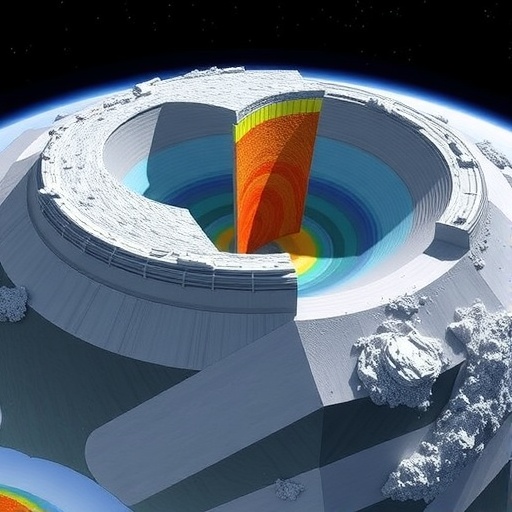
In the realm of seismology, earthquakes are traditionally understood as ruptures that propagate outward from a focal point deep beneath the Earth’s surface, sending waves that ripple through the crust and shake the ground above. Yet, recent advances in geophysical modeling and observational data have illuminated a fascinating and less common phenomenon: boomerang earthquakes. These atypical seismic events, characterized by a reversal of rupture propagation back toward areas recently affected, challenge conventional wisdom about earthquake dynamics. Recent research conducted by scientists at the Massachusetts Institute of Technology (MIT) has revealed that such back-propagating ruptures are not exclusive to complex fault networks but may also occur along seemingly straightforward, simple faults.
Historically, seismologists have observed boomerang-like rupture behavior primarily within multi-fault systems where the fault geometry and interactions provide a plausible mechanism for seismic energy to ricochet. However, the groundbreaking study recently published in AGU Advances by the MIT team contends that given certain physical conditions—namely, unilateral rupture propagation along an extended fault with rapidly fluctuating frictional properties—boomerang earthquakes can manifest even in the simplest geological settings. This insight reframes our understanding of earthquake rupture physics and suggests that such back-propagating seismic fronts could be more prevalent than previously documented.
The MIT researchers approached this enigmatic behavior by designing a computational model that simulated rupture mechanics on a single, straight fault embedded within an elastic crustal medium. By methodically controlling variables such as fault length, rupture initiation location, and rupture propagation direction, they discovered that boomerang ruptures only arise in unilateral rupture scenarios. This indicates that the rupture initially propagates strictly in one direction, later producing a bifurcation where a portion of the rupture reverses course, effectively generating a dual-front system with distinct forward and backward propagation waves.
One of the pivotal factors identified lies in the fault’s frictional response under dynamic sliding conditions. While textbook models often simplify fault friction as a steadily decreasing function allowing for continued rupture propagation, the MIT team incorporated a more complex friction law where friction rapidly decreases, then resurges before falling again. This transient frictional strengthening zone behind the rupture front temporarily halts slip, allowing stress to accumulate anew and subsequently trigger a secondary rupture front traveling back toward the origin. Such frictional behavior engenders a segmented rupture process that departs significantly from classical steady rupture models.
Moreover, the necessity of a sufficiently long rupture distance emerged as another critical condition for the back-propagation phenomenon. The simulations showed that only earthquakes that propagate over a considerable fault length exhibited these boomerang ruptures. This observation implies that large-scale earthquakes do not merely represent scaled-up versions of smaller events but embody qualitatively distinct rupture dynamics capable of producing complex rupture patterns such as reversals.
Importantly, such boomerang behavior could have profound implications for seismic hazard assessments. The reverse waves might lead to unexpected intensification of ground shaking in areas that experienced the initial rupture front, complicating both real-time earthquake response and long-term risk modeling. Since conventional seismological instruments and methodologies often fail to detect such subtle rupture reversals due to their complex ground motion signatures, a sizable fraction of past earthquakes may have involved undetected back-propagating fronts.
These findings carry particular significance for well-known simple faults, including segments of California’s San Andreas fault system. Despite its relatively straightforward geometry compared to more intricate fault zones, the San Andreas could harbor the potential for such enigmatic rupture behaviors, influencing how future seismic hazard models are constructed. Increased recognition of boomerang earthquakes invites a reassessment of mature, simple faults, which until now were often regarded as mechanically less complex.
The MIT researchers emphasize the need for enhanced observational techniques and data analysis approaches capable of discerning these elusive rupture reversals in real seismic datasets. As existing seismic networks and inversion methods often simplify rupture models, integrating physics-based insights from these simulations could improve earthquake source characterizations. Doing so may ultimately allow communities in seismically active regions to better anticipate the spatial distribution and intensity of future ground shaking, enhancing preparedness and resilience.
Scientists also highlight that uncovering the frequency and distribution of boomerang earthquakes in nature remains an open frontier. Current data is limited to a handful of events detected through complex waveform analyses, including notable cases in the mid-Atlantic Ocean in 2016, Japan’s devastating 2011 Tohoku earthquake, and the recent 2023 magnitude 7.8 earthquake along the Turkey-Syria border. These instances underscore the global relevance of the phenomenon and motivate further international collaboration to monitor and study such rupture characteristics.
This transformative study not only challenges the traditional simplicity assigned to mature, linear faults but also opens new avenues for exploring the nuanced interplay between frictional heterogeneities and rupture kinematics. It bridges theoretical seismology and practical hazard mitigation by driving home the message that even the simplest faults can host remarkably complex faulting behaviors with significant consequences.
By advancing a rigorous theoretical framework grounded in detailed numerical simulations, the MIT team’s work paves the way for more nuanced earthquake models that reflect the true diversity of rupture dynamics in nature. This innovation enriches the scientific narrative of how faults rupture, urging both the research community and policymakers to reconsider strategies for earthquake forecasting, ground shaking prediction, and infrastructure resilience in faulted regions worldwide.
As seismic hazard science evolves, this new understanding of boomerang earthquakes stands as a testament to the value of integrative, physics-based research in revealing the hidden complexities beneath the Earth’s surface. Ultimately, these findings foster optimism that through deeper insight into rupture mechanics, society can better coexist with the persistent yet dynamic forces that shape our planet’s geophysical landscape.
News Publication Date: Not specified in the source text
Web References: DOI: 10.1029/2025AV001649
References: Published article in AGU Advances
Cite Scienmag News
Violet Maxwell. (February 18, 2026). New Study Reveals How “Boomerang” Earthquakes Unfold. Scienmag. https://scienmag.com/new-study-reveals-how-boomerang-earthquakes-unfold/
Violet Maxwell. "New Study Reveals How “Boomerang” Earthquakes Unfold." Scienmag, 18 February 2026, https://scienmag.com/new-study-reveals-how-boomerang-earthquakes-unfold/. Accessed 4 September 2026.
Violet Maxwell. "New Study Reveals How “Boomerang” Earthquakes Unfold." Scienmag. February 18, 2026. https://scienmag.com/new-study-reveals-how-boomerang-earthquakes-unfold/


