


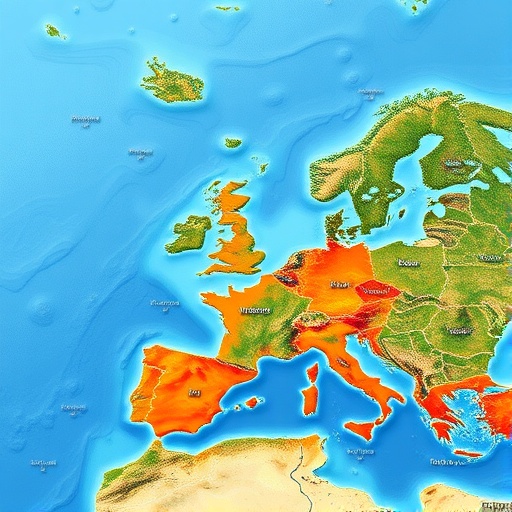
A groundbreaking advancement in Mediterranean Sea forecasting has emerged with the development of SeaCast, an innovative high-resolution model that employs artificial intelligence to revolutionize oceanographic predictions. Unlike traditional numerical models that require extensive computational resources and time, SeaCast leverages the power of graph-based deep learning to deliver markedly faster and more energy-efficient forecasts, while maintaining an unprecedented level of accuracy at regional scales. This advancement represents a significant leap forward in marine forecasting science, with implications spanning climate research, environmental management, and maritime operations.
SeaCast distinguishes itself from existing global AI ocean forecasting approaches by operating at an inherently higher spatial resolution—approximately 4 kilometers, or 1/24th of a degree—an order of magnitude finer than many coarse-grained global models. This granularity aligns with the detailed resolution of the CMCC Mediterranean operational forecasting system, known as MedFS, enabling the capture of fine-scale oceanographic and atmospheric processes that shape the Mediterranean basin’s complex marine environment. This spatial fidelity is crucial for understanding localized coastal phenomena, eddy dynamics, and the interplay between sea and atmosphere in a semi-enclosed sea like the Mediterranean.
A fundamental innovation of SeaCast lies in its integration of both oceanic and atmospheric data streams within the training and forecasting architecture. Unlike many prior AI models that rely predominantly on ocean variables alone, SeaCast incorporates atmospheric forcing data, which profoundly influence surface ocean conditions. This dual-domain approach allows the model to unravel the intricate feedback mechanisms between air and sea, particularly in regions where atmospheric conditions drive ocean temperature, salinity, and circulation patterns. Sensitivity analyses within the study reveal that inclusion of such atmospheric parameters significantly enhances forecast skill, especially in surface layers affected by wind stress, heat flux, and precipitation variability.
The technical backbone of SeaCast is a graph-based neural network framework, designed to represent the Mediterranean Sea’s irregular coastline, complex bathymetry, and lateral boundary conditions with remarkable precision. By structuring the ocean and atmosphere data as interconnected nodes on a graph, the model effectively captures spatial dependencies and non-linear interactions that often confound grid-based methods. This graph representation supports flexible, high-fidelity modeling of coastal processes and exchanges at boundaries, traditionally challenging for conventional numerical methods. Such a data-structural innovation is crucial for enabling AI to navigate the geometrical complexities of regional ocean systems.
Crucially, SeaCast’s training leverages decades of high-quality CMCC Mediterranean reanalysis data, a resource offering consistent physical ocean and atmospheric variables over a 35-year historical period. This extensive temporal coverage enables the model to learn a comprehensive representation of seasonal cycles, interannual variability, and extreme events, fostering robust predictive capabilities across varied conditions. The reanalysis datasets, accessible freely via the Copernicus Marine Service, provide a well-validated foundation upon which SeaCast’s deep learning algorithms build their forecasting acumen.
From a performance standpoint, SeaCast demonstrates dramatic efficiency improvements. Whereas traditional Copernicus numerical models require approximately 70 minutes using 89 CPUs to generate a 10-day forecast, SeaCast produces 15-day forecasts in merely around 20 seconds on a single graphical processing unit (GPU). This sharp reduction in computation time and hardware demand not only signifies substantial energy savings but also opens new avenues for rapidly conducting ensemble forecasts and “what-if” scenario analyses, tools indispensable for quantifying uncertainty and exploring future climatic perturbations.
The scientific implications of SeaCast’s efficiency extend beyond speed. The model’s rapid turnaround times facilitate probabilistic ensemble forecasting, a technique where multiple simulations with varied initial conditions or parameters generate probabilistic distributions of future states. Such ensembles enrich understanding of forecast uncertainty, critical for risk assessments in maritime navigation, coastal hazard management, and ecosystem protection. By enabling near real-time ensemble production, SeaCast could transform operational ocean forecasting paradigms in the Mediterranean and beyond.
Operational integration efforts are currently underway to amalgamate SeaCast with existing physics-based forecasting chains. This hybrid approach promises to harness the complementary strengths of classical numerical simulations—grounded in conservation laws and physical principles—and data-driven AI paradigms, ensuring comprehensive and reliable marine environment monitoring. Seamless incorporation of SeaCast into established forecasting infrastructures could expedite the delivery of actionable forecasts to policymakers, researchers, and stakeholders dependent on Mediterranean Sea conditions.
The ability of SeaCast to forecast down to 200 meters depth underscores the model’s vertical resolution and dynamical reach. This capacity is essential for depicting subsurface features such as thermoclines, intermediate water masses, and circulation undercurrents, which bear on heat transport, nutrient cycling, and marine biology. By capturing three-dimensional ocean dynamics in high detail, SeaCast advances beachhead efforts in vertically-resolved intelligent ocean prediction, moving beyond surface-layer focus that limits many previous AI models.
The model’s core developers emphasize the interdisciplinary collaboration essential to this achievement. Oceanographers, atmospheric scientists, and AI specialists combined domain knowledge and computational expertise to overcome challenges typical of regional ocean forecasting—such as complex boundaries and multivariate interactions—that have historically resisted purely numerical solutions. This convergence of disciplines exemplifies the transformative potential of integrating physical insight with cutting-edge data science to reshape oceanography.
Beyond scientific innovation, SeaCast’s forecasts hold tangible societal value for the Mediterranean region. Accurate, high-resolution predictions support critical sectors including shipping logistics, where route optimization enhances safety and efficiency; aquaculture operations, which depend on anticipating local ocean conditions to mitigate risks; environmental monitoring initiatives tracking pollution or algal blooms; and coastal risk management by informing flood or erosion forecasts. By providing timely, precise forecasts, SeaCast empowers stakeholders to adopt proactive strategies against environmental and economic threats.
The inclusion of an extensive historical dataset spanning over three decades significantly empowers SeaCast’s training foundation. This allows the model not only to recognize normal seasonal patterns but also to learn from historic anomalies, strengthening its ability to anticipate rare and extreme meteorological and oceanographic events. Such foresight is vital for regions such as the Mediterranean, where climate variability and anthropogenic pressures interact in complex ways.
As SeaCast sets a new standard for AI-driven regional ocean forecasting, its architecture and methodology may well inspire analogous efforts in other ocean basins. The model’s successful fusion of high-resolution data, graph neural networks, and atmospheric-ocean coupling opens a path for replicating and adapting this framework to diverse marine environments around the globe. The potential to democratize accurate, fast ocean forecasts worldwide marks a transformative shift in marine sciences and operational oceanography’s future.
SeaCast’s pioneering approach signals a paradigm shift in how ocean forecasts can be produced—combining the precision and reliability of physical models with the computational efficiency and adaptability of AI. This breakthrough heralds a future where high-resolution, multi-day marine forecasts become accessible rapidly to fuel scientific discovery, operational decision-making, and climate resilience in an age where ocean health and coastal safety are paramount.
Web References:
- CMCC Mediterranean operational forecasting system MedFS: https://medfs.cmcc.it/
- Copernicus Marine Service product MEDSEA_ANALYSISFORECAST_PHY_006_013: https://data.marine.copernicus.eu/product/MEDSEA_ANALYSISFORECAST_PHY_006_013/description
- Copernicus Marine reanalysis data MEDSEA_MULTIYEAR_PHY_006_004: https://data.marine.copernicus.eu/product/MEDSEA_MULTIYEAR_PHY_006_004/description
- DOI link: http://dx.doi.org/10.1038/s41598-025-31177-w
References:
Scientific Reports, DOI: 10.1038/s41598-025-31177-w
Cite Scienmag News
Eleanor C. (February 17, 2026). AI-Driven SeaCast Transforms Mediterranean Sea Forecasting with Unprecedented Speed and Precision. Scienmag. https://scienmag.com/ai-driven-seacast-transforms-mediterranean-sea-forecasting-with-unprecedented-speed-and-precision/
Eleanor C. "AI-Driven SeaCast Transforms Mediterranean Sea Forecasting with Unprecedented Speed and Precision." Scienmag, 17 February 2026, https://scienmag.com/ai-driven-seacast-transforms-mediterranean-sea-forecasting-with-unprecedented-speed-and-precision/. Accessed 28 August 2026.
Eleanor C. "AI-Driven SeaCast Transforms Mediterranean Sea Forecasting with Unprecedented Speed and Precision." Scienmag. February 17, 2026. https://scienmag.com/ai-driven-seacast-transforms-mediterranean-sea-forecasting-with-unprecedented-speed-and-precision/


