


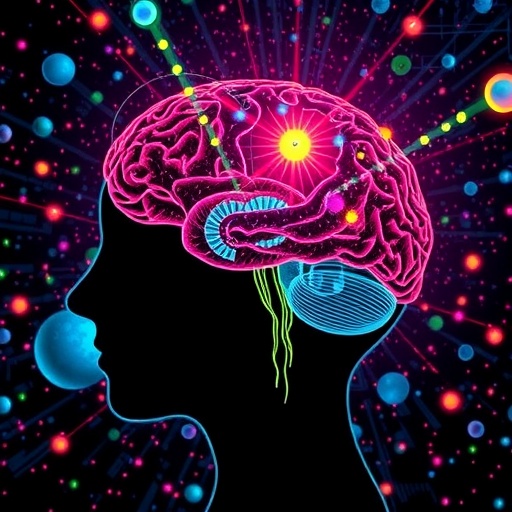
Psychedelic substances have intrigued scientists and the public alike for their profound effects on perception, cognition, and consciousness. A groundbreaking study recently published in Communications Biology sheds light on the neural mechanisms by which these substances alter visual experience and brain activity. Researchers led by Professor Dirk Jancke and first author Callum White have unveiled a detailed neurophysiological model illustrating how psychedelics trigger oscillatory brain dynamics that underpin hallucinatory phenomena.
At the core of the psychedelic effect is the activation of a specific subtype of serotonin receptor known as 5-HT2A. Serotonin, an essential neurotransmitter, interacts with at least 14 receptor variants, but psychedelics show particular affinity for the 5-HT2A receptor. This receptor plays a multifaceted role in cognitive processes, including modulation of visual processing and learning. Earlier studies by the team demonstrated that activation of 5-HT2A receptors suppresses cortical visual pathways, effectively dampening the brain’s reception of sensory input from the external environment. This sensory suppression results in an information gap that the brain attempts to fill by generating visual experiences from memory stores, leading to hallucinations.
Delving further into the neural dynamics, the study reveals that psychedelics amplify low-frequency oscillations, particularly at 5 Hz, within visual cortical regions. Neural oscillations are rhythmic fluctuations in electrical activity that coordinate communication across brain regions. The heightened 5-Hz oscillations observed act as a carrier wave to engage the retrosplenial cortex, a hub implicated in memory retrieval and integration. This shift in brain activity denotes a fundamental change in information flow: ongoing perception is reduced while endogenous memory content gains prominence, producing dream-like, internally-generated visual experiences.
To visualize these intricate processes, the researchers employed an advanced optical imaging technique capable of capturing real-time neural activity across the cortical surface. Utilizing genetically modified mice developed at Hong Kong Baptist University, which express fluorescent proteins selectively in pyramidal neurons of cortical layers 2/3 and 5, the team pinpointed the cellular origin of the measured signals. This method allowed unprecedented insight into the microcircuitry underpinning psychedelic-induced oscillations and their propagation through brain networks critical for perception and memory.
The observed reconfiguration of brain oscillatory patterns dovetails with current psychological approaches exploring psychedelics as therapeutic agents for psychiatric conditions such as anxiety and depression. Under controlled medical supervision, psychedelic compounds can transiently alter brain states to unlock access to positive memories while weakening entrenched negative cognitive schemas. This neuroplastic potential holds promise for remodeling maladaptive thought patterns in clinical populations, a therapeutic avenue that is rapidly gaining momentum.
Notably, the study’s findings provide a mechanistic basis for the “partial dreaming” analogy often used to describe psychedelic experiences. They suggest the psychedelic brain operates in a hybrid mode where exogenous sensory input is suppressed and replaced by endogenous visual constructions derived from stored memories. This state shares characteristics with dreaming but occurs with a retained awareness and sensory grounding unique to the psychedelic state.
Furthermore, by characterizing the precise oscillatory frequencies and interregional communication pathways involved, the research opens the door to targeted neuromodulation strategies. Future clinical applications may harness these oscillation patterns or their receptor targets to fine-tune therapeutic interventions, optimizing efficacy and minimizing side effects.
The convergence of cutting-edge optical imaging, genetic engineering, and systems neuroscience exemplified in this study underscores the transformative potential of interdisciplinary research in unraveling the complex neural basis of consciousness and perception. Moreover, it highlights how studying psychedelics can illuminate fundamental brain processes with wide-ranging implications beyond psychopharmacology.
The implications extend well into the realm of cognitive neuroscience, providing a compelling framework for understanding how the brain balances external sensory input with internal memory representations. This balance is essential for coherent perception; psychedelics skew this equilibrium, revealing how flexible and dynamic neural networks accommodate altered states of consciousness.
Research from Professor Jancke’s group not only elucidates the neurophysiological underpinnings of psychedelic hallucinations but also encourages a reevaluation of mental health treatments. As the stigmatization of psychedelic therapy wanes and regulatory landscapes shift, such mechanistic insights will be crucial in guiding safe and effective clinical applications.
Addressing the broader scientific community, this study ignites interest in the interplay between neural oscillations, receptor pharmacology, and consciousness, encouraging further exploration into how modulatory systems sculpt perceptual experience. It reinforces the notion that subjective phenomena like hallucinations are not mere aberrations but emerge from definable neural circuits and patterns.
As research progresses, the translation of these findings into novel diagnostics and therapies will be transformative. By leveraging the influence of the 5-HT2A receptor and associated oscillations, clinicians may soon have sophisticated tools to rewire maladaptive networks underlying psychiatric disorders, ushering in a new era of personalized brain medicine.
In sum, this pioneering investigation enriches our understanding of the psychedelic brain, offering a compelling mechanistic narrative: psychedelics activate 5-HT2A receptors to suppress visual processing, engender synchronized 5-Hz oscillations that recruit memory-related regions, and generate hallucinatory perceptions from internal neural stores. The work not only advances basic neuroscience but also sets the stage for innovative therapeutic modalities targeting brain rhythm and receptor function.
News Publication Date: 11-Feb-2026
Web References: DOI: 10.1038/s42003-025-09492-9
Cite Scienmag News
Cassandra Pierce. (February 13, 2026). How Psychedelic Drugs Impact Brain Function: Insights from New Research. Scienmag. https://scienmag.com/how-psychedelic-drugs-impact-brain-function-insights-from-new-research/
Cassandra Pierce. "How Psychedelic Drugs Impact Brain Function: Insights from New Research." Scienmag, 13 February 2026, https://scienmag.com/how-psychedelic-drugs-impact-brain-function-insights-from-new-research/. Accessed 4 September 2026.
Cassandra Pierce. "How Psychedelic Drugs Impact Brain Function: Insights from New Research." Scienmag. February 13, 2026. https://scienmag.com/how-psychedelic-drugs-impact-brain-function-insights-from-new-research/


