


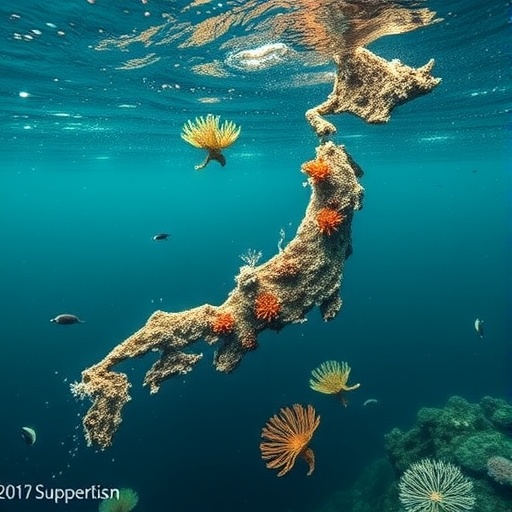
In a groundbreaking study published in Nature Communications, an international team of researchers has uncovered compelling evidence of ancient megathrust earthquakes and seismic supercycles in subtropical Japan, drawing this information from the subtle growth patterns etched within millennia-old coral microatolls. This research marks a significant advancement in our understanding of seismic hazards in one of the world’s most tectonically active regions, providing critical insights that could inform future earthquake preparedness and risk mitigation strategies.
The investigation leverages the unique geological archive preserved in coral microatolls—circular colonies of coral that have grown over centuries along coastal fringes susceptible to fluctuating sea levels and tectonic movements. These formation features act as natural “strain gauges” that meticulously record the vertical land movements associated with seismic activity. By meticulously analyzing samples dated over thousands of years, the authors were able to reconstruct a detailed history of seismic events otherwise invisible in the historical record.
Central to the study is the concept of the seismic supercycle, a phenomenon involving clusters of large megathrust earthquakes occurring at irregular intervals within subduction zones. This challenges the traditional paradigm of relatively steady recurrence intervals for major earthquakes, highlighting periods of unusually high seismic activity followed by quiescent phases. Japan, situated at the convergence of multiple tectonic plates including the Pacific, Philippine Sea, and Eurasian Plates, provides an ideal natural laboratory for studying these cycles due to its complex seismic regime.
The research hinged on high-resolution paleo-seismological methodologies, including precise uranium-thorium dating techniques, which facilitated the chronological mapping of coral growth interruptions caused by sudden land-level changes. These abrupt shifts are indicative of coseismic uplift or subsidence linked to significant megathrust events. Significantly, the patterns recovered from the coral microatolls corresponded with known historical earthquakes but also revealed previously undetected prehistoric events spanning over several millennia.
The ability to identify and date such ancient seismic events is transformative for seismic hazard assessment. Traditional paleoseismic studies have often relied on land-based sediment or fault trenching methods, which are limited by erosion, deposition, and incomplete records. Coral microatolls offer a complementary temporal perspective, recording coastal changes with annual to subannual resolution and extending the seismic record back thousands of years, thereby enriching the historical context for risk estimates.
This study also underscores the dynamic nature of the Nankai Trough mega-subduction zone, a fault system notorious for generating devastating earthquakes and tsunamis, including the catastrophic events in 1946 and 1944. By elucidating the frequency and clustering of megathrust activity, the researchers illustrated how seismic energy is released in seismic supercycles, interspersed with extended quiescence, potentially linked to varying plate interface conditions such as frictional properties and fluid pressures.
Furthermore, the implications of these findings extend beyond southern Japan. Understanding seismic supercycles improves regional earthquake forecasting models and can guide infrastructure resilience measures in other subduction zones worldwide, such as those found in Cascadia, Sumatra, and the Chilean coast. The application of coral microatoll analysis could be globally replicated in suitable coastal regions, offering a potentially universal tool for deciphering long-term seismic histories.
An intriguing aspect of this research is the multidisciplinary integration of marine geology, geochronology, seismology, and ecology, reflecting a holistic approach to natural hazards science. By interpreting biogenic structures through the lens of geological processes, the study bridges the gap between biological archives and tectonic mechanisms, opening new avenues to explore Earth’s dynamic systems.
The research team also addressed the challenging task of disentangling the subtle signals of tectonic uplift from other environmental factors influencing coral growth, such as sea-level changes due to global climate fluctuations. Advanced statistical models and comparative analyses with other paleoclimate proxies were used to confidently attribute the coral microatoll deformation patterns to seismic events rather than eustatic sea-level oscillations.
The temporal resolution achieved in this study—identifying events spanning up to 3,000 years—provides unprecedented visibility into the recurrence intervals of extraordinary seismic phenomena that surpass the scope of written records and traditional geological dating tools. This extended timeline is instrumental for policymakers and hazard modelers striving to incorporate long-term risks into urban planning and disaster readiness activities.
Moreover, the findings reinforce the interconnectedness of seismic and tsunami hazards since megathrust earthquakes along subduction zones frequently trigger destructive tsunamis, as exemplified by historic events in the region. Coral microatolls, by tracking uplift and subsidence, indirectly reflect the amplitude and frequency of tsunamigenic displacements, adding layers of understanding critical for comprehensive risk assessments.
Highlighting the critical need for continuous monitoring of vulnerable coastal ecosystems, the study posits coral reefs not only as biodiversity hotspots but also as invaluable natural laboratories and early warning systems that record the pulse of the Earth’s tectonic heartbeat. Preservation of these ecosystems thus holds both ecological and scientific significance.
By unraveling the megathrust earthquake history concealed within coral microatolls, this research exemplifies innovative approaches to hazard science that marry ancient biological records with cutting-edge geochemistry and seismology. It elicits a deeper appreciation for the complex cycles governing seismicity in Japan’s subtropical zones and reinforces the urgency of integrating long-term geological archives into modern hazard assessments.
As seismic risk escalates globally due to urban expansion in tectonically active zones, such studies provide a critical knowledge foundation for enhancing resilience strategies. The refined understanding of seismic supercycles captured through these marine coral archives is poised to revolutionize how societies anticipate and mitigate earthquake disasters.
This pioneering work not only enriches scientific knowledge but also carries profound implications for public safety, urban development, and environmental stewardship in one of the most earthquake-prone regions on Earth. Ultimately, it testifies to nature’s capacity to document its own dynamic upheavals and challenges humanity to listen carefully to these enduring biological signals.
Cite Scienmag News
Violet Maxwell. (February 10, 2026). Millennia-Old Corals Reveal Japan’s Seismic Supercycles. Scienmag. https://scienmag.com/millennia-old-corals-reveal-japans-seismic-supercycles/
Violet Maxwell. "Millennia-Old Corals Reveal Japan’s Seismic Supercycles." Scienmag, 10 February 2026, https://scienmag.com/millennia-old-corals-reveal-japans-seismic-supercycles/. Accessed 5 September 2026.
Violet Maxwell. "Millennia-Old Corals Reveal Japan’s Seismic Supercycles." Scienmag. February 10, 2026. https://scienmag.com/millennia-old-corals-reveal-japans-seismic-supercycles/


