


Face attribute classification (FAC) is a high-profile problem in biometric verification and face retrieval. Although recent research has been devoted to extracting more delicate image attribute features and exploiting the inter-attribute correlations, significant challenges still remain.
To solve the problems, a research team led by Na LIU published their new research on 15 June 2024 in Frontiers of Computer Science co-published by Higher Education Press and Springer Nature.
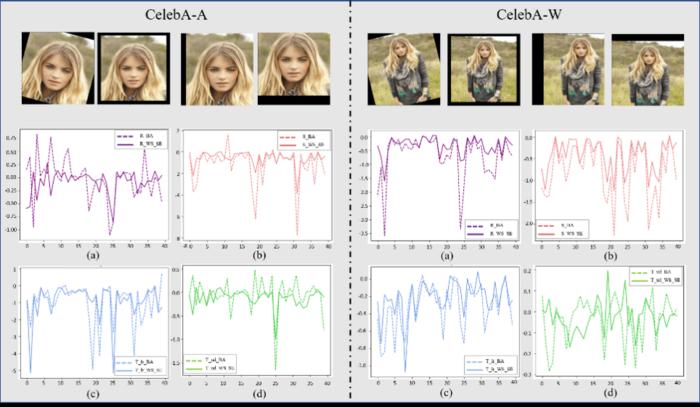
The team proposed a scattering-based hybrid block, termed WS-SE, to incorporate frequency-domain (WST) and image-domain (CNN) features in a channel attention manner. Compared with CNN, WS-SE achieved a more efficient FAC performance and compensated for the model sensitivity of the small-scale affine transform.
In addition, to further exploit the relationships among the attribute labels, the team proposed a learning strategy from a causal view. The cause attributes defined using the causality-related information can be utilized to infer the effect attributes with a high confidence level.
Future work will consider the design of hybrid networks based on non-average integration at different scales and rotations, as well as the direct application of WST to local texture enhancement to achieve lightweight fusion models and improve the performance of FAC.
DOI: 10.1007/s11704-023-2570-6

Credit: Na LIU, Fan ZHANG, Liang CHANG, Fuqing DUAN.
Face attribute classification (FAC) is a high-profile problem in biometric verification and face retrieval. Although recent research has been devoted to extracting more delicate image attribute features and exploiting the inter-attribute correlations, significant challenges still remain.
To solve the problems, a research team led by Na LIU published their new research on 15 June 2024 in Frontiers of Computer Science co-published by Higher Education Press and Springer Nature.
The team proposed a scattering-based hybrid block, termed WS-SE, to incorporate frequency-domain (WST) and image-domain (CNN) features in a channel attention manner. Compared with CNN, WS-SE achieved a more efficient FAC performance and compensated for the model sensitivity of the small-scale affine transform.
In addition, to further exploit the relationships among the attribute labels, the team proposed a learning strategy from a causal view. The cause attributes defined using the causality-related information can be utilized to infer the effect attributes with a high confidence level.
Future work will consider the design of hybrid networks based on non-average integration at different scales and rotations, as well as the direct application of WST to local texture enhancement to achieve lightweight fusion models and improve the performance of FAC.
DOI: 10.1007/s11704-023-2570-6
Journal
Frontiers of Computer Science
Method of Research
Experimental study
Subject of Research
Not applicable
Article Title
Scattering-based hybrid network for facial attribute classification
Article Publication Date
15-Jun-2024
Cite Scienmag News
Denise Maddox. (July 10, 2024). An approach for robust facial attribute classification. Scienmag. https://scienmag.com/an-approach-for-robust-facial-attribute-classification/
Denise Maddox. "An approach for robust facial attribute classification." Scienmag, 10 July 2024, https://scienmag.com/an-approach-for-robust-facial-attribute-classification/. Accessed 3 September 2026.
Denise Maddox. "An approach for robust facial attribute classification." Scienmag. July 10, 2024. https://scienmag.com/an-approach-for-robust-facial-attribute-classification/

