


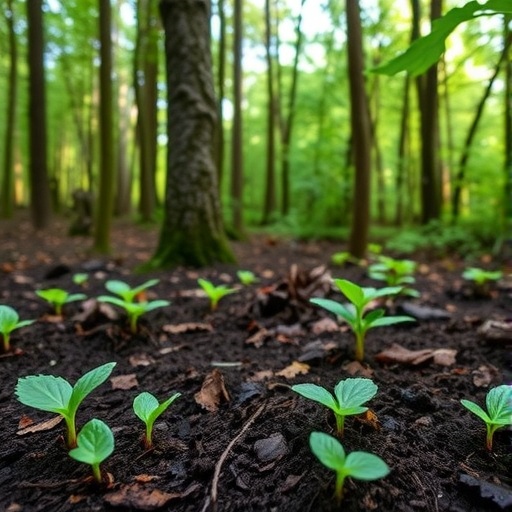
Forest soils, often overlooked in the grand scheme of climate regulation, are now increasingly recognized as pivotal players in the global methane cycle. Methane (CH4), a potent greenhouse gas with a global warming potential significantly higher than carbon dioxide over a 20-year period, is effectively absorbed and metabolized by forest soils, which act as substantial methane sinks. A groundbreaking long-term study conducted by researchers at the University of Göttingen and the Baden-Württemberg Forest Research Institute (FVA) has yielded compelling evidence showing that under certain climatic conditions, methane uptake by forest soils does not diminish but rather intensifies. This counters prevailing assumptions within the climate science community and sheds new light on the adaptive dynamics of soil-atmosphere interactions in temperate forests.
The researchers meticulously analyzed the world’s most comprehensive and longitudinal data set on methane uptake, deriving from 13 forest plots located in south-western Germany. These plots, encompassing predominantly beech and spruce forest ecosystems typical of Central Europe, were monitored consistently over a span extending up to 24 years. Such an extended observational window enabled the team to discern subtle yet statistically significant trends influenced by progressive climatic shifts. Surprisingly, the findings indicate that forest soils in this region are absorbing on average three percent more methane per year, a trend strongly correlated with a gradual decline in precipitation and a concurrent rise in ambient temperature.
Methodologically, the research hinged on sophisticated soil gas profiling techniques routinely employed since the inception of the FVA’s soil gas monitoring program. Gas concentration measurements were taken biweekly from air samples extracted at multiple soil depths using fine tubing inserted into the forest floor. These profiles reflect the intricate vertical gradients and dynamics of methane within the soil microenvironment. Complementary verification was obtained through flux chamber experiments—airtight enclosures placed on the soil surface monitored methane concentration changes over time, allowing precise calculation of methane fluxes between the soil and atmosphere. This dual-pronged approach ensured high fidelity in quantifying methane consumption by forest soils.
Understanding why methane uptake increased requires a nuanced appreciation of soil physical-chemical properties and microbial ecology. The data elucidates that as rainfall decreases, soil moisture content correspondingly declines, leading to drier soil conditions. Dry soils inherently contain a higher proportion of air-filled pores compared to saturated soils. This increased porosity facilitates the diffusion of atmospheric methane molecules into the soil matrix, enhancing substrate availability for methanotrophic bacteria—specialized microorganisms that consume methane as an energy source. Concurrently, rising temperatures accelerate microbial metabolic rates, further boosting methane oxidation efficiency. Therefore, the synergistic effect of soil dryness and warming appears to amplify the methane sink capacity of forest soils in this temperate zone.
These insights substantially challenge prevailing global meta-analyses which predominantly report a decline in methane uptake across forest soils worldwide due to climatic and anthropogenic pressures. Notably, a landmark study from the United States documented reductions up to 80 percent in methane absorption linked to increased precipitation. However, the contrasting results from this extensive German field study underscore the critical importance of regional variability and long-term observational data. They intimate that climate change impacts on biogeochemical cycles are not universally detrimental but can engender complex, context-dependent feedback mechanisms in terrestrial ecosystems.
The findings have far-reaching implications for global methane budget estimates and climate modeling. Inclusion of regionally specific, temporally extended data sets into Earth system models can dramatically improve projections of greenhouse gas fluxes under different climate change scenarios. Recognizing forest soils as dynamic sinks that can potentially amplify methane removal reinforces the necessity to conserve and manage forest ecosystems thoughtfully. Moreover, this evolving understanding may influence policy frameworks aimed at climate change mitigation by underscoring soils as vital natural carbon and methane regulators.
Extending beyond the scientific implications, this research elevates the role of meticulous, sustained environmental monitoring programs. The FVA’s soil gas monitoring program, with its long-term continuous dataset, exemplifies the indispensable value of consistent data collection methodologies over multiple decades. Short-term studies or meta-analyses lacking extensive temporal resolution may overlook or misinterpret emergent ecological trends. Hence, sustained environmental observation infrastructures are crucial to unraveling the complex interactions between climate variables and soil-atmosphere gas exchanges.
Critically, the study team emphasized the necessity to broaden monitoring efforts spatially and temporally across diverse forest types and climatic zones globally. Variations in soil texture, vegetation cover, microbial community composition, and local climate regimes could yield heterogeneous methane flux responses to changing environmental conditions. Comprehensive, standardized data from multiple biomes are essential to validate and generalize findings from regional case studies and to refine global methane cycling understanding.
Furthermore, the intricate interplay between hydrological cycles and methane fluxes necessitates advancing research on soil moisture dynamics. Future studies should aim to decode the threshold moisture conditions under which methane uptake peaks or diminishes. Enhanced understanding of these nonlinear moisture-methane relationships will enable better anticipation of feedbacks arising from altered precipitation patterns projected under climate change.
Technologically, the deployment of increasingly sophisticated gas sensing and molecular techniques promises to deepen insights into the microbial drivers underpinning methane oxidation. Metagenomic and transcriptomic approaches may reveal functional adaptations within methanotrophic communities to environmental stressors such as drought and warming. Such cutting-edge methodologies integrated with classical soil gas flux measurements stand to revolutionize soil methane cycling research.
In summary, this remarkable study from south-west Germany presents a paradigm shift, illustrating that climate-driven reductions in rainfall and rising temperatures can paradoxically enhance methane uptake by forest soils through improved gas diffusion and microbial oxidation rates. This challenges existing dogma and highlights the vital role of long-term regional datasets to accurately capture ecosystem responses under evolving climatic regimes. As the scientific community strives for more precise greenhouse gas accounting, these findings offer hope that forest soils may bolster their buffering capacity against atmospheric methane increases, reinforcing the critical importance of conserving forested landscapes worldwide.
Cite Scienmag News
Russell Cooper. (February 4, 2026). Forest Soils Enhance Their Role as Natural Methane Sinks, Drawing More Gas from the Atmosphere. Scienmag. https://scienmag.com/forest-soils-enhance-their-role-as-natural-methane-sinks-drawing-more-gas-from-the-atmosphere/
Russell Cooper. "Forest Soils Enhance Their Role as Natural Methane Sinks, Drawing More Gas from the Atmosphere." Scienmag, 4 February 2026, https://scienmag.com/forest-soils-enhance-their-role-as-natural-methane-sinks-drawing-more-gas-from-the-atmosphere/. Accessed 4 September 2026.
Russell Cooper. "Forest Soils Enhance Their Role as Natural Methane Sinks, Drawing More Gas from the Atmosphere." Scienmag. February 4, 2026. https://scienmag.com/forest-soils-enhance-their-role-as-natural-methane-sinks-drawing-more-gas-from-the-atmosphere/


