


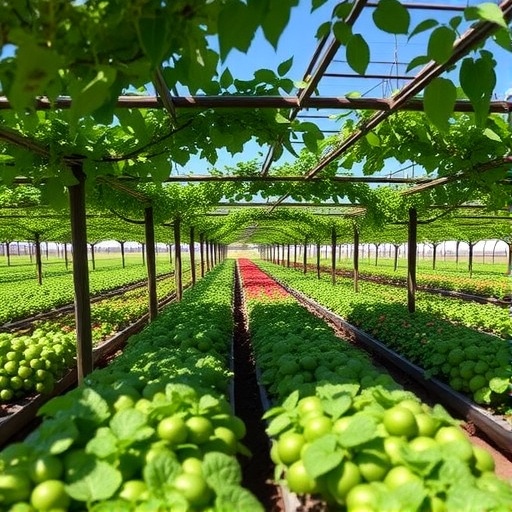
In the quest for sustainable agricultural systems that can meet the escalating global food demand while simultaneously harnessing renewable energy, agrivoltaics has emerged as a revolutionary approach. This innovative practice integrates photovoltaic solar panels with crop production on the same land, generating electricity without compromising agricultural output. A recent comprehensive study led by Maruyama and colleagues, published in npj Sustainable Agriculture, unravels the complex interactions between on-farm agrivoltaic systems and main crop yields, focusing on the nuanced roles of shade avoidance mechanisms, cultivation practices, and crop varieties. This landmark research offers critical insights into optimizing agrivoltaic configurations for maximum productivity and sustainable energy generation.
Agrivoltaics represents a pioneering convergence of solar technology and agriculture, designed to deliver dual benefits from a single piece of land. However, the implementation challenges are profound due to the conflicting light requirements of solar panels and crops. Crops rely on sunlight for photosynthesis, while solar panels cast shadows that reduce light availability. Understanding how crops respond physiologically and morphologically to these altered light environments is paramount to realizing agrivoltaics’ full potential. Maruyama et al.’s work addresses this challenge by dissecting the shade avoidance responses of plants—their innate strategies to grow in shaded conditions by modifying growth patterns and physiology.
Shade avoidance syndrome (SAS) is a dynamic plant response characterized by elongation of stems and leaves, increased leaf angle, and accelerated phenology, typically triggered by a reduction in the red to far-red light ratio under shading. These adaptations allow plants to optimize light capture but often incur trade-offs such as reduced biomass allocation to reproductive organs, potentially impacting yield. The study systematically assesses how SAS manifests under the partial shading imposed by agrivoltaic panels, revealing that this response varies significantly among crop species and even among varieties within a species. This variation underscores the importance of selecting cultivars with favorable SAS traits suitable for agrivoltaic conditions.
Moreover, the research delves into the critical influence of cultivation practices on crop performance under solar panels. Adjusting planting density, row orientation relative to solar panel arrays, and irrigation scheduling emerged as pivotal factors moderating crop yield. The integration of precision agriculture tools to monitor microclimate shifts induced by the panels allows farmers to fine-tune these variables in real time. Maruyama and colleagues demonstrate that traditional practices must evolve, embracing adaptive strategies that exploit the altered light and temperature microenvironments created by agrivoltaic infrastructure.
An intriguing facet of the study is the comparison of crop varieties, highlighting genetic variability in tolerance to shaded environments. Certain varieties exhibit enhanced photosynthetic efficiency under reduced irradiance or have morphological traits that minimize light interception competition within the canopy. This genetic diversity presents a trove of opportunities for plant breeders to develop cultivars customized for agrivoltaic systems. The authors suggest that breeding programs should prioritize traits related to shade tolerance and resource use efficiency to fully harness the synergies between crop production and solar energy harvesting.
Beyond the biological responses, the study rigorously quantifies the direct impacts of agrivoltaic systems on yield metrics across multiple major food crops. These empirical yield data reveal a nuanced landscape where some crops can maintain or even improve yields under appropriately designed agrivoltaic systems, while others experience modest reductions. Importantly, the researchers identify threshold light levels below which yield penalties become significant, providing actionable guidelines for spatial configurations of solar panels. This quantitative framework empowers stakeholders to balance energy generation goals with food production requirements effectively.
The microclimatic modifications introduced by solar panels also extend beyond shading. For instance, the panels can reduce evapotranspiration and soil temperature fluctuations, which may enhance water use efficiency and mitigate heat stress in crops. Maruyama et al. examined these secondary effects and their implications for crop physiology. Their findings suggest that the agrivoltaic environment creates a buffered microclimate that could be particularly beneficial under scenarios of climate variability and increasing incidences of drought stress, a critical advantage amid global climate change.
In addition, the team explored how agrivoltaic setups might influence pest and disease dynamics. Shading and altered humidity patterns under panels can affect pathogen development cycles and pest behavior. Although this study primarily focused on yield and physiological responses, preliminary observations indicate that agrivoltaics may contribute to integrated pest management strategies by disrupting favorable conditions for certain pests without the need for chemical interventions. This ecological benefit adds another layer of sustainability to the agrivoltaic paradigm.
From an energy systems perspective, the research sheds light on optimizing solar panel placement to maximize electricity output while minimizing detrimental effects on crops. The interplay of solar geometry, panel height, tilt angle, and row spacing is crucial in determining system efficacy. Maruyama et al. utilized advanced modeling to simulate various configurations, providing a toolbox for designing agrivoltaic arrays tailored to specific crop types and regional conditions. This multidisciplinary approach bridges agronomy, plant physiology, and renewable energy engineering.
The study’s implications extend to policy and land-use planning. As land scarcity becomes a feature of many agricultural regions, agrivoltaics offers a dual land-use solution that bolsters rural economic resilience by diversifying income streams through both crop sales and energy production. Maruyama and colleagues advocate for integrating agrivoltaics into sustainable agriculture frameworks and energy policies, emphasizing the need for incentives and support for farmers adopting these integrated systems. This synergy aligns with global sustainability goals, including the United Nations Sustainable Development Goals (SDGs).
Furthermore, the research highlights the socio-economic dimensions of adopting agrivoltaic technology. While technical optimization is fundamental, farmer knowledge, perceptions, and capacity to manage novel systems are equally critical. The authors recommend participatory approaches to system design and knowledge transfer, ensuring that agrivoltaic deployment is context-specific and farmer-centric. This perspective acknowledges the complex human-environment interactions that underpin successful agricultural innovation.
Technological advancements in sensor deployment and data analytics also play a role in maximizing agrivoltaic system performance. The integration of IoT devices to monitor environmental parameters and plant physiological markers can enable precision management, enhancing yield predictability and energy output simultaneously. Maruyama et al. envision a future where agrivoltaic farms operate as smart agroecosystems, leveraging real-time data for dynamic adaptation to fluctuating conditions.
This in-depth exploration of agrivoltaic impacts on crop yield represents a significant stride forward in understanding how to harmonize food production with renewable energy generation. The multidimensional insights into plant responses, cultivation adjustments, varietal selection, and system design provide a robust foundation for scaling agrivoltaics globally. As the agricultural landscape grapples with the twin challenges of climate change and food security, such integrative solutions become indispensable.
In essence, this study paints a compelling portrait of agrivoltaics not merely as a technological intervention but as an agroecological innovation that demands holistic consideration of plant biology, farm management, and energy science. It challenges the traditional separations between crop and energy domains, urging stakeholders to reconceptualize land use with a focus on multifunctionality and sustainability. The future of agriculture may well hinge on these synergistic, layered systems where sunlight is captured efficiently above and below, generating sustenance and power in tandem.
Maruyama and colleagues’ research thus marks a pivotal development on the path toward resilient, sustainable agrisolar landscapes. The integration of scientific rigor with practical insights equips the agricultural community with the knowledge needed to embrace agrivoltaics with confidence. As these systems become more widespread, continuous refinement informed by empirical data will further unlock their potential, paving the way toward a greener, food-secure future.
For scientists, engineers, farmers, and policymakers alike, this work offers a beacon of innovation at the nexus of environmental stewardship and human well-being. The promise of agrivoltaics lies in its capacity to transform challenges into opportunities—turning shading into a source of resilience, competition into cooperation, and fields into multifunctional powerhouses of global sustainability.
Cite Scienmag News
Alan Morgan. (February 2, 2026). On-Farm Agrivoltaics: Shade, Practices, Varieties Impact Yield. Scienmag. https://scienmag.com/on-farm-agrivoltaics-shade-practices-varieties-impact-yield/
Alan Morgan. "On-Farm Agrivoltaics: Shade, Practices, Varieties Impact Yield." Scienmag, 2 February 2026, https://scienmag.com/on-farm-agrivoltaics-shade-practices-varieties-impact-yield/. Accessed 3 September 2026.
Alan Morgan. "On-Farm Agrivoltaics: Shade, Practices, Varieties Impact Yield." Scienmag. February 2, 2026. https://scienmag.com/on-farm-agrivoltaics-shade-practices-varieties-impact-yield/


