


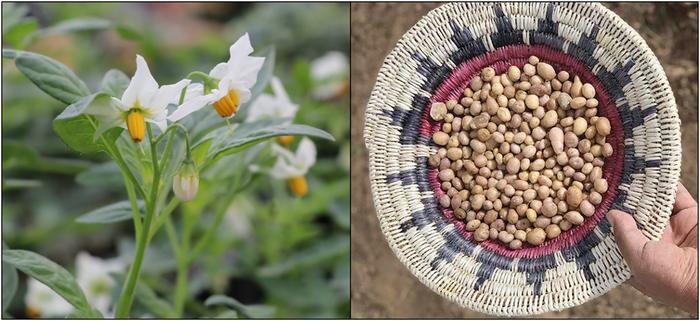
In a groundbreaking study published in the open-access journal PLOS One on January 21, 2026, researchers from the University of Utah have unveiled compelling evidence that ancient Indigenous peoples played a pivotal role in the early domestication and dispersal of the Four Corners potato (Solanum jamesii). This wild tuber, resilient and nutritionally rich, is native to the southwestern United States but was historically transported across vast distances, significantly influencing its genetic diversity and cultural importance in the region.
The research team, led by Lisbeth Louderback, employed an innovative blend of archaeobotanical and ethnographic approaches to unravel a complex narrative of human-plant interaction spanning over ten millennia. By analyzing starch granules embedded in ground stone tools excavated from 14 archaeological sites across the Colorado Plateau, the team traced the presence and use of S. jamesii from as early as 10,900 calendar years before present (cal BP). These sites predominantly cluster around the Four Corners area—where Colorado, Utah, Arizona, and New Mexico converge—highlighting a remarkable pattern of long-distance transport and usage by ancient inhabitants.
Previous genetic analyses had hinted at a south-to-north movement of the species, but Louderback and colleagues provided the crucial archaeological confirmation supporting these molecular findings. The starch residues found on tools from nine archaeological sites directly implicate early human agency in moving this species far beyond its natural distribution, effectively expanding its range into northern territories such as Utah and Colorado. This anthropogenic dispersal mirrors some of the earliest stages of crop domestication processes seen globally.
The implications of this discovery stretch far beyond simple plant movement. The act of transporting and cultivating S. jamesii suggests a sophisticated level of environmental management and knowledge transmission among Indigenous peoples. By maintaining populations of this wild potato, they may have instigated subtle genetic changes through selective harvesting or cultivation, thus nudging the species onto a path towards domestication—a crucial milestone in human subsistence strategies across history.
Delving deeper into the cultural ramifications, the research team conducted interviews with 15 Navajo (Diné) elders, whose oral histories underscore the enduring spiritual and dietary significance of the Four Corners potato in contemporary Indigenous communities. This living legacy bridges ancient practices and modern cultural identity, illustrating a continuous and dynamic relationship with this wild tuber that survives to this day.
Louderback emphasized that integrating data from starch residue analysis, genetic sequencing, and living memories constructs a holistic picture of the plant’s anthropogenic range—which starkly contrasts with its natural ecological footprint. This synthesis not only recalibrates our understanding of early agriculture in North America but also spotlights an Indigenous cultural identity deeply entwined with the species’ history of human-mediated dispersal.
Moreover, co-author Cynthia Wilson highlighted the pivotal roles of kinship and especially matrilineal knowledge transmission in sustaining this botanical heritage. Indigenous women, as knowledge holders, safeguarded the seedlings and stories across generations, preserving essential ties to ancestral land and food systems. Such custodianship underscores how social structures implicitly influenced resource mobility and domestication dynamics within these communities.
The methodology underpinning this study is equally noteworthy. Ground stone tools, often overshadowed in archaeological research, emerged as invaluable proxies for tracing ancient plant use via microscopic starch residue analysis. This technique allowed researchers to detect minute granules of S. jamesii long after physical tubers had perished, thus filling critical gaps in reconstructing prehistoric diets and plant management practices.
From a broader scientific perspective, this study challenges conventional narratives that domestication arose solely through plant cultivation. Instead, it illuminates a more nuanced scenario where wild species were deliberately moved and managed long before full domestication traits appeared, reflecting an early stage of human-plant co-evolution. This view enriches the global discourse on agricultural origins and supports a paradigm recognizing the complexity of Indigenous contributions to biodiversity management.
The Four Corners potato’s story also parallels other indigenous plant management systems globally, offering an exemplar for conservation efforts. Understanding how ancient communities navigated and shaped their environments can guide contemporary approaches to sustainable agriculture and ecological resilience, especially in arid and semi-arid landscapes facing climate change pressures.
Funding for this pivotal research was provided by the National Science Foundation and supported by institutions including Red Butte Garden and the Natural History Museum of Utah. The authors declared no competing interests, underscoring the objective rigor of their findings.
As modern science continues to unravel the depth of indigenous knowledge embedded within ecosystems, this study stands out as a testament to the enduring legacies of Indigenous peoples. Their millennia-long stewardship of the Four Corners potato not only shaped the landscape but also forged a cultural lineage that remains vibrant and influential.
For readers wishing to explore the full scientific article and supplementary materials, the study is freely accessible via PLOS One at https://plos.io/3Z3PICV. This open-access format ensures global accessibility, promoting wider appreciation and integration of Indigenous agricultural heritage into contemporary scientific discourse.
Cite Scienmag News
Courtney Benton. (February 1, 2026). Tracing the Journey of Wild Potato Domestication in the American Southwest. Scienmag. https://scienmag.com/tracing-the-journey-of-wild-potato-domestication-in-the-american-southwest/
Courtney Benton. "Tracing the Journey of Wild Potato Domestication in the American Southwest." Scienmag, 1 February 2026, https://scienmag.com/tracing-the-journey-of-wild-potato-domestication-in-the-american-southwest/. Accessed 3 September 2026.
Courtney Benton. "Tracing the Journey of Wild Potato Domestication in the American Southwest." Scienmag. February 1, 2026. https://scienmag.com/tracing-the-journey-of-wild-potato-domestication-in-the-american-southwest/


