


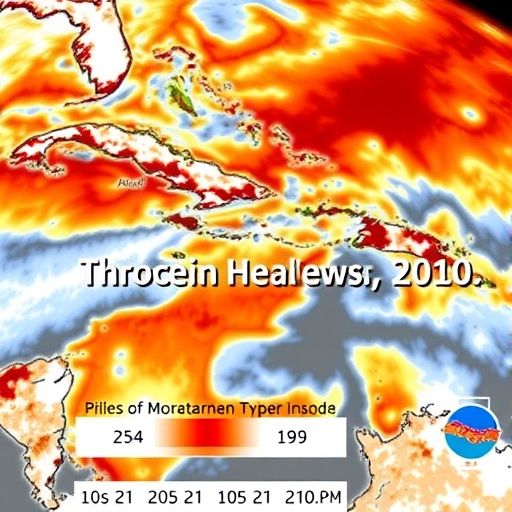
In recent decades, the Caribbean region has become increasingly susceptible to extreme heatwaves, a trend that is intensifying in both frequency and severity. A pioneering study led by climatologists at the University at Albany delves into the dynamics behind these relentless heat events, revealing critical insights into how climate change exacerbates this regional hazard. By meticulously scrutinizing over 50 years of climate data spanning from 1971 to 2025, the research team has unraveled patterns that underscore the growing threat of heatwaves in the Caribbean, particularly in Cuba, Haiti, Puerto Rico, and the Dominican Republic.
Heatwaves, characterized by prolonged periods of excessive heat with both daytime highs and nighttime temperatures remaining elevated beyond typical thresholds, are a significant concern for tropical zones. This latest investigation quantifies such heat extremes by focusing on days where maximum and minimum heat indices surpass the 95th percentile, a rigorous metric establishing the most intense and persistent heat conditions. The findings highlight a troubling trend: not only have heatwaves become more frequent by up to three additional days each decade in major urban centers like Havana, Santo Domingo, San Juan, and Port-au-Prince, but their intensity has surged as well, with “feel-like” temperatures peaking beyond 115 degrees Fahrenheit in recent years.
The study emphasizes the complex interplay between rising global temperatures and local atmospheric conditions in driving this intensification. The Caribbean’s location close to the equator ensures that it receives substantial solar radiation year-round. During heatwave events, a reduction in cloud coverage significantly amplifies solar energy absorption by the surface, fostering an inexorable rise in temperatures. These mechanisms combine with anthropogenic climate change, contributing to sustained warming trends that fuel longer and more severe heat episodes.
Adding a valuable dimension to their analysis, the researchers have identified the role of large-scale oceanic and atmospheric phenomena, notably the El Niño Southern Oscillation (ENSO), in modulating the pattern of heatwaves. El Niño events, which involve anomalously warm sea surface temperatures in the central and eastern Pacific Ocean, correlate with notable increases in extreme heat occurrences across the Caribbean basin. On average, these events contribute approximately two extra heatwave days per season, amplifying the region’s vulnerability to climate extremes.
The dataset underpinning this research incorporates satellite observations, ground-based meteorological records, and reanalysis products, empowering the team to capture the spatial and temporal intricacies of heatwave variability. This comprehensive approach allows for robust trend detection and attribution studies, clarifying the extent to which human-driven global warming versus natural climate variability influences Caribbean heatwave patterns. The evidence firmly attributes much of the observed intensification to anthropogenic factors, reflecting the urgent need for mitigation and adaptation strategies.
Public health implications emerge starkly from the study’s conclusions, as extreme heat poses a direct threat to human well-being. Elevated temperatures exacerbate risks of heat-related illnesses, particularly in urban locales where the urban heat island effect magnifies ambient conditions. Vulnerable populations, including the elderly, children, and those with preexisting health conditions, face increased morbidity and mortality risks during protracted heatwaves. This underscores a pressing societal challenge: developing effective interventions and policies that prioritize heat preparedness and resilience.
Moreover, the research sheds light on how heatwaves affect critical infrastructure durability and energy demand. Rising and prolonged temperatures strain power grids, especially through amplified air conditioning needs, potentially precipitating blackouts or system failures. Transmission towers, a key focus for sensor deployment by climatologists Jorge González-Cruz and Frederick Oppong, represent one aspect of the region’s fragile infrastructure that requires enhanced monitoring to ensure operational safety during extreme weather. Such technological integrations form a crucial part of the broader strategy to safeguard infrastructure integrity amid climate stressors.
The implications of this study resonate broadly beyond the scientific community. Jorge González-Cruz, a Puerto Rican native and professor specializing in coastal-urban climatology, highlights the importance of integrating these findings into regional climate action frameworks. By collaborating through the Caribbean Collaborative Action Network, a multidisciplinary assembly of researchers and stakeholders facilitated by NOAA’s Climate Adaptation Partnerships, the study’s insights can inform policy development, risk communication, and community engagement aimed at reducing heatwave impacts.
The comprehensive nature of the study also serves as a foundational resource for future climate resilience efforts. Implementing enhanced climate monitoring systems, heat adaptation infrastructure, and community education initiatives emerge as pivotal steps to prepare for an evolving climate landscape. Strategic investments in these areas will empower Caribbean governments and communities to anticipate and mitigate the effects of extreme heat, ultimately safeguarding human health and economic vitality.
Furthermore, this investigation ignites vital discourse on the interconnectedness of global-scale climatic phenomena and localized environmental hazards. The amplification of heatwaves due to both rising greenhouse gas concentrations and periodic oscillations like El Niño underscores the complexity inherent in climate dynamics. It also signals the necessity for nuanced, multi-layered approaches to climate science that account for both global trends and regional idiosyncrasies.
The researchers behind this work advocate for sustained interdisciplinary collaboration, combining atmospheric sciences, urban planning, public health, and social sciences to comprehensively address heatwave risks. Their study represents a significant advancement in climatology, illuminating pathways not only to understand but also to confront the escalating challenges posed by extreme heat in vulnerable tropical regions such as the Caribbean.
In conclusion, extreme heatwaves in the Caribbean are no longer episodic anomalies but increasingly persistent and severe events shaped by anthropogenic climate change and natural variability. This study’s meticulous analysis of decades-long temperature data provides irrefutable evidence of shifts in heatwave characteristics that have profound implications for public health, infrastructure resilience, and policy planning. Addressing these emerging challenges demands coordinated scientific inquiry, innovative technological applications, and proactive governance to foster a safer and more climate-resilient Caribbean.
Cite Scienmag News
Russell Cooper. (February 1, 2026). Study Finds Rising Frequency and Intensity of Extreme Heatwaves Across the Caribbean. Scienmag. https://scienmag.com/study-finds-rising-frequency-and-intensity-of-extreme-heatwaves-across-the-caribbean/
Russell Cooper. "Study Finds Rising Frequency and Intensity of Extreme Heatwaves Across the Caribbean." Scienmag, 1 February 2026, https://scienmag.com/study-finds-rising-frequency-and-intensity-of-extreme-heatwaves-across-the-caribbean/. Accessed 4 September 2026.
Russell Cooper. "Study Finds Rising Frequency and Intensity of Extreme Heatwaves Across the Caribbean." Scienmag. February 1, 2026. https://scienmag.com/study-finds-rising-frequency-and-intensity-of-extreme-heatwaves-across-the-caribbean/


