


University of Cincinnati researchers have pioneered an animal model that sheds light on the role an understudied organ in the brain has in repairing damage caused by stroke.

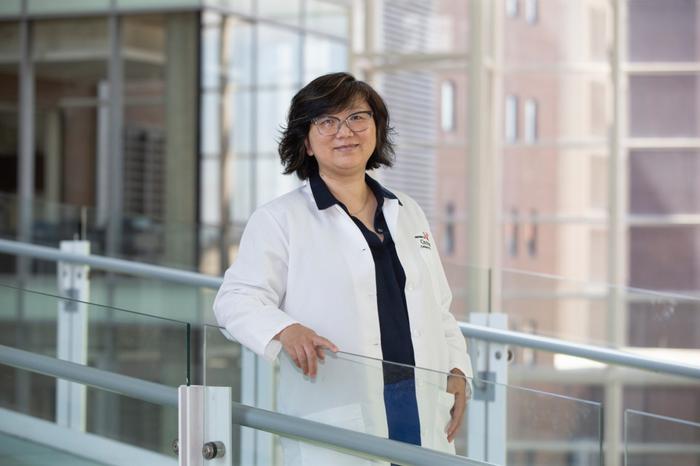
Credit: Photo/Andrew Higley/UC Marketing + Brand.
University of Cincinnati researchers have pioneered an animal model that sheds light on the role an understudied organ in the brain has in repairing damage caused by stroke.
The research was published July 2 in the Proceedings of the National Academy of Sciences and sought to learn more about how the adult brain generates new neurons to repair damaged tissue.
The research team focused on the choroid plexus, a small organ within brain ventricles that produces the brain’s cerebrospinal fluid (CSF). CSF circulates throughout the brain, carrying signaling molecules and other factors thought to be important for maintaining brain function. However, prior to this study, little was known about the roles the choroid plexus and CSF play in brain repair after injury due to a lack of available adult animal models.
“We have discovered a new use of an animal model to be able to allow us to manipulate the adult choroid plexus and CSF for the first time,” said Agnes (Yu) Luo, PhD, corresponding author on the study, and professor and vice chair in the Department of Molecular and Cellular Biosciences in UC’s College of Medicine. “Now that we’ve discovered it, this will be vitally applicable to allow researchers to manipulate the adult choroid plexus and CSF to study different disease models and biological processes.”
UC graduate student and study coauthor Aleksandr Taranov explained that in a process called adult neurogenesis, the adult brain maintains a certain capacity to repair damage by regenerating newly born neurons.
“However, we still don’t know what actually regulates adult neurogenesis and how to redirect the neurons into the lesion site following a stroke,” Taranov said.
Using this new model, the researchers found that removing the choroid plexus — and the resulting loss of CSF in brain ventricles — led to a reduction of newly born immature neurons called neuroblasts. In a model of ischemic stroke, the team found the loss of the choroid plexus and CSF led to fewer neuroblasts migrating to the lesion site and repairing damage caused by a stroke.
“This suggests that the choroid plexus may be needed to retain these neuroblasts in the area where they usually reside,” Taranov said. “And the choroid plexus might actually be required to retain the neuroblasts so they can readily migrate into the stroke site whenever a stroke or other injury occurs.”
Essentially, Luo said, it appears the choroid plexus keeps a garrison of regenerative cells that are ready to be deployed to injured areas in the brain in animal models of stroke. Further research is needed to confirm whether this also occurs in human brains.
Moving forward, Taranov is studying how the loss of the choroid plexus and CSF affects the clearing of toxic proteins in a model of Alzheimer’s disease, and fellow graduate student Elliot Wegman is studying the same effects in a model of Parkinson’s disease.
Other study coauthors include UC’s Alicia Bedolla, and Eri Iwasawa, Farrah Brown, Sarah Baumgartner, Elizabeth Fugate, Joel Levoy, Steven A. Crone and June Goto of Cincinnati Children’s Hospital Medical Center.
This study was supported by National Institutes of Health grants (R01AG083164 and R21NS127177).
Journal
Proceedings of the National Academy of Sciences
Method of Research
Experimental study
Subject of Research
Animals
Article Title
The choroid plexus maintains adult brain ventricles and subventricular zone neuroblast pool, which facilitates poststroke neurogenesis
Article Publication Date
2-Jul-2024
COI Statement
The authors declare no competing interest.
Cite Scienmag News
Cassandra Pierce. (July 8, 2024). University of Cincinnati study: Brain organ plays key role in adult neurogenesis. Scienmag. https://scienmag.com/university-of-cincinnati-study-brain-organ-plays-key-role-in-adult-neurogenesis/
Cassandra Pierce. "University of Cincinnati study: Brain organ plays key role in adult neurogenesis." Scienmag, 8 July 2024, https://scienmag.com/university-of-cincinnati-study-brain-organ-plays-key-role-in-adult-neurogenesis/. Accessed 5 September 2026.
Cassandra Pierce. "University of Cincinnati study: Brain organ plays key role in adult neurogenesis." Scienmag. July 8, 2024. https://scienmag.com/university-of-cincinnati-study-brain-organ-plays-key-role-in-adult-neurogenesis/

