
Friday, September 4, 2026
Science
No Result
View All Result
  • Login
  • HOME
  • SCIENCE NEWS
  • CONTACT US
  • HOME
  • SCIENCE NEWS
  • CONTACT US
No Result
View All Result
Scienmag
No Result
View All Result
Home Science News Cancer

CARM1 drives triple-negative breast cancer progression by coordinating with HIF1A

July 8, 2024
in Cancer
Nathaniel Bowman
By Nathaniel Bowman Scienmag Editorial Profile - Precision Oncology
Reading Time: 3 mins read
0
CARM1 drives triple-negative breast cancer progression by coordinating with HIF1A
66
SHARES
604
VIEWS
Share on FacebookShare on Twitter
ADVERTISEMENT

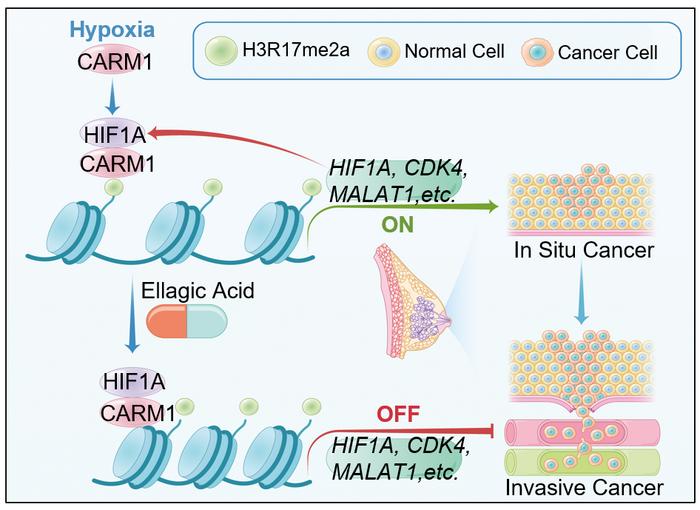
The article includes an introduction to the significance of breast cancer, particularly TNBC, and the role of post-translational modifications such as arginine methylation. The study details the expression and functional analysis of CARM1 in breast cancer, its interaction with HIF1A, and its impact on TNBC progression. Experimental data demonstrate that CARM1 promotes proliferation, invasion, EMT, and stemness in TNBC cells. Genome-wide analysis identifies CARM1’s transcriptional targets, emphasizing its role in various signaling pathways. The study concludes with findings on the potential therapeutic effects of ellagic acid as a CARM1 inhibitor.

Image

Credit: Dandan Feng, Jie Gao, Ruiqiong Liu, Wei Liu, Tianyang Gao, Yunkai Yang, Die Zhang, Tianshu Yang, Xin Yin, Hefen Yu, Wei Huang, and Yan Wang

The article includes an introduction to the significance of breast cancer, particularly TNBC, and the role of post-translational modifications such as arginine methylation. The study details the expression and functional analysis of CARM1 in breast cancer, its interaction with HIF1A, and its impact on TNBC progression. Experimental data demonstrate that CARM1 promotes proliferation, invasion, EMT, and stemness in TNBC cells. Genome-wide analysis identifies CARM1’s transcriptional targets, emphasizing its role in various signaling pathways. The study concludes with findings on the potential therapeutic effects of ellagic acid as a CARM1 inhibitor.

Key findings from the study include:

  1. CARM1 is highly expressed in breast cancer tissues, particularly in basal-like and triple-negative breast cancers. Clinical data and experimental analyses confirm its upregulation and correlation with breast cancer progression.
  2. Gain- and loss-of-function experiments show that CARM1 overexpression increases proliferation and invasion in TNBC cells, while its knockdown inhibits these processes. CARM1 influences cell cycle regulation and EMT marker expression.
  3. CARM1 overexpression leads to increased expression of mesenchymal markers and stemness-related genes, promoting EMT and stem cell-like properties in TNBC cells. Knockdown of CARM1 results in the opposite effect.
  4. Chromatin immunoprecipitation sequencing (ChIP-seq) and RNA sequencing (RNA-seq) identify CARM1’s binding sites and target genes. CARM1 regulates genes involved in key signaling pathways such as HIF-1, Wnt, and VEGF, contributing to TNBC progression.
  5. CARM1 physically associates with HIF1A, and this interaction is crucial for its recruitment to target gene promoters. This partnership drives the expression of genes critical for cell cycle progression and survival under hypoxic conditions.
  6. Ellagic acid, a natural inhibitor of CARM1, effectively reduces TNBC cell proliferation and invasion by directly inhibiting CDK4 expression. This finding suggests that targeting CARM1 with ellagic acid could be a promising therapeutic strategy for TNBC.

The study concludes that CARM1 plays a significant role in the progression of triple-negative breast cancer by interacting with HIF1A and regulating genes involved in cell cycle and signaling pathways. The upregulation of CARM1 in breast cancer tissues, especially in more aggressive subtypes like TNBC, highlights its potential as a biomarker for cancer progression. Experimental evidence demonstrates that CARM1 enhances proliferation, invasion, EMT, and stemness in TNBC cells, indicating its pivotal role in cancer metastasis and resistance to treatment. The identification of ellagic acid as a potent inhibitor of CARM1 opens new avenues for therapeutic intervention. By suppressing CDK4 expression, ellagic acid shows promise in reducing TNBC proliferation and invasion, providing a potential natural compound for cancer therapy. This research underscores the importance of targeting CARM1 in developing effective treatments for TNBC and possibly other cancers with elevated CARM1 expression. The work entitled “ CARM1 drives triple-negative breast cancer progression by coordinating with HIF1A ” was published on Protein & Cell (published on Mar. 13, 2024).


Journal

Protein & Cell

DOI

10.1093/procel/pwae010

Method of Research

Experimental study

Subject of Research

Animals

Article Title

CARM1 drives triple-negative breast cancer progression by coordinating with HIF1A

Article Publication Date

13-Mar-2024

Subject of Research: Cancer

Article Title: CARM1 drives triple-negative breast cancer progression by coordinating with HIF1A

Article References: Original research article

Image Credits: AI Generated

DOI: Not provided

Keywords: Not provided

Cite Scienmag News

Nathaniel Bowman. (July 8, 2024). CARM1 drives triple-negative breast cancer progression by coordinating with HIF1A. Scienmag. https://scienmag.com/carm1-drives-triple-negative-breast-cancer-progression-by-coordinating-with-hif1a/

Nathaniel Bowman. "CARM1 drives triple-negative breast cancer progression by coordinating with HIF1A." Scienmag, 8 July 2024, https://scienmag.com/carm1-drives-triple-negative-breast-cancer-progression-by-coordinating-with-hif1a/. Accessed 4 September 2026.

Nathaniel Bowman. "CARM1 drives triple-negative breast cancer progression by coordinating with HIF1A." Scienmag. July 8, 2024. https://scienmag.com/carm1-drives-triple-negative-breast-cancer-progression-by-coordinating-with-hif1a/

Share26Tweet17
Previous Post

Noise no more: transforming sound barriers with material optimization

Next Post

Almost half of US counties have no cardiologists despite higher prevalence of CV risk factors, mortality

Related Posts

Targeted nutrition during oesophageal cancer treatment preserves muscle and aids recovery
Cancer

Targeted nutrition during oesophageal cancer treatment preserves muscle and aids recovery

September 3, 2026
Digital health tools reshape cancer prevention alongside traditional in-person care
Cancer

Digital health tools reshape cancer prevention alongside traditional in-person care

September 3, 2026
What influences cancer survivors’ participation in colorectal and breast screening
Cancer

What influences cancer survivors’ participation in colorectal and breast screening

September 3, 2026
α-Synuclein curbs glioma growth via CDH13–JNK/c-Jun signaling pathway
Cancer

α-Synuclein curbs glioma growth via CDH13–JNK/c-Jun signaling pathway

September 3, 2026
A heterogeneous multimodal ensemble framework for multi-omics breast cancer prognosis
Cancer

A heterogeneous multimodal ensemble framework for multi-omics breast cancer prognosis

September 3, 2026
Largest Study of Its Kind Reveals How Australian Dogs Fare Against Lymphoma
Cancer

Largest Study of Its Kind Reveals How Australian Dogs Fare Against Lymphoma

September 3, 2026
Next Post
Almost half of US counties have no cardiologists despite higher

Almost half of US counties have no cardiologists despite higher prevalence of CV risk factors, mortality

  • Mothers who receive childcare support from maternal grandparents show more optimized

    Mothers who receive childcare support from maternal grandparents show more parental warmth, finds NTU Singapore study

    27656 shares
    Share 11059 Tweet 6912
  • University of Seville Breaks 120-Year-Old Mystery, Revises a Key Einstein Concept

    1061 shares
    Share 424 Tweet 265
  • Bee body mass, pathogens and local climate influence heat tolerance

    682 shares
    Share 273 Tweet 171
  • Researchers record first-ever images and data of a shark experiencing a boat strike

    546 shares
    Share 218 Tweet 137
  • Groundbreaking Clinical Trial Reveals Lubiprostone Enhances Kidney Function

    531 shares
    Share 212 Tweet 133
Science

Embark on a thrilling journey of discovery with Scienmag.com—your ultimate source for cutting-edge breakthroughs. Immerse yourself in a world where curiosity knows no limits and tomorrow’s possibilities become today’s reality!

RECENT NEWS

  • Quantum computers tackle image loading and classification at utility scale
  • Quantum Codes Derived from Constacyclic Codes over Non-Chain Finite Rings
  • Groundwater extraction drives dispossession across India’s Kaveri Delta
  • Satellite data and climate models reveal Arabian Gulf warming trends

Categories

  • Agriculture
  • Anthropology
  • Archaeology
  • Athmospheric
  • Biology
  • Biotechnology
  • Blog
  • Bussines
  • Cancer
  • Chemistry
  • Climate
  • Earth Science
  • Editorial Policy
  • Marine
  • Mathematics
  • Medicine
  • Pediatry
  • Policy
  • Psychology & Psychiatry
  • Science Education
  • Social Science
  • Space
  • Technology and Engineering

Subscribe to Blog via Email

Enter your email address to subscribe to this blog and receive notifications of new posts by email.

Join 5,151 other subscribers

© 2025 Scienmag - Science Magazine

Welcome Back!

Login to your account below

Forgotten Password?

Retrieve your password

Please enter your username or email address to reset your password.

Log In
No Result
View All Result
  • HOME
  • SCIENCE NEWS
  • CONTACT US

© 2025 Scienmag - Science Magazine

Discover more from Science

Subscribe now to keep reading and get access to the full archive.

Continue reading