


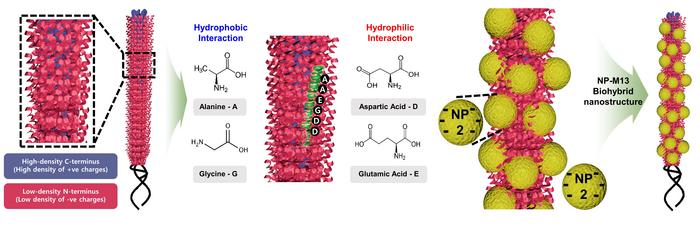
The research team of Dr. Jae Ho Kim and Dr. Myungkwan Song from the Energy and Environmental Materials Research Division at the Korea Institute of Materials Science (KIMS), under the direction of President Chul-jin Choi, in collaboration with Professor Jin-Woo Oh from Pusan National University and Professor Jin Woo Choi from Kongju National University, developed hybrid bio-nanostructures. Utilizing these nanostructures, they fabricated fibrous solar cells (FSCs) and fibrous organic light-emitting diodes (FOLEDs) that demonstrate high performance and stability across a wide temperature range, from minus 80 degrees Celsius to 150 degrees Celsius. The team reported a 40% increase in a power conversion efficiency (PCE) of the FSCs and a 47% increase in an external quantum efficiency (EQE) of the FOLEDs.

Credit: Korea Institute of Materials Science (KIMS)
The research team of Dr. Jae Ho Kim and Dr. Myungkwan Song from the Energy and Environmental Materials Research Division at the Korea Institute of Materials Science (KIMS), under the direction of President Chul-jin Choi, in collaboration with Professor Jin-Woo Oh from Pusan National University and Professor Jin Woo Choi from Kongju National University, developed hybrid bio-nanostructures. Utilizing these nanostructures, they fabricated fibrous solar cells (FSCs) and fibrous organic light-emitting diodes (FOLEDs) that demonstrate high performance and stability across a wide temperature range, from minus 80 degrees Celsius to 150 degrees Celsius. The team reported a 40% increase in a power conversion efficiency (PCE) of the FSCs and a 47% increase in an external quantum efficiency (EQE) of the FOLEDs.
The ‘spin coating’ method, commonly used for coating metal nanoparticles, allows for the quick and simple creation of thin films. However, this method has the drawback of being unable to coat metal nanoparticles evenly and orderly. To address this issue, the team synthesized the‘M13 bacteriophage’, a biomaterial that has the property of arranging metal nanoparticles uniformly and orderly. The M13 bacteriophage possesses active groups that bind to metal cations, ensuring consistent arrangement of all metal cations. As a result, the hybrid bio-nanostructure synthesized from M13 bacteriophage exhibits high stability in air and moisture, and enabling high-performance FSCs and FOLEDs. In addition, it was confirmed that it showed excellent characteristics in extreme environments (-80 ℃ and 150 ℃) and washing durability.
The M13 bacteriophage can be utilized in various electronic devices, including piezoelectric devices, solar cells, sensors, and organic light-emitting diodes. A distinctive feature of this technology is its ability to easily arrange and align metal nanoparticles when using hybrid bio-nanostructures. It can also maximize the surface plasmonic effect, making it applicable to a wide range of electronic devices. If this technology is employed to accelerate localization and mass production, it is expected to generate significant economic benefits for electronic device companies.
Myungkwan Song, a principal investigator and the lead of this research, said, “By utilizing hybrid bio-nanostructures, we can improve both performance and stability in the field of electronic devices,”and added,“It is expected to be applied in various fields such as sensor materials as well as energy production and storage materials in the future.”
This research was funded by the Ministry of Science and ICT through the fundamental project of KIMS (development of a fiber-type energy harvesting and storage platform) and the mid-career researcher support project of the National Research Foundation of Korea. The research results were published in Small Structures on May 7. Currently, the research team is continuing to conduct follow-up research to develop various bio-nanostructures for applications in organic electronic devices and in vitro diagnostic sensors.
————————————————————————-
###
About Korea Institute of Materials Science(KIMS)
KIMS is a non-profit government-funded research institute under the Ministry of Science and ICT of the Republic of Korea. As the only institute specializing in comprehensive materials technologies in Korea, KIMS has contributed to Korean industry by carrying out a wide range of activities related to materials science including R&D, inspection, testing&evaluation, and technology support.
Journal
Small Structures
Article Title
Novel Strategy towards Efficiency Enhancement of Flexible Optoelectronic Devices with Engineered M13 Bacteriophage
Article Publication Date
7-May-2024
Cite Scienmag News
Denise Maddox. (July 8, 2024). Achieving high performance and stability simultaneously! Scienmag. https://scienmag.com/achieving-high-performance-and-stability-simultaneously/
Denise Maddox. "Achieving high performance and stability simultaneously!" Scienmag, 8 July 2024, https://scienmag.com/achieving-high-performance-and-stability-simultaneously/. Accessed 3 September 2026.
Denise Maddox. "Achieving high performance and stability simultaneously!" Scienmag. July 8, 2024. https://scienmag.com/achieving-high-performance-and-stability-simultaneously/

