


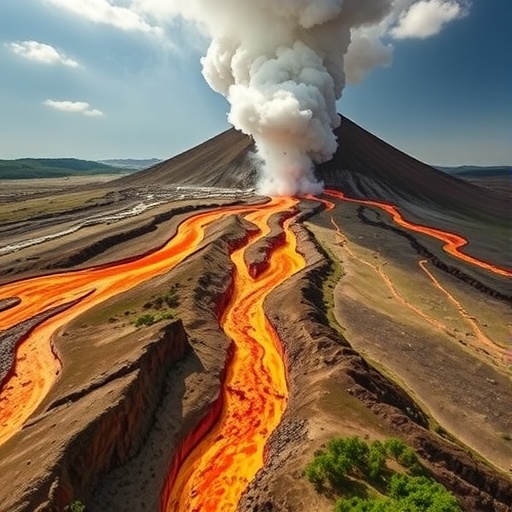
In recent years, the study of pyroclastic density currents (PDCs) has emerged as one of the most vital areas of research within volcanology and geophysical sciences. Pyroclastic density currents, which are fast-moving mixtures of volcanic gases, ash, and other volcanic materials, represent a significant hazard due to their destructive potential and ability to travel over large distances. A groundbreaking study conducted by scientists including Biagioli, Métaxian, and Stutzmann aims to enhance our understanding of these phenomena through the deployment of multiparameter geophysical sensing techniques. Their research is featured in a recent article published in Commun Earth Environ and sheds light on the dynamic behavior of PDCs.
Determining the practical applications of multiparameter geophysical sensing has revealed its remarkable capacity to monitor active volcanic systems in real-time. Traditional observational methods often fall short in capturing the complexity and rapid changes associated with PDCs. However, this new approach allows for the integration of various sensing technologies, providing a more comprehensive view of the volcanic processes. The incorporation of multiple data sources enables researchers to analyze the flow dynamics, material composition, and thermal characteristics of these hazardous currents in unprecedented detail.
One of the major advantages of employing a multiparameter sensing approach is the ability to track different parameters simultaneously. This includes not only velocity and flow direction but also temperature gradients and gas emissions. Such multifaceted data collection significantly improves our understanding of how PDCs evolve during an eruption, which in turn can help forecast their movement and potential impact on surrounding regions. The innovative integration of these various parameters marks a crucial development in volcanic monitoring.
The research highlighted by Biagioli and collaborators emphasizes the need for real-time data acquisition during volcanic eruptions. Time-lapse studies and high-resolution spatial data can reveal critical insights regarding the initiation, propagation, and deposition of PDCs. By understanding how these currents form and their subsequent behavior, scientists can devise better hazard assessments and evacuation plans for communities situated near active volcanoes. The potential for saving lives and reducing economic losses is profound, highlighting the societal relevance of this research.
In addition to immediate hazard mitigation efforts, the findings from this study also contribute to theoretical models of volcanic behavior. Current models often rely on historical data or limited field observations, but the dynamic nature of PDCs means that these models can become outdated quickly. The incorporation of real-time data into these models allows for more adaptive approaches, leading to predictive capabilities that can be adjusted as new information becomes available during an eruption.
Moreover, the study signifies a move towards more interdisciplinary approaches in volcanic research. The collaboration among geophysicists, volcanologists, and data scientists has paved the way for innovative methodologies that merge traditional geological understanding with cutting-edge technology. This collaborative spirit is essential as the field continues to face the complexities of natural disasters that require multifaceted solutions.
One critical challenge the researchers faced was the installation of sensors in remote and often dangerous volcanic environments. Adaptations had to be made to ensure that equipment could withstand extreme temperatures, corrosive gases, and the stability required to capture accurate data during an eruptive event. Overcoming these installation hurdles emphasizes the perseverance and ingenuity required to advance volcanic monitoring techniques in the field.
Focusing on the broader implications of their findings, the research team also considers the role of public awareness and education regarding the hazards presented by PDCs. By enhancing scientific communication regarding these dangers, the general public may be more inclined to take necessary precautions when living in proximity to active volcanoes. Implementing community engagement strategies that rely on the new data and predictive models can significantly improve public safety during volcanic events.
The publication of these findings is timely, coming at a period when many regions around the globe are experiencing volcanic activity. With an increasing urgency to develop a science-based understanding of volcanic behavior, the work of Biagioli, Métaxian, and Stutzmann stands as a catalyst for continued innovation in this critical area of study. The insights gleaned from their research not only advance scientific knowledge but also contribute to global efforts in disaster risk reduction.
Through the use of cutting-edge technology and methodologies, the research illustrates the importance of being proactive rather than reactive to volcanic hazards. The implications of enhanced monitoring extend beyond immediate danger; they also speak to the broader impacts of climate change on volcanic activity and the subsequent risks posed to human populations and ecosystems. The interplay between volcanoes and climate is an area ripe for further research, potentially offering new avenues for understanding natural disasters in a changing world.
In conclusion, the work by Biagioli and colleagues is a significant step forward in unraveling the complexities of pyroclastic density currents. Their emphasis on the effective use of multiparameter geophysical sensing may redefine how scientists approach volcanic activities and risks. By keeping a keen eye on technological advancements and fostering interdisciplinary collaboration, the scientific community can better prepare for the inevitable challenges posed by these powerful natural events. Future research will undoubtedly build upon these findings, broadening the scope of understanding regarding volcanoes and ultimately enhancing societal resilience to their impacts.
As we further explore the capabilities of multiparameter geophysical sensing, there remains a world of knowledge yet to uncover regarding the dynamics of pyroclastic density currents. The journey of understanding these phenomena is far from over, and the dedication of researchers like Biagioli, Métaxian, and Stutzmann provides hope for safer futures in volcanic regions around the globe.
Biagioli, F., Métaxian, JP., Stutzmann, E. et al. Unraveling pyroclastic density current dynamics with multiparameter geophysical sensing.
Commun Earth Environ (2026). https://doi.org/10.1038/s43247-025-03091-6
Cite Scienmag News
Eleanor C. (January 29, 2026). Decoding Pyroclastic Flows with Advanced Geophysical Sensing. Scienmag. https://scienmag.com/decoding-pyroclastic-flows-with-advanced-geophysical-sensing/
Eleanor C. "Decoding Pyroclastic Flows with Advanced Geophysical Sensing." Scienmag, 29 January 2026, https://scienmag.com/decoding-pyroclastic-flows-with-advanced-geophysical-sensing/. Accessed 29 August 2026.
Eleanor C. "Decoding Pyroclastic Flows with Advanced Geophysical Sensing." Scienmag. January 29, 2026. https://scienmag.com/decoding-pyroclastic-flows-with-advanced-geophysical-sensing/


