


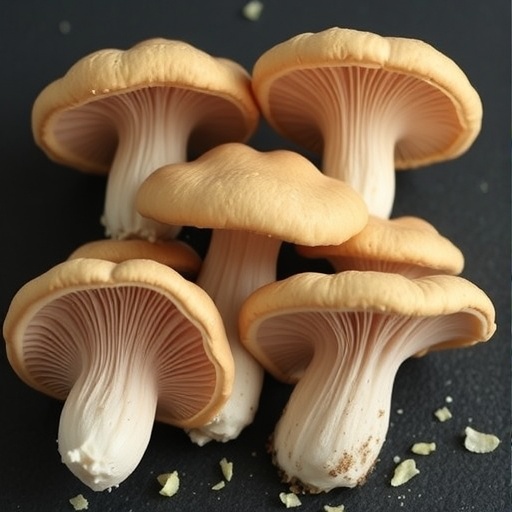
In a groundbreaking advancement poised to revolutionize food preservation, researchers have introduced an innovative edible coating technology that could dramatically extend the shelf life of perishable produce like button mushrooms. This new development harnesses the synergy between polyethylene–nanoclay composites and hydrolyzed protein derived from Turkmen melon seeds, creating a biodegradable barrier that not only preserves freshness but also enhances the safety and quality of foods during storage.
The delicate nature of button mushrooms has long challenged food scientists and the agricultural sector alike, as these fungi are highly susceptible to rapid deterioration post-harvest. Traditional preservation methods often fall short in balancing efficacy with environmental concerns, frequently relying on synthetic preservatives or refrigeration that may not sufficiently inhibit spoilage or microbial growth. The introduction of edible coatings, particularly those based on safe, natural materials, marks a promising pivot toward sustainable preservation solutions.
Central to this innovation is the utilization of polyethylene integrated with nanoclay particles to form a composite matrix. Polyethylene’s well-documented mechanical strength and flexibility, when combined with nanoclay’s exceptional barrier properties against oxygen and moisture diffusion, results in a formidable material capable of shielding mushrooms from environmental factors that accelerate spoilage. The nanoscale dispersion of clay within the polymer significantly enhances the density and tortuosity of the coating, making it exceedingly difficult for deleterious gases to penetrate.
The most distinctive feature of this research, however, is the enrichment of this polymer–nanoclay matrix with hydrolyzed protein extracted from the seeds of the Turkmen melon, a resource previously underexplored for food technology applications. Hydrolyzed proteins, broken down into smaller peptides and amino acids, can interact at the molecular level to improve the coating’s adhesion and flexibility. Furthermore, these proteins offer inherent bioactive properties, such as antimicrobial effects, which further contribute to prolonging the freshness and edibility of coated foods.
Through meticulous process optimization, the researchers achieved a uniform coating that is transparent, tasteless, and non-toxic—qualities imperative to consumer acceptance. The edible coating forms a semi-permeable film over the mushrooms, regulating gas exchange and moisture loss, which are critical parameters for maintaining mushroom texture and appearance. By reducing transpiration and respiration rates, the coating mitigates the enzymatic activities and microbial proliferation responsible for spoilage.
Extensive storage tests revealed that mushrooms treated with the polyethylene–nanoclay–protein coating maintained their firmness, color, and overall sensory attributes significantly longer than untreated controls. While uncoated mushrooms typically deteriorated within a week under standard refrigeration, those enveloped in the innovative coating retained marketable qualities for nearly two weeks. This doubling of shelf life presents profound implications, potentially slashing food waste at distribution nodes and retail shelves.
In addition to preservation performance, the biocompatibility and biodegradability of the edible coatings also address the pressing environmental concerns associated with plastic packaging waste. Conventional polyethylene films pose disposal challenges, often lingering in ecosystems for centuries. However, the incorporation of natural nanoclays and plant-derived proteins facilitates a more sustainable lifecycle, with the coatings designed to break down harmlessly after consumption or disposal.
From a biochemical perspective, the hydrolyzed melon seed proteins exhibited a remarkable capacity to form hydrogen bonds and electrostatic interactions with the polymer matrix. This molecular interplay not only enhances the mechanical integrity of the films but also modulates their permeability characteristics, tailoring them precisely for the nuanced respiration needs of mushrooms. Furthermore, preliminary antimicrobial assays indicated a suppression of common spoilage and pathogenic microorganisms, suggesting an inherent food safety advantage.
Importantly, the sourcing of Turkmen melon seeds as a raw material introduces an element of circular economy and value addition to agricultural by-products. Often overlooked or discarded, these seeds are rich in proteins that can be enzymatically hydrolyzed to produce functional peptides suitable for food applications. This valorization strategy not only provides cost-effective inputs but also incentivizes sustainable agricultural practices in melon-producing regions.
The multidisciplinary nature of this research—spanning polymer science, food chemistry, nanotechnology, and agricultural sustainability—exemplifies the collaborative efforts required to solve contemporary food preservation challenges. The study employed advanced characterization techniques such as scanning electron microscopy to elucidate film morphology, Fourier-transform infrared spectroscopy to analyze molecular interactions, and dynamic mechanical analysis to assess coating elasticity and resilience under varying conditions.
While the current findings are promising, the research team acknowledges that further scaling studies and consumer acceptance testing are critical before commercial adoption. Future investigations will explore the coating’s applicability to other highly perishable fruits and vegetables, its behavior under different storage atmospheres, and the economic viability of upscaling production. Integration with intelligent packaging systems is also on the horizon, potentially enabling real-time monitoring of freshness and spoilage indicators.
A key takeaway from this novel edible coating technology is its multifaceted contribution to food preservation—extending shelf life, improving food safety, reducing environmental impact, and promoting sustainable resource use. As global demand for fresh produce continues to escalate and food waste becomes an increasingly urgent issue, such innovations pave the way for smarter, more responsible food supply chains.
In conclusion, the enrichment of polyethylene–nanoclay edible coatings with Turkmen melon seed hydrolyzed protein represents a leap forward in edible film technology. By combining natural bioactive molecules with state-of-the-art nanocomposite materials, this approach offers a potent, eco-friendly solution to enhance the longevity and quality of delicate fruits and vegetables. The implications for consumers, producers, and the planet alike suggest a transformative impact on how we think about food preservation in the coming decades.
Cite Scienmag News
Drew Townsend. (January 29, 2026). Nanoclay-Melon Protein Coatings Extend Mushroom Shelf Life. Scienmag. https://scienmag.com/nanoclay-melon-protein-coatings-extend-mushroom-shelf-life/
Drew Townsend. "Nanoclay-Melon Protein Coatings Extend Mushroom Shelf Life." Scienmag, 29 January 2026, https://scienmag.com/nanoclay-melon-protein-coatings-extend-mushroom-shelf-life/. Accessed 3 September 2026.
Drew Townsend. "Nanoclay-Melon Protein Coatings Extend Mushroom Shelf Life." Scienmag. January 29, 2026. https://scienmag.com/nanoclay-melon-protein-coatings-extend-mushroom-shelf-life/


