


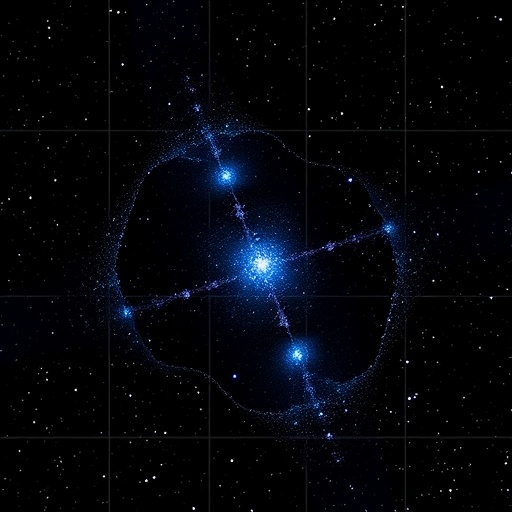
In a groundbreaking advancement that promises to deepen our understanding of the Universe’s hidden architecture, astronomers have produced the most detailed and expansive weak gravitational lensing map to date. This ultra-high-resolution mass map, uncovered through the unparalleled capabilities of the James Webb Space Telescope (JWST), opens a new window on the elusive dark matter that dominates the cosmos but remains invisible to conventional observation. By precisely charting the subtle warping of light as it travels through vast cosmic structures, researchers have illuminated the complex relationship between dark and ordinary matter across a swathe of the Universe that reaches back billions of years.
For decades, the cosmic puzzle posed by dark matter—an invisible substance forming nearly five times the mass of all visible matter combined—has mystified scientists. Ordinary matter, the stuff that composes stars, planets, and humans, accounts for only roughly one-sixth of all matter in the cosmos. The rest, dark matter, interacts primarily through gravity, eluding direct detection through electromagnetic radiation. Its gravitational influence, however, sculpts the large-scale structure of the Universe, making gravitational lensing one of the few tools capable of probing its distribution.
The technique employed here, weak gravitational lensing, involves detecting tiny distortions in the shape of distant galaxies caused by the gravitational pull of matter lying along the line of sight. Unlike strong lensing, which bends light into easily recognizable arcs or multiple images, weak lensing’s subtlety demands exquisite precision in measuring galactic shapes over large areas of the sky. Achieving such precision has historically been challenging, limited by the resolution and sensitivity of previous space telescopes.
Enter JWST, whose cutting-edge instrumentation and infrared imaging capabilities, particularly through the COSMOS-Web survey, have revolutionized weak lensing studies. The new map covers an area of 0.77 by 0.70 degrees on the sky, a relatively small patch by cosmic standards but an enormous leap in detail. By leveraging the shapes of 129 galaxies per square arcminute—many surveyed independently in two infrared bands, F115W and F150W—the researchers attain an angular resolution finer than 1 arcminute. This resolution is more than twice that achieved by prior surveys using the Hubble Space Telescope, enabling astronomers to trace the intricate cosmic web with unprecedented clarity.
The resulting mass map reveals not only the distribution of dark matter but also its intimate interplay with luminous galaxies. Structures such as filaments, clusters, and vast underdense voids emerge vividly, illustrating how dark and ordinary matter co-evolve over cosmic time. Notably, this map extends its reach out to redshifts approaching z ≈ 2, capturing mass structures at a time when the Universe was less than half its current age. This high-redshift sensitivity is crucial for understanding the environments in which galaxies formed and evolved during the epoch of peak cosmic star formation.
Among the features highlighted by the map is a massive structure located at a redshift of approximately z ≈ 1.1, making it one of the most distant mass concentrations ever observed through weak lensing. By tracing such distant structures, the study offers insights into the underlying scaffolding that guided the formation of galaxies and large-scale structures billions of years ago. The clarity and detail of this new lensing map provide a vital benchmark for testing competing theories about the nature of dark matter, whether cold, warm, or self-interacting, as well as models of cosmic evolution.
The significance of this achievement extends beyond astrophysics; mapping dark matter to such precision holds profound implications for particle physics, cosmology, and our understanding of fundamental forces. As JWST’s deep, high-resolution observations continue, astronomers anticipate refining cosmological parameters with tighter constraints, potentially revealing deviations from the standard model of cosmology or uncovering new physics.
Technical experts emphasize that the methodology behind the map’s creation involved meticulous calibration and shape measurement algorithms capable of disentangling lensing signals from noise and systematic errors. The dual-band approach, utilizing both F115W and F150W infrared filters, mitigates biases linked to galaxy color and morphological evolution, ensuring robustness in the signals extracted. The combination of deep field coverage and high galaxy density yields a lensing signal of exceptional fidelity.
Moreover, this map sets a new standard for future surveys, such as those anticipated with the Nancy Grace Roman Space Telescope and the Euclid mission. These forthcoming programs aim to survey much larger areas but with resolutions that historically could not match JWST’s. Consequently, the COSMOS-Web map functions as a template to calibrate and validate larger-scale lensing analyses, particularly in regimes probing higher redshift structures.
The study also marks an important milestone in leveraging space-based infrared observations to complement optical data. Infrared imaging penetrates dust and extends surveys to more distant galaxies whose emitted light is redshifted beyond optical wavelengths. This feature is pivotal for unraveling the growth of structure during early cosmic epochs, where galaxy clusters form and evolve amidst a rapidly changing backdrop of star formation and dark matter accretion.
Intriguingly, the detailed mapping of dark matter filaments connecting galaxy clusters offers tantalizing perspectives on the mechanisms driving galaxy interactions, cluster mergers, and the flow of baryonic matter along these cosmic highways. By dissecting these connections at an angular scale below 1 arcminute, astronomers can probe environments where dark matter density gradients influence gas dynamics, star formation rates, and feedback from black holes.
Additionally, the data harnessed here provides fertile ground for machine learning and artificial intelligence applications, potentially accelerating the classification of cosmic structures and uncovering subtle lensing features overlooked by traditional analysis. The marriage of JWST’s unparalleled imagery with advanced computational techniques heralds a new era of dark matter science.
This pioneering work emphatically demonstrates that the quest to map the invisible Universe is accelerating at an extraordinary pace, fueled by technological innovation and collaborative scientific efforts. As researchers continue to analyze JWST’s treasure trove of data, we can expect transformative insights into the dark sector’s role in shaping cosmic history and the ultimate fate of the cosmos.
The authors of this study, led by D. Scognamiglio, G. Leroy, and D. Harvey among others, have not only produced a stunningly detailed map but have also laid the groundwork for future investigations coupling weak lensing with other cosmological probes. By integrating these findings with observations across the electromagnetic spectrum and particle detectors on Earth, the scientific community moves closer to unraveling the profound mysteries of dark matter.
In conclusion, this unprecedented weak lensing mass map embodies a monumental leap forward in cosmology, revealing the hidden structure of the Universe with unprecedented sharpness and depth. It challenges theorists to reconcile these empirical observations with existing models and ignites excitement for what future observations might reveal. In an era where the cosmic dark frontier remains largely uncharted, the James Webb Space Telescope has provided a beacon, illuminating the shadowy matter that orchestrates the grand cosmic dance.
Cite Scienmag News
Grant Pearson. (January 26, 2026). Ultra-High-Resolution Dark Matter Map Unveiled. Scienmag. https://scienmag.com/ultra-high-resolution-dark-matter-map-unveiled/
Grant Pearson. "Ultra-High-Resolution Dark Matter Map Unveiled." Scienmag, 26 January 2026, https://scienmag.com/ultra-high-resolution-dark-matter-map-unveiled/. Accessed 3 September 2026.
Grant Pearson. "Ultra-High-Resolution Dark Matter Map Unveiled." Scienmag. January 26, 2026. https://scienmag.com/ultra-high-resolution-dark-matter-map-unveiled/


