


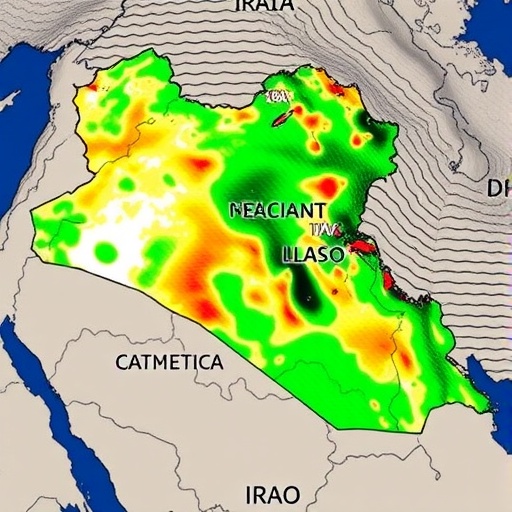
In an era where environmental concerns reign supreme, accurate forecasting of carbon dioxide (CO₂) emissions has emerged as a pivotal element in formulating effective climate policies. A recent study conducted by Rahim, S.A. and Shaker Ismael Botani has shed light on the complex dynamics of CO₂ emissions in Iraq, using advanced analytical techniques, namely Autoregressive Integrated Moving Average with Exogenous Variables (ARIMAX) and artificial neural networks (ANN). Their research not only highlights the pressing issue of greenhouse gas emissions but also showcases the significance of predictive modeling in environmental science.
This groundbreaking study focuses on Iraq, a nation that has witnessed significant industrial growth and urban expansion in recent decades. The implications of this growth, particularly regarding CO₂ emissions, cannot be overstated. Iraq’s reliance on fossil fuels combined with rapid population growth has compounded the challenge of managing greenhouse gases. It is essential to comprehend the patterns and projections of CO₂ emissions to create effective strategies for mitigation.
The research employs a comparative modeling approach, contrasting the efficacy of ARIMAX and ANN methodologies. ARIMAX is a statistical method that combines autoregression and moving averages with external variables to generate forecasts. It leverages historical data to predict future emissions, making it a traditional yet robust approach in time series analysis. On the other hand, artificial neural networks are inspired by biological neural networks and are adept at recognizing patterns through complex, non-linear relationships. This machine-learning technique is particularly useful when dealing with large datasets and can capture relationships that traditional methods may overlook.
One of the remarkable aspects of the study is the dual approach to forecasting emissions. By integrating the strengths of both ARIMAX and ANN, the researchers aim to establish a more nuanced understanding of the driving factors behind CO₂ emissions in Iraq. This comparative analysis not only enhances the accuracy of predictions but also allows for a deeper exploration of the underlying variables influencing emissions, such as energy consumption and economic activities.
The researchers utilized an extensive dataset encompassing several years of CO₂ emission records, alongside relevant variables including industrial output, energy consumption, and population growth rates. This wealth of data enabled them to conduct a thorough analysis, critical for understanding the multifaceted nature of emissions. The findings underscore a significant growth trend in CO₂ emissions, correlating with the increased dependency on oil and gas both for energy and economic development.
The implications of this study extend far beyond historical trends. As climate change continues to exert its influence globally, the need for timely and accurate forecasts becomes increasingly crucial. Policymakers and environmental agencies are tasked with the significant challenge of implementing effective strategies to curb emissions. By utilizing findings from this research, stakeholders can make informed decisions that prioritize sustainability and environmental preservation.
Moreover, this research addresses an overarching concern in the realm of climate science: the need for local data-driven models. Many existing global models may not accurately represent local circumstances and trends. The study conducted by Rahim et al. offers invaluable insights specifically tailored to Iraq’s unique economic and environmental context, thus paving the way for localized solutions.
Furthermore, the research underscores the importance of integrating advanced computational techniques into environmental planning. The use of artificial intelligence, particularly through ANN, illustrates the potential for innovative approaches to capture the complexities of emissions data. As technology continues to evolve, the fusion of traditional statistical methods with modern machine learning can revolutionize the way researchers and policymakers approach environmental challenges.
As the urgency of climate action escalates, this study serves as a clarion call for more robust modeling techniques in developing nations, where data scarcity often hampers effective environmental management. The findings advocate for a proactive approach towards emissions forecasting, emphasizing that accurate models are essential not only for predicting trends but also for strategizing mitigatory actions.
In conclusion, the work carried out by Rahim, S.A. and Shaker Ismael Botani is a significant contribution to the field of environmental science. By comparing ARIMAX and ANN models to forecast CO₂ emissions in Iraq, this research not only highlights the growing concern of greenhouse gases but also propels the discussion on the methodologies employed in emissions forecasting. The insights derived from this study could underpin strategic actions in Iraq and similar developing nations, ultimately contributing to global efforts in combating climate change.
As more researchers gravitate towards such comparative analyses, the hope is that the environmental science community will continue to innovate and refine its forecasting methods. In doing so, a future may be envisioned where informed policy decisions lead to tangible reductions in greenhouse gas emissions, paving the way for a more sustainable planet.
In an age where every fraction of a degree matters in the fight against climate change, studies like these represent the critical steps taken towards a better understanding of our environmental footprint.
Rahim, S.A., Shaker Ismael Botani, D. Forecasting CO\(_2\) emissions in Iraq using ARIMAX and artificial neural networks: a comparative modeling approach.
Environ Sci Pollut Res (2026). https://doi.org/10.1007/s11356-026-37394-8
Cite Scienmag News
Cassandra Pierce. (January 19, 2026). Comparing ARIMAX and Neural Networks for Iraq’s CO\(_2\) Emissions. Scienmag. https://scienmag.com/comparing-arimax-and-neural-networks-for-iraqs-co_2-emissions/
Cassandra Pierce. "Comparing ARIMAX and Neural Networks for Iraq’s CO\(_2\) Emissions." Scienmag, 19 January 2026, https://scienmag.com/comparing-arimax-and-neural-networks-for-iraqs-co_2-emissions/. Accessed 4 September 2026.
Cassandra Pierce. "Comparing ARIMAX and Neural Networks for Iraq’s CO\(_2\) Emissions." Scienmag. January 19, 2026. https://scienmag.com/comparing-arimax-and-neural-networks-for-iraqs-co_2-emissions/


