


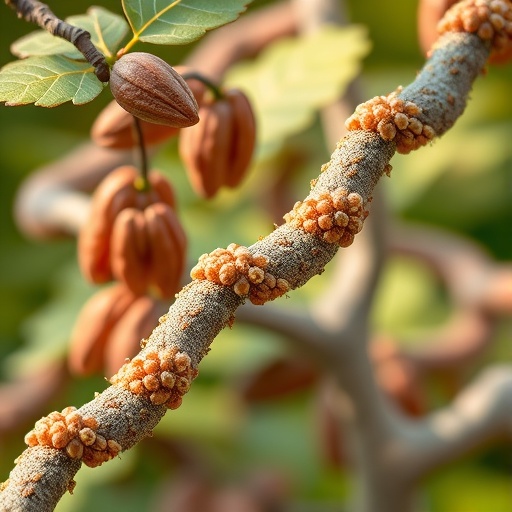
Researchers have delved deeply into the enigmatic world of plant genetics, spotlighting the BAHD gene family and its pivotal role within the pecan tree (Carya illinoinensis). This exhaustive study sheds light on how these genes influence various developmental processes and the response to environmental stressors. Advancements in genomic sequencing technologies have made it increasingly feasible to explore complex gene families, and the BAHD family is no exception. Characterized by their essential functions in the biosynthesis of secondary metabolites, these genes have significant implications for plant health and adaptability.
The BAHD gene family comprises numerous members that encode acyl transferases, crucial enzymes responsible for modifying diverse substrates. Their involvement in the biosynthesis of phenolic compounds, flavonoids, and lignins positions them as key players in the plant’s defensive strategies. The equilibrium between growth and stress response in pecans might significantly hinge on the activity of these genes, warranting rigorous genomic analysis. As environmental stresses become increasingly pronounced due to climate change, understanding genetic responses within crops becomes not just academic but essential for developing resilience in agricultural systems.
In examining the expression patterns of BAHD genes during various developmental stages, the study uncovers a dynamic tapestry of gene activity. In young pecan trees, a pronounced activation of certain BAHD genes was observed, indicating their role in early growth phases. Conversely, as trees progress to maturity, different subsets of BAHD genes are upregulated, suggesting a transition in metabolic priorities. This developmental shift is crucial; it underscores how plants recalibrate their genetic responses to align with their life stage, ultimately influencing productivity and resilience.
Moreover, the research highlights the response of BAHD genes to abiotic stresses—primarily drought and salinity, which are pressing concerns for pecan cultivation in many regions. The study demonstrated that under drought conditions, specific BAHD genes exhibited significantly increased expression levels. This response may be interpreted as a genetic adaptation mechanism that aids in stress mitigation. Consequently, insights from this genomic analysis could guide targeted breeding initiatives aimed at enhancing drought resistance in pecan and related species.
Apart from the focus on development and stress responses, the study expands its purview to polyploidy in relation to BAHD gene diversification. Pecan trees, being a polyploid species, possess multiple copies of BAHD genes, which can lead to functional redundancy or divergence. The gene duplication events observed in the pecan genome suggest that these variants may evolve unique functions that further enhance the tree’s adaptability. This genomic flexibility is pivotal, especially in fluctuating environmental contexts, as it allows for a diverse array of metabolic pathways to be activated in response to varying stimuli.
In conjunction with analyzing gene expression patterns, the authors employed various bioinformatics tools to predict the regulatory networks governing BAHD gene expression. By identifying specific transcription factors that interact with BAHD gene promoters, this research advances the field of plant genomics. Understanding how these regulatory pathways coordinate gene expression offers profound insights into the complexities of plant growth and development. It anchors the role of BAHD genes not just as isolated entities but as part of an intricate genetic orchestra.
The implications of this research extend beyond academic curiosity into practical applications. With ongoing climate challenges, developing varieties of pecan that are more resilient to environmental stresses can translate to better yields and sustainability in agriculture. Moreover, the insights into the BAHD gene family could bolster efforts to engineer other crops, effectively harnessing genetic adaptations that have evolved in response to similar environmental pressures.
The authors of the study advocate for the potential integration of genomic insights into breeding programs. As conventional breeding practices often hinge on phenotypic selection, the ideal incorporation of genetic understanding could enhance selection efficiency. By focusing on BAHD gene variants with proven resilience traits, breeders can compile a portfolio of desirable genetic characteristics, creating a more robust pecan crop capable of weathering climatic adversities.
Significantly, the research also hints at the potential for using BAHD genes as biomarkers, which could streamline the assessment of stress resistance in pecan saplings. Such a biomarker approach could facilitate early identification of resilient plants, ensuring that these varieties are prioritized for cultivation and research. Consequently, armed with genomic knowledge, agriculture could pivot toward more informed decision-making processes that are both science-driven and sustainable.
Additionally, the findings could inspire broader investigations into similar gene families in other economically significant crops. The interconnectedness of plant genetics suggests that lessons learned from the BAHD gene family in pecan could resonate across species, paving the way for multidisciplinary research efforts that blend genomics, botany, and agricultural sciences.
As this insightful research illuminates the hidden complexities of the BAHD gene family, it invites future work aimed at unraveling even more intricate genetic networks. The questions raised in this study open up a treasure trove of opportunities for subsequent research, presenting a challenge for scientists to further understand not only the BAHD family but the vast landscape of plant genomics as a whole.
In conclusion, the comprehensive genomic analysis of the BAHD gene family marks a significant leap forward in our understanding of plant resilience and adaptation. The study not only furthers our comprehension of pecan trees but also sets a precedent for integrating genomic insights into sustainable agricultural practices. As we move forward, the implications of these findings could profoundly shape future crop breeding strategies, enhancing food security in an era marked by environmental uncertainty.
As researchers continue to untangle the complexities of plant genomes, the seeds of knowledge fostered through studies like this one will undoubtedly influence the future of agriculture, driving innovations that enhance crop productivity while mitigating environmental impacts.
Lv, J., Jiao, Y., Sun, J. et al. Comprehensive genomic analysis of BAHD gene family: expression patterns during development and stress responses in pecan (Carya illinoinensis).
BMC Genomics (2026). https://doi.org/10.1186/s12864-026-12520-5
Cite Scienmag News
Juliet Wilcox. (January 17, 2026). Exploring BAHD Genes in Pecan Development and Stress. Scienmag. https://scienmag.com/exploring-bahd-genes-in-pecan-development-and-stress/
Juliet Wilcox. "Exploring BAHD Genes in Pecan Development and Stress." Scienmag, 17 January 2026, https://scienmag.com/exploring-bahd-genes-in-pecan-development-and-stress/. Accessed 4 September 2026.
Juliet Wilcox. "Exploring BAHD Genes in Pecan Development and Stress." Scienmag. January 17, 2026. https://scienmag.com/exploring-bahd-genes-in-pecan-development-and-stress/


