

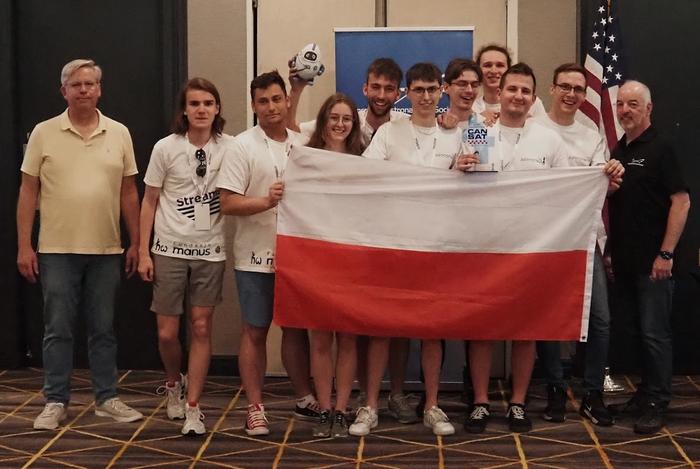
WASHINGTON – Hosted by the U.S. Naval Research Laboratory (NRL), American Astronautical Society (AAS) and NASA, the 2024 student CanSat competition concludes with Team PWr Aerospace, Wroclaw University of Science and Technology, Poland, the victor.
Created by AAS and the American Institute of Aeronautics and Astronautics (AIAA), the International CanSat Competition is an undergraduate and graduate level design-build-launch event simulating the end-to-end life cycle of a “complex engineering project.”
Since its conception in 2005, the competition has become an annual event providing a unique opportunity for international university and college student teams to design, build, and launch a soda can-size satellite – CanSat – designed to meet specific mission objectives. Participating teams must be able to design and build a space-type system following the approved competition guidelines, and then compete against each other at the end of two semesters to determine winners.
As in previous years, the mission is designed to simulate the mission and landing sequence of an extraterrestrial planetary probe.
Criteria for the competition state, once the Cansat is deployed from the rocket, it shall descend using a parachute at a rate of 15 meters per-second (m/s). At 500 meters, the Cansat shall release a probe that will open a heat shield that will also be used as an aerobraking device with a descent rate of 20 m/s or less. At this stage, use of a parachute, streamer, parafoil, or similar device is prohibited.
When the probe reaches 200 meters, the probe can then deploy a parachute and slow the descent rate to 5 m/s. Once the probe has landed, it is to attempt to upright itself and raise a flag above the probe. A video camera shall also be included as part of the payload and should be pointed towards the ground during descent.
This year’s competition included students from 31 universities and colleges from around the globe converging in Monterey, Virginia, June 6-9 to finalize proof of concept. After a full day of planning and preparation, each of the 31 team’s launch, tracking and recovery efforts are assessed and judged.
For the 19th annual competition, the top five winners of 2024 are recorded as follows:

Credit: American Astronautical Society (AAS)
WASHINGTON – Hosted by the U.S. Naval Research Laboratory (NRL), American Astronautical Society (AAS) and NASA, the 2024 student CanSat competition concludes with Team PWr Aerospace, Wroclaw University of Science and Technology, Poland, the victor.
Created by AAS and the American Institute of Aeronautics and Astronautics (AIAA), the International CanSat Competition is an undergraduate and graduate level design-build-launch event simulating the end-to-end life cycle of a “complex engineering project.”
Since its conception in 2005, the competition has become an annual event providing a unique opportunity for international university and college student teams to design, build, and launch a soda can-size satellite – CanSat – designed to meet specific mission objectives. Participating teams must be able to design and build a space-type system following the approved competition guidelines, and then compete against each other at the end of two semesters to determine winners.
As in previous years, the mission is designed to simulate the mission and landing sequence of an extraterrestrial planetary probe.
Criteria for the competition state, once the Cansat is deployed from the rocket, it shall descend using a parachute at a rate of 15 meters per-second (m/s). At 500 meters, the Cansat shall release a probe that will open a heat shield that will also be used as an aerobraking device with a descent rate of 20 m/s or less. At this stage, use of a parachute, streamer, parafoil, or similar device is prohibited.
When the probe reaches 200 meters, the probe can then deploy a parachute and slow the descent rate to 5 m/s. Once the probe has landed, it is to attempt to upright itself and raise a flag above the probe. A video camera shall also be included as part of the payload and should be pointed towards the ground during descent.
This year’s competition included students from 31 universities and colleges from around the globe converging in Monterey, Virginia, June 6-9 to finalize proof of concept. After a full day of planning and preparation, each of the 31 team’s launch, tracking and recovery efforts are assessed and judged.
For the 19th annual competition, the top five winners of 2024 are recorded as follows:
- First place – Team PWr Aerospace, Wroclaw University of Science and Technology, Wroclaw, Poland
- Second place – Team Shockwave, University of Alabama Huntsville (UAH), United States
- Third place – Team KoNaR Can, Scientific Society of Roboticists KoNaR, Wroclaw, Poland
- Fourth place to Team UCI CanSat, University of California Irvine (UCI), United States
- Fifth place to Team SEDS ITBA, Instituto Tecnológico de Buenos Aires (ITBA), Buenos Aires, Argentina
“Congratulations to the winners and all participants of this exciting and challenging demonstration of engineering prowess, ingenuity and team collaboration,” said Ivan Galysh, Head, NRL Signal Processing Section. “We look forward to the return of many teams and the engagement of many more new teams as we head into the 20th anniversary of this spectacular event.”
For a complete listing and ranking of all participating teams, as well as information regarding the annual CanSat competition, please visit:
About the U.S. Naval Research Laboratory
NRL is a scientific and engineering command dedicated to research that drives innovative advances for the U.S. Navy and Marine Corps from the seafloor to space and in the information domain. NRL is located in Washington, D.C. with major field sites in Stennis Space Center, Mississippi; Key West, Florida; Monterey, California, and employs approximately 3,000 civilian scientists, engineers and support personnel.
For more information, contact NRL Corporate Communications at (202) 480-3746 or nrlpao@us.navy.mil.

