


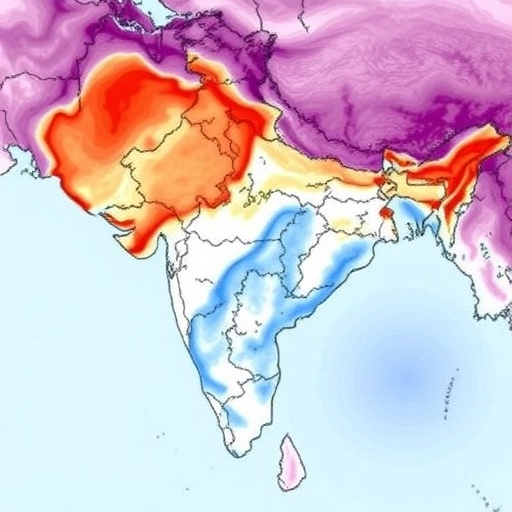
In a groundbreaking study published in Environmental Earth Sciences, researchers have unveiled a comprehensive spatiotemporal analysis detailing drought patterns and their intricate teleconnections across India’s diverse agroclimatic zones. This research, led by Sah, Singh, Das, and colleagues, represents a major advancement in understanding the complex environmental phenomena shaping one of the world’s most agriculturally and demographically critical regions. As climate variability threatens global food security, understanding drought dynamics at both regional and temporal scales has become urgent, and this study’s insights could reshape policy and adaptive strategies in the Indian subcontinent.
The authors embarked on a meticulous exploration of historical drought episodes using sophisticated drought indices and climate data spanning multiple decades. Their study is not merely descriptive; it integrates a robust spatiotemporal framework that dissects drought incidence across India’s ten distinct agroclimatic zones, ranging from arid desert regions to humid tropical areas. By utilizing high-resolution rainfall data alongside established drought severity measurements, the research identifies patterns that are otherwise obscured in broader national or continental assessments. This granular approach reveals subtle yet critical drought trends that span well beyond conventional meteorological evaluations.
Central to the investigation is the concept of teleconnections—large-scale climate drivers whose effects propagate across vast geographical expanses influencing local drought conditions in distal regions. The researchers link drought variations in India to atmospheric phenomena such as the El Niño-Southern Oscillation (ENSO), the Indian Ocean Dipole (IOD), and the Madden-Julian Oscillation (MJO), demonstrating how these far-reaching oscillations modulate precipitation and drought vulnerability unevenly across agroclimatic zones. By elucidating these connections, the study bridges regional drought occurrences with global climate dynamics, offering predictive insights crucial for early warning systems.
The spatiotemporal analysis leveraged advanced statistical tools including standardized precipitation evapotranspiration index (SPEI) and other drought metrics to characterize intensity, duration, and frequency over both seasonal and multi-decadal periods. This enabled the team to distill complex datasets into intelligible patterns, exposing trends not only of increasing drought severity in some regions but also notable variability within zones previously considered climatically stable. Such findings suggest that localized agricultural planning must now incorporate these dynamical shifts to mitigate future climate risks effectively.
One of the pivotal revelations of the study is the asynchronous nature of drought impacts within various agroclimatic regions, highlighting that droughts rarely affect the entire country uniformly. For instance, while northwestern India exhibited persistent drought episodes influenced heavily by ENSO phases, eastern agroclimatic zones displayed sensitivity primarily tied to IOD fluctuations. This spatial differentiation underlines the necessity for tailored water resource management and agricultural strategies that are zone-specific rather than generic national policies, a principle that the researchers emphasize forcefully.
Further deepening totemporal dynamics, the authors observed changes in drought periodicities associated with climate oscillations shifting in strength and frequency. In the past three decades, the increasing dominance of negative IOD events corresponded with prolonged dry spells in central Indian zones, contrasting with historical drought patterns. Such findings point to evolving driver mechanisms that challenge existing climate models, calling for continuous inclusion of updated teleconnection parameters in drought forecasting frameworks.
The study also confirms the compounding effects of drought overlapping with other climatic stressors such as heatwaves and erratic rainfall distribution. The interplay among these factors exacerbates agricultural vulnerability, threatening food production in regions heavily dependent on rainfed farming. Documented shifts in drought onset and cessation periods further complicate traditional cropping calendars, demanding innovation in cultivar selection and irrigation techniques to sustain yields under increased climatic uncertainty.
By integrating remote sensing data with ground-based meteorological observations, the researchers achieved an unprecedented level of cross-validation for drought monitoring. The spatial resolution of this dual-data approach enabled the detection of micro-level drought events and their progression, offering potential for real-time drought advisories and adaptive interventions. Such integrative methodologies point toward a new paradigm in environmental monitoring, where satellite-derived insights are harmoniously blended with terrestrial sensor networks.
The extensive data analysis was supported by climatological models refined for India’s geographic heterogeneities, allowing simulation of future drought scenarios under various Representative Concentration Pathways (RCPs). Projections indicate a probable intensification and spatial expansion of drought conditions in certain agroclimatic zones by mid-century. These foresights are critical for policymakers, signaling the need for urgent investment in drought-resistant infrastructure, water conservation technologies, and risk transfer mechanisms such as crop insurance schemes.
Discussion within the paper goes beyond climatic factors, considering socio-economic dimensions that modulate drought vulnerability including population density, irrigation coverage, and socioeconomic status. The authors argue that mitigating drought impacts requires concurrent advancements in governance and socio-technical systems, engaging stakeholders at multiple scales for resilience building. This comprehensive perspective aligns with global sustainability goals and highlights the multifaceted nature of drought as a challenge that transcends pure climatology.
The findings hold relevance not only for India but for other regions similarly situated within monsoonal climates where teleconnections influence hydrological extremes. Lessons drawn from India’s heterogeneous agroclimatic landscapes may inform strategies in Southeast Asia and parts of Africa, where adaptive capacity remains variable. Consequently, this study contributes to the broader scientific quest for understanding climate-drought interplay on a planetary scale, underpinning international collaborative efforts to tackle climate-scale challenges.
Moreover, the paper illuminates the importance of temporal granularity in drought studies. Short-term drought events, often overlooked in datasets focusing on long-term averages, produce severe localized damage affecting livelihoods and ecosystems. The authors’ approach in segmenting drought timelines provides a nuanced narrative that captures both acute drought shocks and chronic water stress scenarios, potentially transforming disaster preparedness and response frameworks.
In conclusion, Sah and colleagues’ study stands out as a landmark contribution, advancing the state-of-the-art in drought science through its innovative blend of spatiotemporal analytics, teleconnection theory, and pragmatic policy implications. Their work emphasizes that understanding drought dynamics at the intersection of climate variability, geography, and human factors is imperative as nations grapple with the realities of climate change. This research not only enriches academic discourse but also offers a beacon for stakeholders seeking to safeguard agricultural sustainability and water security in India and beyond.
As the climate crisis intensifies, deciphering the signals embedded within teleconnection patterns and their influence on local drought episodes becomes paramount. This study’s rigorous methodology and holistic insights chart a path forward for integrated climate risk assessment, early warning capabilities, and adaptive management. Ultimately, such scientific endeavors are critical pillars supporting humanity’s efforts to navigate an increasingly uncertain environmental future while securing food and water resources for billions.
This transformative research invites further exploration of how teleconnections evolve under anthropogenic climate forcing and how adaptive capacities at regional scales can be aligned with emergent climate realities. It represents an ideal fusion of cutting-edge climate science with actionable environmental stewardship, a model for future interdisciplinary studies addressing the grand challenges of our time.
Cite Scienmag News
Violet Maxwell. (January 13, 2026). Drought Patterns and Teleconnections Across India’s Agro Zones. Scienmag. https://scienmag.com/drought-patterns-and-teleconnections-across-indias-agro-zones/
Violet Maxwell. "Drought Patterns and Teleconnections Across India’s Agro Zones." Scienmag, 13 January 2026, https://scienmag.com/drought-patterns-and-teleconnections-across-indias-agro-zones/. Accessed 6 September 2026.
Violet Maxwell. "Drought Patterns and Teleconnections Across India’s Agro Zones." Scienmag. January 13, 2026. https://scienmag.com/drought-patterns-and-teleconnections-across-indias-agro-zones/


