


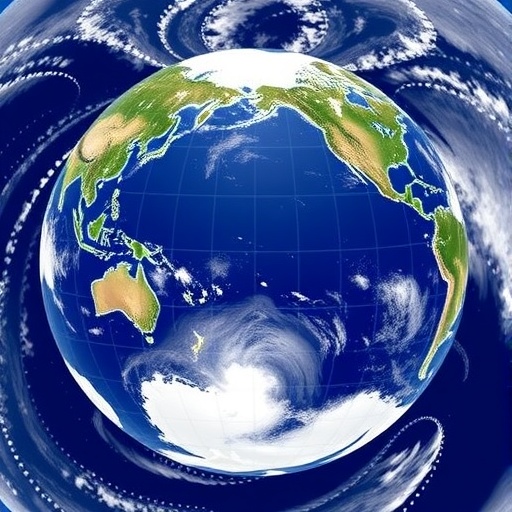
In a groundbreaking study published in Nature, researchers have unveiled compelling evidence that climate change is driving a significant poleward shift in the North Pacific winter storm track. This discovery carries profound implications for the Arctic, ocean ecosystems, and the climatic fabric of western North America. For decades, climatologists have debated the extent to which global warming influences mid-latitude storm tracks, critical conduits for heat and moisture. Now, through innovative observational constraints and rigorous analysis, this new work conclusively demonstrates that the storm track has migrated northward beyond the bounds of natural variability.
The mid-latitude storm track over the North Pacific plays a pivotal role in transporting atmospheric heat and moisture polewards into the Arctic and over the western coast of North America. These dynamic weather systems largely govern the precipitation patterns and temperature regimes of these regions, affecting ecosystems, water resources, and human livelihoods. Prior modeling efforts have projected this storm track’s displacement towards higher latitudes by the century’s end, yet observational uncertainties and incomplete datasets left open questions about whether such changes were already underway.
By meticulously analyzing recent decades of observational data, the authors have managed to circumvent the traditional reliance on wind records, which have historically been sparse and inconsistent over the vast expanse of the North Pacific Ocean. Utilizing innovative diagnostic methods, they effectively constrained the storm track location and intensity, revealing an unmistakable poleward progression. This shift aligns with, and indeed exceeds, predictions based on natural climate variability, underscoring an anthropogenic fingerprint on atmospheric circulation patterns.
The consequences of this poleward migration are multifold. With the storm track shifting northwards, the associated heat and moisture fluxes also relocate, intensifying precipitation extremes and altering temperature distributions across western North America. This could exacerbate drought conditions in some areas and increase flood risks in others, while simultaneously disrupting terrestrial and marine ecosystems dependent on historical climate stability.
Importantly, the study also highlights a glaring discrepancy between observed changes and those simulated by state-of-the-art climate models. The models have tended to underestimate both the magnitude and pace of the poleward storm track shift seen in recent decades. This discrepancy suggests that projections of future human-induced impacts on storm track-driven climate phenomena, including Arctic warming and North Pacific ecosystem dynamics, may require substantial upward revision.
The interplay between Arctic amplification—an accelerated warming of the polar region—and mid-latitude atmospheric dynamics is central to this research. Amplified Arctic warming weakens equator-to-pole temperature gradients, which fundamentally influence jet stream behavior and storm track positioning. The observed poleward migration of the North Pacific storm track may thus represent a direct atmospheric response to this altered thermal structure. Understanding this nexus is critical to forecasting future climate extremes and improving regional climate resilience.
Reanalysis datasets historically suggested a poleward trend in storm track location, but comprehensive verification remained elusive given the absence of reliable wind observations across the Pacific basin. This study bridges that gap by employing novel metrics that characterize storm track intensity and trajectory using temperature and moisture flux data. The results confirm a statistically significant polewards displacement in the winter season, unmistakably surpassing the expected background variability.
The ramifications extend beyond immediate meteorological impacts. Storm tracks serve as fundamental drivers of ocean–atmosphere interactions along the North Pacific rim, influencing sea surface temperatures, nutrient upwelling, and biological productivity. A poleward shift could alter ocean circulation patterns and the distribution of marine species, with cascading effects on fisheries and global carbon cycling. The research signals a pressing need for integrated climate and ecosystem models that capture these complex feedbacks.
From a societal perspective, water availability in western North America is intricately linked to these storm-driven weather systems. Changes in storm frequency and path could redefine water resource management practices. The study’s findings thus carry vital importance for policymakers and stakeholders aiming to mitigate climate risks and safeguard agricultural, urban, and natural water supplies in an era of rapid environmental change.
The researchers acknowledge the challenges inherent in attributing storm track changes directly to anthropogenic forcing amidst the oscillations of natural variability. Nevertheless, the consistent northward trend across multiple independent observational proxies strengthens the causal connection to human-induced climate change. This advancement provides a critical benchmark for assessing the fidelity of climate models and refining predictive capabilities.
As climate systems continue to evolve, this research serves as both a warning and a call to advance monitoring and modeling frameworks. By elucidating the complex mechanisms behind storm track shifts, the study equips the scientific community with a deeper understanding necessary to anticipate and adapt to future climatic transformations. The North Pacific, as a nexus of atmospheric and oceanic processes, remains a sentinel region for detecting the fingerprints of global warming.
In conclusion, the documented poleward displacement of the North Pacific winter storm track represents a significant manifestation of climate change with far-reaching environmental and societal consequences. Bridging the gap between observation and modeling, this research lays the foundation for improved forecasts of regional climate impacts and underscores the urgency of addressing ongoing atmospheric alterations driven by humanity’s carbon emissions. As the planet warms, understanding and responding to shifting storm patterns will be crucial for ensuring ecological resilience and human well-being across the Pacific domain.
Cite Scienmag News
Sloane Callahan. (January 8, 2026). Climate Change Pushes North Pacific Storms Poleward. Scienmag. https://scienmag.com/climate-change-pushes-north-pacific-storms-poleward/
Sloane Callahan. "Climate Change Pushes North Pacific Storms Poleward." Scienmag, 8 January 2026, https://scienmag.com/climate-change-pushes-north-pacific-storms-poleward/. Accessed 4 September 2026.
Sloane Callahan. "Climate Change Pushes North Pacific Storms Poleward." Scienmag. January 8, 2026. https://scienmag.com/climate-change-pushes-north-pacific-storms-poleward/


